
Champagne
#F7E7CE- Champagne Pink
- Crayola Gold
Color comparison
Hold a champagne scarf and a gold one under your chin, one at a time, by a window. Watch your skin. One lifts it. The other can turn loud. Ten seconds is enough.
#F7E7CE#D4AF37Side by side
On a screen a metal is only a finish: these are the closest reference colors of each one.
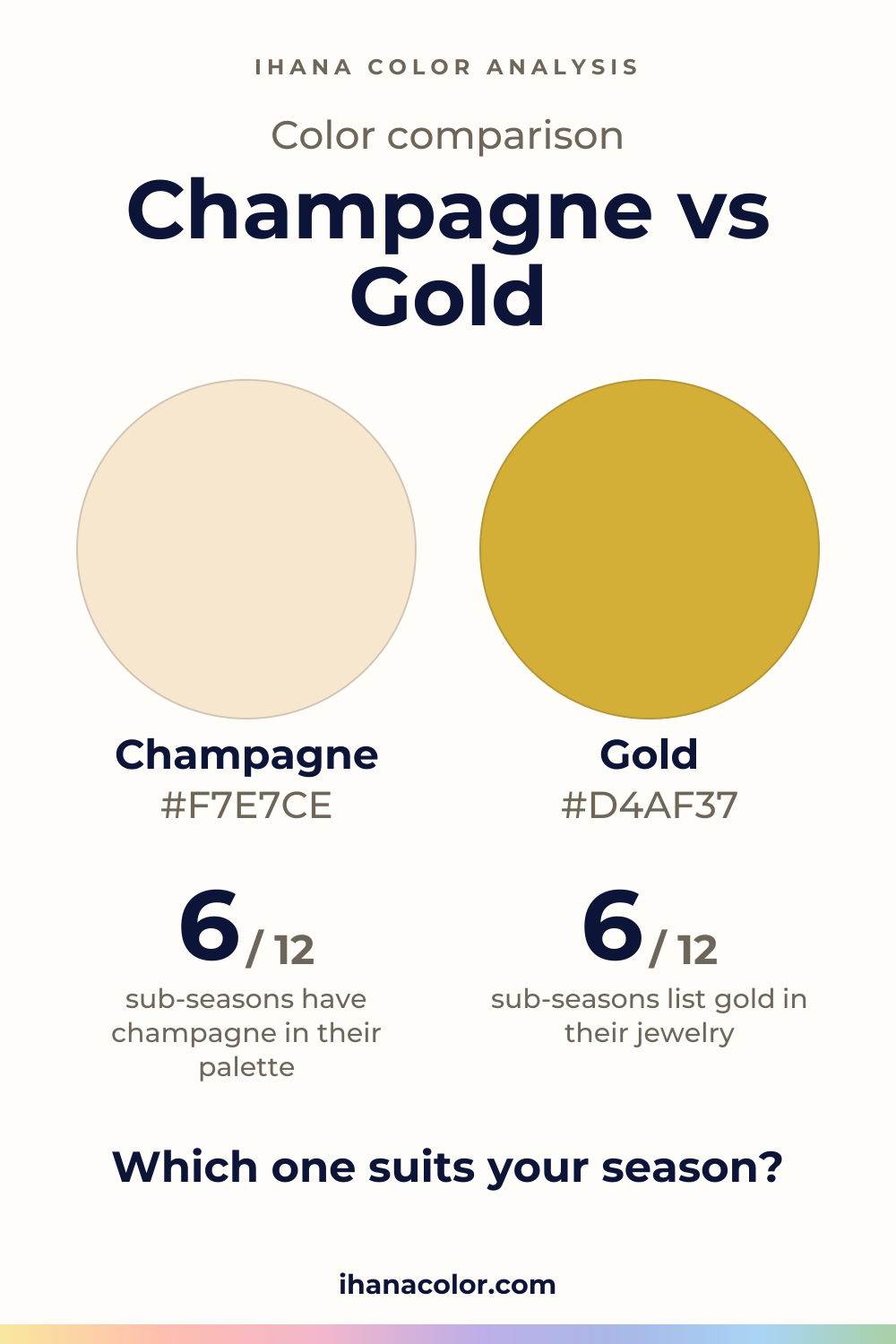
Champagne is lighter, Gold is more vivid; both sit in the orange range.
A pale, hushed color. Champagne itself is very light and muted, with an orange lean you notice only when you hold it next to a white. Champagne Pink is just as light and nearly neutral, with a faint red-orange blush.
Crayola Gold is the odd one out in the family. It is light rather than very light, and medium in intensity, the most intense of the three.
On a fabric, champagne reads as a glow, not a shine. On a face, it sits close to the skin and stays quiet. As a metal, picture a soft, pale finish that doesn’t shout.
Gold is the louder of the two. Its four shades are all light, and three are vivid. Gold and Goldenrod tip toward orange, Old Gold toward yellow. Vegas Gold is the calm one: medium in intensity, yellow in hue.
That spread matters. Goldenrod has the most punch, Vegas Gold the least. If a gold feels like too much, try the calmer shade before you give up on gold.
On a fabric, gold catches the eye first. On a face, it throws a strong glow onto the skin. That can feel like sunlight or like too much, depending on the face. As a metal, it’s the yellow look: a finish with obvious color.
Two differences, both visible. Champagne is lighter. Gold is more vivid. That is the whole gap, and it explains most of what you feel when you hold them up.
Lightness changes how the color meets your skin. A very light champagne sits close to your complexion and blends in. Gold sits further from it, so it stands out as a color in its own right.
Intensity changes how much color reaches your face. Vivid gold asks you to match it, with your own coloring or with a plain outfit around it.
What they share is the hue. Both sit in the orange range, so don’t expect one to be cool and the other warm. The real contest is soft against strong.
Start with the group that takes both: Light Spring, Warm Spring, Bright Spring, Soft Autumn, Warm Autumn and Deep Autumn. Six sub-seasons, and none of them cool.
For them, the choice is volume, not permission. Light Spring has both in its palette: champagne, matched with Ivory, and gold, with a jewelry line of light yellow gold, rose gold and fine gold tones. It’s very light and low in contrast, so delicate pieces suit the line.
Warm Autumn has both too. Champagne matches Cream there, and its line lists yellow gold, copper, bronze and brass.
Five sub-seasons land on the champagne side only, as a close match: Light Summer, Cool Summer, Soft Summer, True Winter and Bright Winter. Champagne itself isn’t in their palettes, but a neighbor of it is. For Light Summer and Cool Summer, that’s Soft White. For Soft Summer, Off-White. For True Winter and Bright Winter, Pure White. Their jewelry lines all lead with silver, and each adds white gold or platinum. Bright Winter’s reads shiny silver and platinum, while Soft Summer’s lists rose gold beside brushed silver. Gold is not for any of them, because a vivid finish pulls against these cooler sub-seasons.
One sub-season takes neither: Deep Winter. Champagne is not for it. The closest color in its palette is Pure White, and that’s a stand-in, not a match. Its jewelry line reads silver, platinum and white gold.
To settle it, set up the way color draping at home describes: bare face, window light, one piece at a time.
Gold has a clear list of partners: black, white, navy, burgundy, emerald and ivory. Black and navy give it a dark frame that calms it. Burgundy and emerald make it rich.
White and ivory keep it light.
No partners are listed for champagne, so look for what it needs instead. Keep the neighbors quiet and close in lightness, or add one deeper color for definition. A very pale champagne next to a very pale shirt can go flat, so don’t pair them without a contrast.
If you’re not sure of your sub-season yet, the free color analysis quiz points you to a season worth trying first. It doesn’t watch your skin respond, so confirm with the fabric.
Which one suits you
A metal is read on the jewelry line each sub-season publishes. Open a sub-season to see the rest of its palette.
Both work for you
Both work for you
Both work for you
Champagne is the one for you
Champagne is the one for you
Champagne is the one for you
Both work for you
Both work for you
Both work for you
Neither is for you
Closest in your palettePure White
Champagne is the one for you
Champagne is the one for you
Questions
They share the orange range, so the confusion is fair. But champagne is very light and muted, with only a blush of orange, while gold is light and vivid. Look at how much color reaches your skin, and the two stop looking alike.
Champagne. It’s very light and muted, while gold is light and vivid. Champagne is the lightest of its family, and Crayola Gold the deepest. Gold’s shades stay close in lightness, so what you feel comes mostly from intensity.
Six sub-seasons can: Light Spring, Warm Spring, Bright Spring, Soft Autumn, Warm Autumn and Deep Autumn. For them it is a question of mood. Five take champagne only. One takes neither. If you don’t know yours, the free color analysis quiz is the place to begin.
Gold has six listed partners. The dark ones tone it down, while white and ivory keep it light. No partners are listed for champagne, so look for quiet neighbors with one deeper accent for definition.
Not fully. A screen, a lamp and the dye all shift a metallic color, and a swatch only approximates a finish. Put the two real pieces side by side near your face and see which one your skin answers to.
Keep it
The two colors side by side, ready to pin or to keep on your phone.
Download the imageThe quiz shows you your likely season and a sub-season hint, with no sign-up. A first hint, not a verdict.
Full palette, capsule wardrobe, makeup, hair and a shopping list for each sub-season. Not on sale yet: join the waitlist.
Twelve sub-seasons instead of sixteen, the three things we look at, and why a quiz is only a first hint.
The free quiz shows you your likely season in two minutes. Then hold both colors up to your bare face, in daylight: a first hint, not a verdict.