
Temperature
Is your undertone, the tone under the surface of your skin, more warm (golden) or more cool (pink, bluish)?
Spring and Autumn lean warm. Summer and Winter lean cool. Each sub-season sits somewhere between the two ends.
Method
Twelve seasons, three axes, no shortcuts. This is the method behind the quiz and the season pages, and the positions Lisa Routa holds when she analyzes someone.
The three axes
Every season, and every sub-season inside it, is a position on three scales. You’ll see them again as gauges on each season page.
Is your undertone, the tone under the surface of your skin, more warm (golden) or more cool (pink, bluish)?
Spring and Autumn lean warm. Summer and Winter lean cool. Each sub-season sits somewhere between the two ends.
Also called depth
Do light colors bring you out, or deep ones?
Light Spring and Light Summer sit at the light end. Deep Autumn and Deep Winter sit at the deep end.
Also called clarity
Can you carry bright, clear colors, or do you need soft, muted ones?
Bright Spring and Bright Winter sit at the bright end. Soft Summer and Soft Autumn sit at the soft end.
On each season page you’ll also see contrast: how sharply your hair, eyes and skin stand apart.
Lisa works with twelve seasons. They’re enough to be precise, and few enough to stay clear.
| System | How it splits | What you gain | The catch |
|---|---|---|---|
| 4 seasons | Spring, Summer, Autumn, Winter. | A general direction. | More general: one season covers a wide range of colorings. |
| 12 seasonsLisa’s choice | Each season splits in three. | A precise palette you can use every day. | Two neighboring seasons can still take a trained eye to tell apart. |
| 16 seasons | Each season splits in four. | Even finer shades. | Harder to use day to day. In Lisa’s view, more confusion than clarity. |
Four shortcuts this method refuses.
We never
Hair, eyes or skin alone never decides a season. Red hair is a clue, not a rule. Blond hair doesn’t rule out Winter. Deep skin isn’t automatically Winter.
We never
A quiz, an app, a filter or an AI gives you a first hint. None of them is the equal of a trained eye.
We never
Every skin tone shows up in all four seasons.
We never
Nothing is off-limits. A palette is a compass, not a rulebook. Sometimes the best color is the one that serves your goal.
The quiz asks ten questions about what you can observe yourself: your veins, your jewelry, what black does to you, the colors that earn you compliments.
Each answer nudges you along the three axes. Together, your answers point to a likely season, and your strongest axis points to a sub-season hint.
When the answers don’t settle it, the quiz says so and shows you the two seasons you sit between. It never shows a score, and it never asks for a photo.
A first hint, not a verdict.
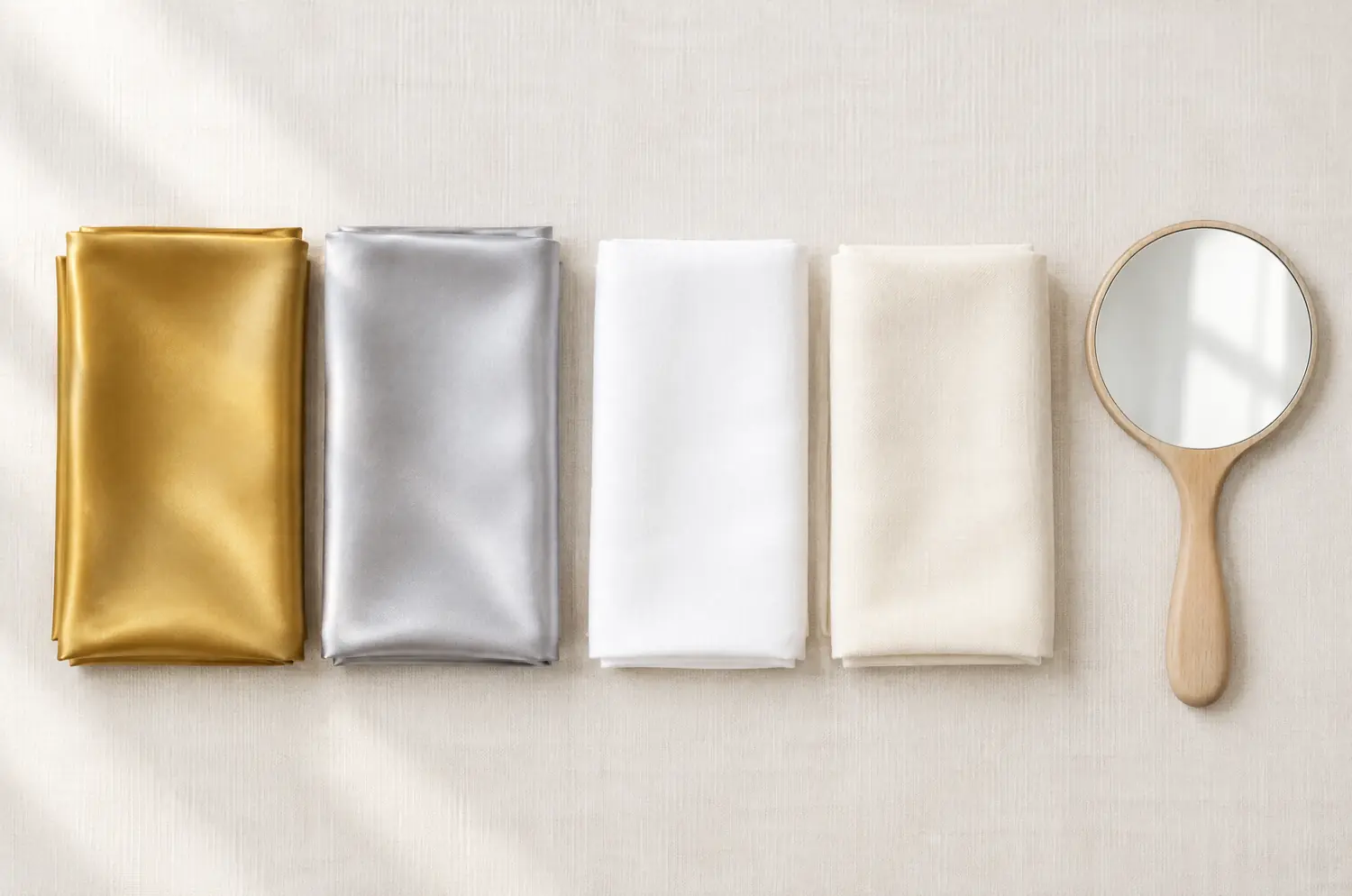
Holding colors up to your face, one after another, and watching what happens to your skin, eyes and hair. One color lights you up. Another makes a shadow appear, or your skin go dull. At home, the two-color test is a simple version of it.
Stand near a window, in daylight. No makeup. Hair pulled back if you dye it.
A photo depends on the light, the screen and the camera settings. The same face can give a different result from one picture to the next.
Lisa’s view
Fun, but hit-or-miss.
An app or an AI takes your photo, measures temperature, contrast, saturation and brightness, and hands you a season. That’s mechanical, and color analysis can’t be decided mechanically: the result changes with the photo and with other settings.
What a trained eye sees is different: a shadow that appears, a complexion that goes dull, eyes that light up.
Use these tools to play and to get a first direction. Our quiz works the same way: a first hint, not a verdict.
Lisa’s one-to-one analysis from your photos, where that trained eye does the work, exists in French only for now.
Twelve seasons are enough to be precise, and few enough to stay clear. Sixteen add finer shades, but in Lisa’s view they bring more confusion than clarity: the differences get harder to see and harder to use day to day.
It can point you to your likely season and give you a hint of your sub-season. That’s a first hint, not a verdict. A quiz can’t see your skin react to colors, and telling two neighboring seasons apart is the work of a trained eye.
Not reliably. Lisa’s view is that they’re fun, but hit-or-miss. A photo depends on the light, the screen and the camera settings, so the result can change from one picture to the next. Use them to play and to get a first direction.
No. Red hair is a clue, not a rule. Two redheads can react very differently to the same colors, and a season is never decided from hair alone. The same goes for the other direction: blond hair doesn’t rule out Winter.
There’s no typical season for any skin tone, olive included. Every skin tone shows up in all four seasons. A season comes from three things together: temperature, lightness and intensity. If your undertone is cool, the cooler seasons (Summer and Winter) are the first place to look, then lightness and intensity point you to a sub-season.
No color is ruled out by a skin tone alone. A color drains you when it fights your temperature, lightness or intensity, and that’s different from one person to the next. Each season page lists the colors to keep away from your face.
Skin tone isn’t an ethnicity, and this method never sorts people by origin. “Olive” describes a tone you can see in people of any background. Every skin tone belongs in all four seasons, and Lisa works against analyses based on skin color alone.
On the season pages, contrast is the gap between your hair, eyes and skin. Warm Spring, Cool Summer and Warm Autumn sit at moderate contrast, and Soft Autumn sits between low and moderate. Contrast is one reading among several, though: it never decides a season on its own.
None, in exactly the same shade. A red, a blue or a neutral comes in warm, cool, soft and bright versions, and each season takes its own. Take the neutrals: for Soft Autumn they’re Cream, Sand Beige, Warm Taupe and Chestnut. For Bright Winter they’re Black, Pure White, Silver Gray and Navy.
Two minutes, no sign-up, and a first hint of your season. Then read your season page, or the complete guide to seasonal color analysis.