
Orchid Pink
#F2BDCD- Pink Lavender
- Cotton Candy
- Cherry Blossom Pink
Color comparison
Cool pink or warm pink? On paper, cousins. Near a face, not twins. The gap is smaller than you think, and it still decides which one works.
#F2BDCD#FF91A4Side by side
Salmon Pink is more vivid, and the two are about as light as each other; both sit in the pink-red range.
Cool Pink gathers Cotton Candy, Orchid Pink, Cherry Blossom Pink and Pink Lavender. All four are light, and three of them are muted.
Pink Lavender is the odd one out. It leans pink-purple, and it’s the darkest of the four.
Near a face, a muted pink asks very little. It puts a soft wash of color beside the skin and leaves the eyes and the mouth in front.
Warm Pink is Melon, Light Salmon, Salmon Pink and Coral Pink. They’re light too, and only Melon is muted.
Look at the hue. Salmon Pink is pink-red, but the other three sit in plain red. It’s a pink with red in it.
Near a face, a medium pink asks more of the eyes and the mouth. It brings more color to the skin than a muted one does.
Both are light, and both sit in the pink-red range. Hold them side by side and you won’t find a gap in depth or in basic hue.
On a face, the muted pink recedes and the medium one speaks first. On a sweater, the muted pink looks softened and the medium one looks clearer. Hue adds a small push: the Warm Pink shades lean toward red, while Cool Pink includes a pink-purple one.
Two sub-seasons have both in the palette. Light Spring matches the cool one with Petal Pink and the warm one with Warm Candy Pink. Light Summer matches them with Powder Pink and Sugar Pink. Both are very light and low in contrast, so a light pink of either kind stays inside their range.
Two take Cool Pink only. Soft Summer matches it with Tea Rose, and that sub-season is very soft and grayed, so a muted pink fits. Warm Pink only comes close to Tea Rose there.
True Winter runs very cool and saturated. Its Cool Pink matches Icy Pink in the palette. Its Warm Pink isn’t for you. Bright Cool Pink is the nearest palette color, and it only stands in.
Three take Warm Pink only, and for all three it’s close, not in the palette. Bright Spring has Flamingo Pink beside it, a vivid neighbor for a very bright sub-season.
Cool Summer is very cool and medium in depth, so its neighbor is plain Pink. Soft Autumn is very soft and desaturated, so its neighbor is Warm Dusty Rose, a muted rose.
Five take neither. Warm Spring is very warm and bright, and for both pinks its nearest palette color is Salmon. Warm Autumn is rich and slightly muted: Cream stands in for Cool Pink, Burnt Coral for Warm Pink.
Deep Autumn and Deep Winter are dark, so a light pink sits above their depth. Deep Autumn’s stand-ins are Cream and Tomato. Deep Winter’s are Pure White and Raspberry Pink.
Bright Winter has Light Pearl Gray for Cool Pink, and Warm Pink is on its avoid list. Every one of these is a stand-in, not a match.
Set up the test once: bare face, daylight, one pink at a time, as the color draping at home article lays out. Watch your skin, not the fabric.
Pair a pink with colors of a similar intensity. A muted Cool Pink wants neighbors that don’t outshout it. A medium Warm Pink can carry more.
If yours takes neither, a stand-in from your palette is a starting point, not a match. The color guides show how other colors pair.
Which one suits you
Each color is checked against the palette of each sub-season, color by color. This is a first hint, not a verdict: see how it looks on your own face.
Both work for you
Neither is for you
Closest in your paletteSalmon
Warm Pink is the one for you
Both work for you
Warm Pink is the one for you
Cool Pink is the one for you
Warm Pink is the one for you
Neither is for you
Closest in your paletteBurnt Coral
Neither is for you
Closest in your paletteCream
Neither is for you
Closest in your palettePure White
Cool Pink is the one for you
Neither is for you
Closest in your paletteBright Candy Pink
Questions
Because they share a lightness and a pink-red range, so a screen shows two light pinks that seem to differ by a breath. The gap is in how much color each carries. A warm pink also has red running through it. Judge a fabric by daylight.
Neither is lighter, since both are light. Vividness is the gap: Salmon Pink carries more color than Orchid Pink, so it reads louder on a sleeve. Three of the four cool shades are muted. Choose by how much noise you want near your face.
Find your sub-season in the section above. Not sure of it? Ten questions with no sign-up on the season quiz give you a likely season and a sub-season hint to start from, nothing more. Then hold each pink near your bare face and see which one keeps your eyes in front.
Two sub-seasons, Light Spring and Light Summer, have both in the palette. For the rest, test one at a time and let your skin pick. Five sub-seasons take neither, so a nearby color of the palette does that job.
Treat a code as a reference, not a promise. A screen, a bulb and a dye all shift a pink. Compare a fabric swatch to your skin in daylight, and trust that over a number.
Keep it
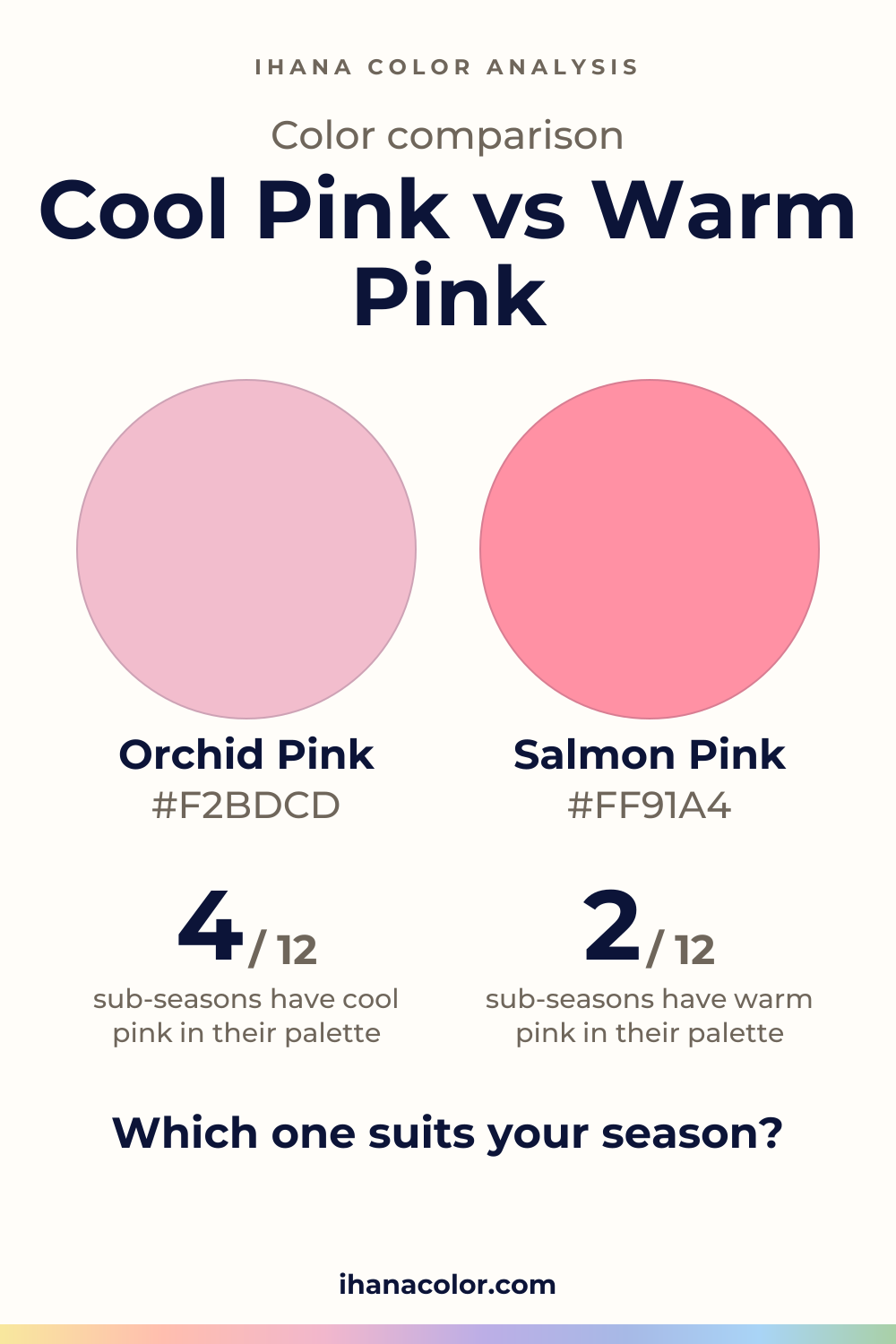
The two colors side by side, ready to pin or to keep on your phone.
Download the imageThe quiz shows you your likely season and a sub-season hint, with no sign-up. A first hint, not a verdict.
Full palette, capsule wardrobe, makeup, hair and a shopping list for each sub-season. Not on sale yet: join the waitlist.
Twelve sub-seasons instead of sixteen, the three things we look at, and why a quiz is only a first hint.
The free quiz shows you your likely season in two minutes. Then hold both colors up to your bare face, in daylight: a first hint, not a verdict.