
Vermilion
#E34234- Chili Red
- Poppy Red
- Tomato Red
Color comparison
“Red is red.” Not quite. Warm red and cool red match in depth and in punch, so the gap is smaller than the names suggest. Your sub-season still picks a side.
#E34234#DC143CSide by side
The two are about as light and as vivid as each other; both sit in the red range.
Vermilion, Chili Red, Poppy Red and Tomato Red. All four are medium in lightness, and all four read red.
Vermilion and Chili Red are vivid. Poppy Red and Tomato Red are very vivid, and Tomato Red is the most intense of the four.
That strength is worth planning for. If a Tomato Red sweater feels like it’s talking over you, move it lower on the body instead of dropping it.
Crimson, Cardinal, Rose Red, Ruby Red and Raspberry. Most are medium in lightness and vivid. Ruby Red is the exception: it’s dark.
Rose Red and Raspberry lean pink-red. The other three read plain red.
So before you judge “cool red,” check which of the five you’re holding. The pink-reds and the dark one behave differently from the other three.
The picks split into four groups, and the axes explain each one.
Warm red only, for three sub-seasons: Warm Spring, Warm Autumn and Deep Autumn. Warm Spring and Warm Autumn are very warm, and Deep Autumn is neutral to warm and dark.
Vermilion sits near Poppy Red in the Warm Spring palette, near Burnt Coral in Warm Autumn’s and near Tomato in Deep Autumn’s. Cool red is only close there: Crimson sits near Poppy Red, Tomato Red and Tomato.
Cool red only, for three more: Deep Winter, True Winter and Cool Summer. Deep Winter and True Winter are both saturated. Crimson sits near Pure Red for Deep Winter and near Raspberry Red for True Winter, and warm red is only close to those same two.
Cool Summer is very cool and soft to medium in intensity. A neighbor of cool red, Soft Cherry, is in its palette. Warm red sits close to Terracotta, a color Cool Summer avoids.
Both, for two: Bright Spring and Bright Winter. Both are very bright, with high to very high contrast. Bright Spring matches Vermilion to Tomato Red and Crimson to Warm Cherry. Bright Winter matches Vermilion to Bright Red and Crimson to Bright Cherry.
Neither, for four: Light Spring, Light Summer, Soft Summer and Soft Autumn. These palettes run very light or very soft, so a vivid red sits far from them. The closest palette color is Light Coral for Light Spring, Light Raspberry for Light Summer, Muted Raspberry for Soft Summer and Light Terracotta for Soft Autumn. Those are stand-ins, not matches.
Set up the test once, as the article on color draping at home explains, then try one red at a time.
No partner colors are listed for either red here, so look for what a vivid red needs. Pick a calm neighbor: a plain, quiet color with no print and no second loud color. Let the red be the only statement in the outfit.
My advice: if your sub-season is on the “neither” list, keep the red below the neckline and put a palette color at your face. That’s a better use of a red you love than giving it up.
Which one suits you
Each color is checked against the palette of each sub-season, color by color. This is a first hint, not a verdict: see how it looks on your own face.
Neither is for you
Closest in your paletteLight Coral
Warm Red is the one for you
Both work for you
Neither is for you
Closest in your paletteLight Raspberry
Cool Red is the one for you
Neither is for you
Closest in your paletteMuted Raspberry
Neither is for you
Closest in your paletteLight Terracotta
Warm Red is the one for you
Warm Red is the one for you
Cool Red is the one for you
Cool Red is the one for you
Both work for you
Questions
No, though they match in lightness and punch. The families differ: cool red has Ruby Red, a dark shade, and two pink-red ones, while warm red has two very vivid shades. That small gap is why one red can sit right on you and the other can look off.
Neither. Both read medium in lightness and vivid. They differ at the edges: cool red runs darker with Ruby Red and pinker with Rose Red and Raspberry, while warm red turns up the strength with Poppy Red and Tomato Red.
Two sub-seasons can: Bright Spring and Bright Winter. If yours takes just one, keep the other away from your face, in pants or a bag. You don’t have to give up a red you love. Test both near your face before you decide.
Don’t trust the screen. Light, dye and display settings all shift a red, and a code is only a reference. Hold the real fabric near your face and see which red your skin answers to.
Start with the groups above. If you don’t know your sub-season, answer ten questions in the free color analysis quiz. It can’t watch your skin react, so take its answer as a first hint, not a verdict, then hold both reds to your face.
Keep it
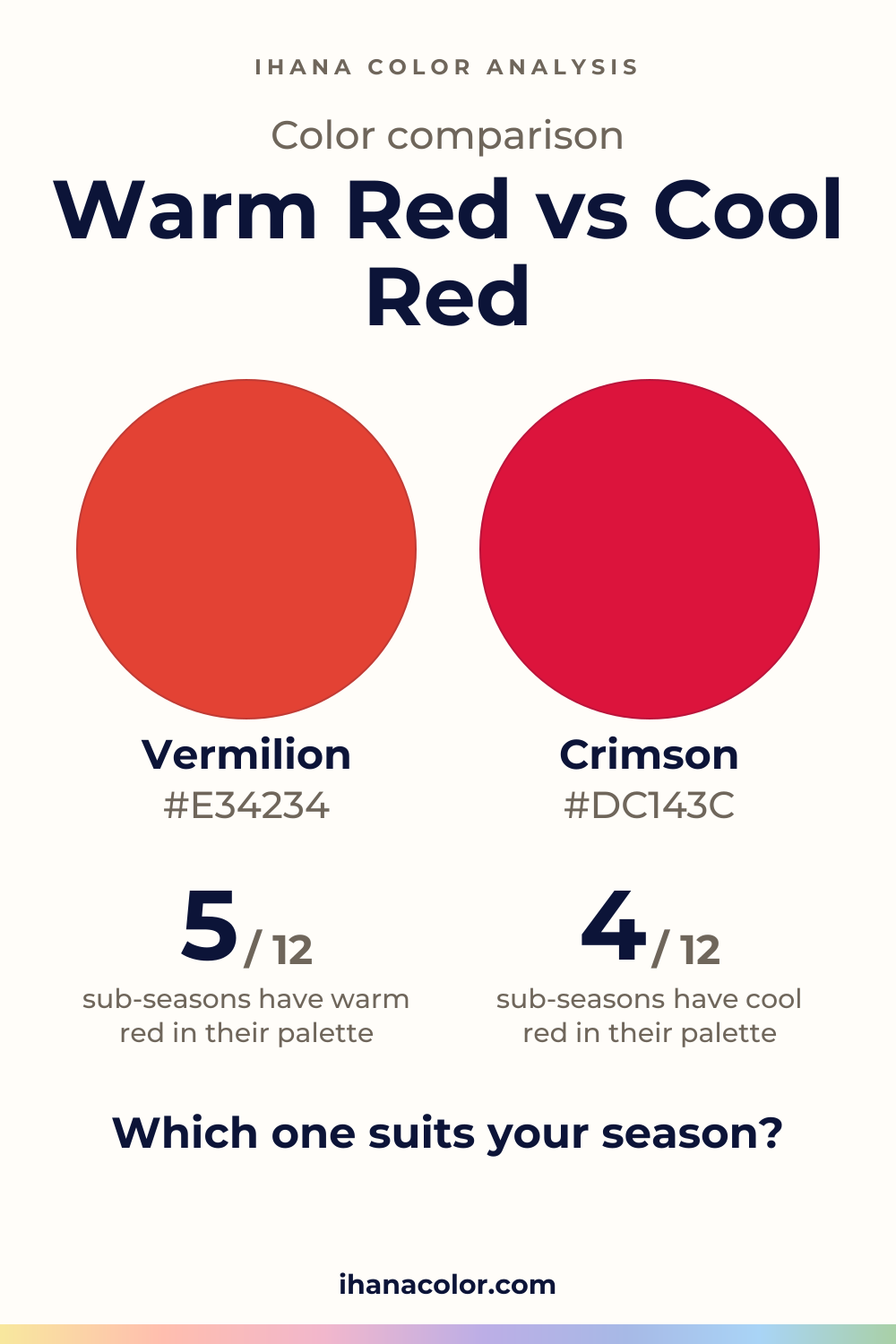
The two colors side by side, ready to pin or to keep on your phone.
Download the imageThe quiz shows you your likely season and a sub-season hint, with no sign-up. A first hint, not a verdict.
Full palette, capsule wardrobe, makeup, hair and a shopping list for each sub-season. Not on sale yet: join the waitlist.
Twelve sub-seasons instead of sixteen, the three things we look at, and why a quiz is only a first hint.
The free quiz shows you your likely season in two minutes. Then hold both colors up to your bare face, in daylight: a first hint, not a verdict.