
Yellow Gold
#D4AF37- Old Gold
- Vegas Gold
Color comparison
Yellow gold or white gold? It looks like a matter of taste. It’s less open than that. One finish is warm, the other nearly neutral, and your sub-season decides.
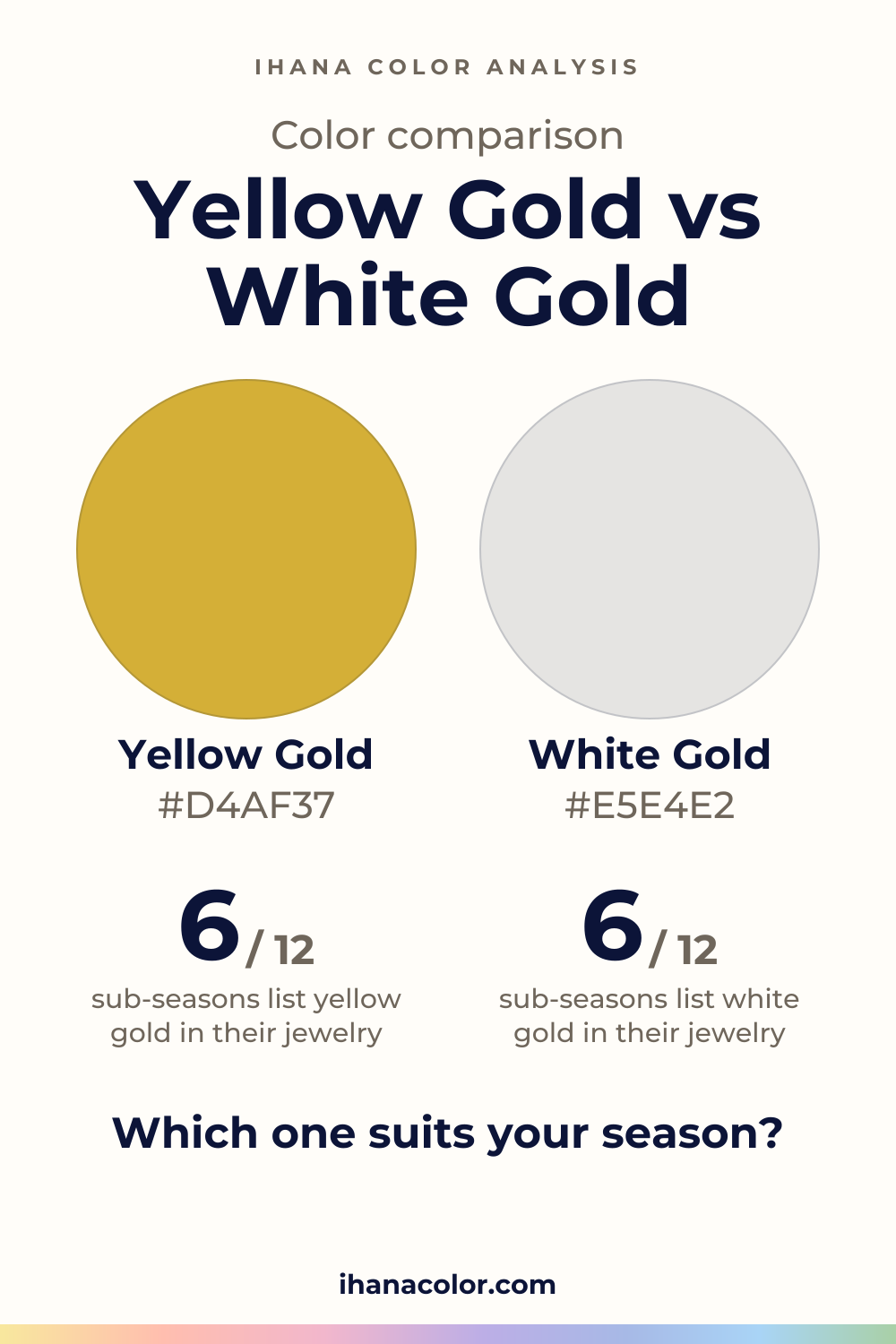
#D4AF37#E5E4E2Side by side
On a screen a metal is only a finish: these are the closest reference colors of each one.
White Gold is lighter, Yellow Gold is more vivid; Yellow Gold sits in the orange range, White Gold has hardly any hue.
Yellow gold is the warm finish. The shade that names it, Yellow Gold, is light and vivid, and it’s in the orange range.
Two other shades round it out. Old Gold is the lightest of the three and leans yellow. Vegas Gold is the deepest, with medium intensity, so it’s less vivid than the other two.
On a fabric, such as a gold thread or a buckle, it reads as a warm accent, not a neutral one. Whether that warmth works for you is something you check near your face, not on the shelf.
White gold is the pale, quiet finish. The shade that names it, White Gold, is very light, nearly neutral and has no clear hue.
Silver and Metallic Silver are the other two shades. Both are light, and both are nearly neutral. By the ordering, Metallic Silver is the most intense of the three, though all of them stay nearly neutral.
Here, “white” is a look, not a recipe. It’s a finish that sends back light and very little color. On a fabric, a silvery sheen reads cooler and cleaner than a warm one.
Three differences, and they all point the same way. White gold is lighter. Yellow gold is more vivid. And yellow gold has a hue, orange, while white gold has hardly any.
On a face, the hue is the one you feel first. A finish with an orange lean warms the skin around it. A finish with no hue stays out of the way and lets the skin speak.
A small earring colors much less of your face than a sweater does, so the hue is what you notice.
What the two share is small. Both sit on the light side. Both catch the light. Both are metal.
So don’t hunt for a big difference in depth. The fork is hue and intensity, orange and vivid against nearly neutral.
The split is clean. Six sub-seasons go with yellow gold: Light Spring, Warm Spring, Bright Spring, Soft Autumn, Warm Autumn and Deep Autumn. Six go with white gold: Light Summer, Cool Summer, Soft Summer, Deep Winter, True Winter and Bright Winter.
The reason is temperature. The Springs and Autumns run neutral to very warm, so a warm finish sits comfortably next to them. The Summers and Winters run from neutral to very cool, and a pale, nearly neutral finish fits them.
Take Warm Spring, the warmest of the group. Its jewelry line lists yellow gold, golden brass and cream pearls. Deep Autumn is dark and high in contrast, and its line lists yellow gold, bronze and dark copper.
On the other side, Soft Summer lists brushed silver, rose gold and white gold, with matte or satin finishes. Bright Winter lists shiny silver, platinum and graphic pieces.
Soft Summer and Soft Autumn are neighbors, and both lines ask for a matte or brushed finish. Soft Summer’s lists white gold, Soft Autumn’s lists matte gold, so the split is cool versus warm.
Light Spring’s line asks for delicate pieces, Light Summer’s lists pearls and moonstone. Read all of this as a direction, not a law.
If you don’t know your sub-season yet, the free color analysis quiz points you to a likely season and a sub-season hint. It can’t watch your skin react, so use it to start.
Hold each piece near your bare face in daylight, one at a time, and watch your skin. The setup is explained in my guide to color draping at home.
No partner colors are listed for either metal, so look at the finish instead. A warm sub-season wears yellow gold best when it matches its own sheen: delicate for Light Spring, graphic and bright for Bright Spring, matte or brushed for Soft Autumn. A cool one does the same with silver: satin for Soft Summer, shiny for Bright Winter.
Some jewelry lines list rose gold, Soft Autumn’s among them. The comparison of yellow gold vs rose gold covers that choice.
Which one suits you
A metal is read on the jewelry line each sub-season publishes. Open a sub-season to see the rest of its palette.
Yellow Gold is the one for you
Yellow Gold is the one for you
Yellow Gold is the one for you
White Gold is the one for you
White Gold is the one for you
White Gold is the one for you
Yellow Gold is the one for you
Yellow Gold is the one for you
Yellow Gold is the one for you
White Gold is the one for you
White Gold is the one for you
White Gold is the one for you
Questions
No. Yellow gold is a warm finish that leans orange. White gold is pale, nearly neutral and has hardly any hue.
Both are light, so they’re closer in depth than in hue. That gap is what sorts the twelve sub-seasons.
White gold. It is very light, while yellow gold is light. Yellow gold is the more vivid of the two, though. So white gold looks paler and quieter, and yellow gold looks richer and warmer, even when you hold them under the same lamp.
You can. Nothing is off-limits. But none of the twelve sub-seasons takes both, so the jewelry line is a direction. Test both near your bare face, and if you love the other metal, wear it away from your face.
The Springs and the Autumns go with yellow gold. The Summers and the Winters go with white gold. If you don’t know your sub-season, take the free quiz for a likely season, then confirm it by holding each finish near your bare face.
Treat it as a reference. A screen, a bulb and a photo each shift how a metal looks, and so does the finish, polished or matte. Look at the piece in daylight, next to your skin, before you decide.
Keep it
The two colors side by side, ready to pin or to keep on your phone.
Download the imageThe quiz shows you your likely season and a sub-season hint, with no sign-up. A first hint, not a verdict.
Full palette, capsule wardrobe, makeup, hair and a shopping list for each sub-season. Not on sale yet: join the waitlist.
Twelve sub-seasons instead of sixteen, the three things we look at, and why a quiz is only a first hint.
The free quiz shows you your likely season in two minutes. Then hold both colors up to your bare face, in daylight: a first hint, not a verdict.