
Black
#000000- Jet
- Onyx
- Eerie Black
- Raisin Black
Color comparison
“Brown is just a softer black.” It isn’t. Black is depth. Brown is warmth. Hold both near your face and your skin answers each one differently.
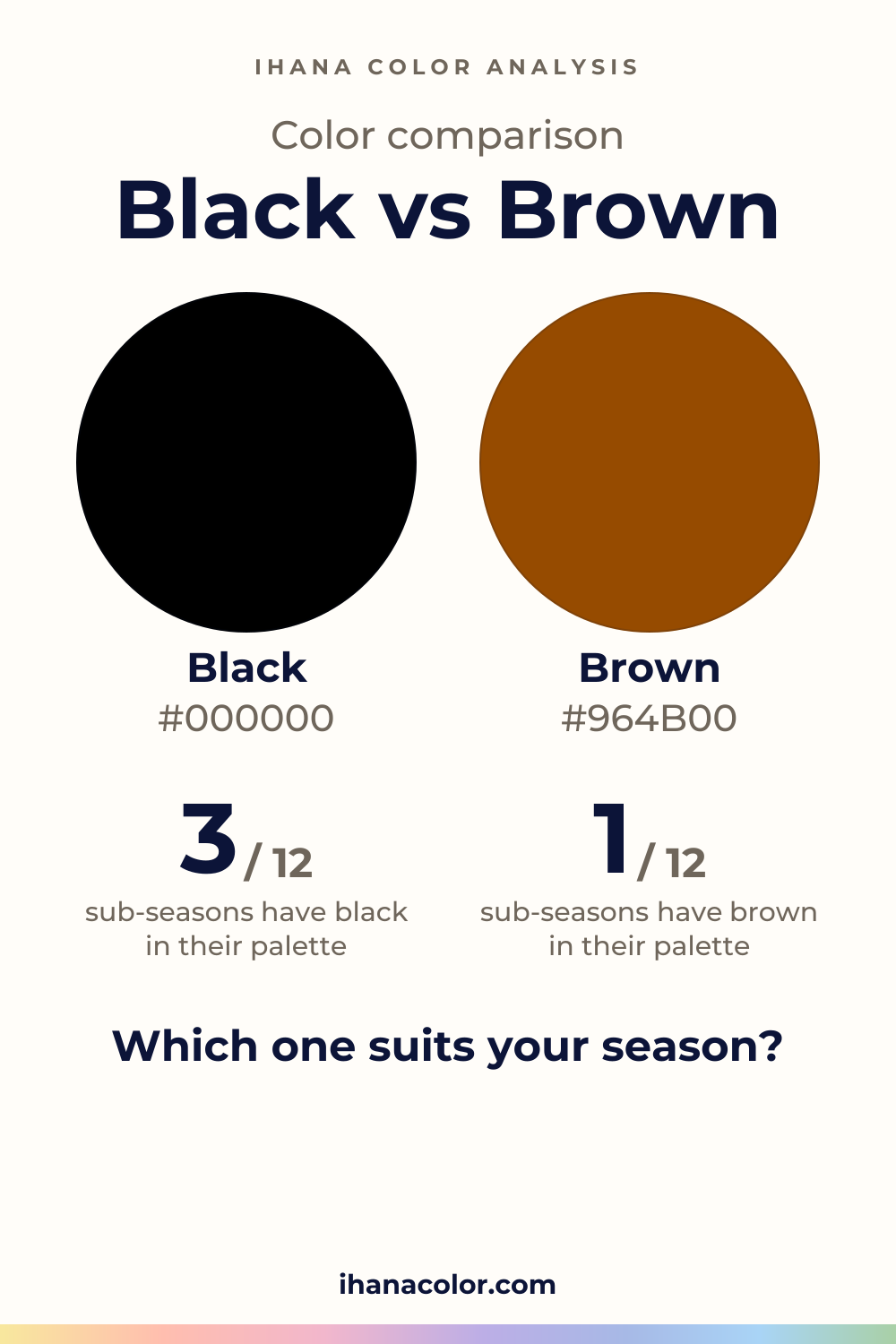
#000000#964B00Side by side
Brown is both lighter and more vivid; Black has hardly any hue, Brown sits in the red-orange range.
Black is the deepest color on the page. Its shades (Black, Eerie Black, Raisin Black, Jet and Onyx) run from dark to very dark, and every one of them is nearly neutral. None leans toward a hue.
That is the whole character of black. It adds no color of its own, so next to a face it takes over by contrast. Skin and eyes either hold their ground against it or get swallowed.
Onyx and Jet are the lightest of the family, and Raisin Black carries a trace of color that the others don’t. On a fabric, those differences are small. Light and dye shift them more than the name does.
A face with strong contrast between hair, eyes and skin can answer back to black. A softer face often can’t. That is a question of what your features can carry, not a question of taste.
Brown spreads out in a way black doesn’t. Its shades are Brown, Chocolate, Coffee, Raw Umber and Liver Chestnut, and they range from medium to dark. Brown itself is the most vivid of them. Coffee and Liver Chestnut are muted.
Every one of them carries a hue, red-orange for most, a little more orange for Raw Umber. Brown always has warmth in it. Black never does.
So the question with brown is rarely “brown or not.” It is which brown. A vivid Brown and a muted Coffee behave like two different colors near the same face. One sparkles, the other settles down.
In my view, that range is why brown forgives more than black does. You can move along it until the skin stops looking tired and starts looking awake.
Here are the picks for the twelve sub-seasons, and the reasons behind them.
Black only belongs to three: Deep Winter, True Winter and Bright Winter. Black is in the palette of all three, matched with Black itself. They are cool-leaning and high in contrast, and their features can answer a very dark color.
Brown is not for them. The stand-ins are Pure Red for Deep Winter, Raspberry Red for True Winter and Bright Red for Bright Winter.
Brown only belongs to three more: Warm Spring, Warm Autumn and Deep Autumn. Deep Autumn has Brown in its palette, matched with Dark Copper. Warm Spring and Warm Autumn sit close to it: Golden Brown for the first, Rust for the second. These are the warm sub-seasons, and brown’s red-orange lean meets them halfway.
Deep Autumn’s black is only a neighbor of Espresso, and Warm Autumn’s black sits on its avoid list, with Chocolate as the stand-in.
Neither belongs to six: Light Spring, Bright Spring, Light Summer, Cool Summer, Soft Summer and Soft Autumn. For them, the closest palette colors are stand-ins, not matches.
That means Light Camel for Light Spring, Navy for Cool Summer and Grayed Navy for Soft Summer in place of black. In place of brown it is Rosy Taupe for Light Summer and Chestnut for Soft Autumn.
Stand by a window with nothing on your face and swap one for the other. Color draping at home lays out the setup. Notice whether the skin looks rested or goes gray.
Black takes White, Cream, Camel, Burgundy, Emerald and Light Gray. Burgundy and emerald give black something to answer to, and light gray softens the edge against the face.
Brown takes Cream, Powder Blue, Navy, Olive, Baby Pink and Camel. Powder blue and baby pink are the surprise: they cool and lighten a color that can feel heavy.
If your sub-season takes neither, wear them away from your face: pants, a belt, boots. Put your own palette’s stand-in near the neckline. For more pairings, the color guides go color by color.
If you don’t know your sub-season yet, the free color analysis quiz gives you a season to try first and a lead on your sub-season.
Which one suits you
Each color is checked against the palette of each sub-season, color by color. This is a first hint, not a verdict: see how it looks on your own face.
Neither is for you
Closest in your paletteLight Camel
Brown is the one for you
Neither is for you
Closest in your paletteTomato Red
Neither is for you
Closest in your paletteSoft Navy
Neither is for you
Closest in your paletteNavy
Neither is for you
Closest in your paletteRosy Cocoa
Neither is for you
Closest in your paletteChestnut
Brown is the one for you
Brown is the one for you
Black is the one for you
Black is the one for you
Black is the one for you
Questions
Sometimes, in low light. But black is very dark and nearly without hue. Brown is medium to dark, more vivid, and leans red-orange. Next to your face, black adds depth while brown adds warmth. They can look alike on a dim screen, but daylight separates them quickly.
Coffee comes closest, since it is dark and muted. Even so, it keeps a red-orange lean that black never has. Brown overall is lighter and more vivid, with shades from medium to dark, while black runs dark to very dark.
Check the picks above. Black belongs to Deep Winter, True Winter and Bright Winter. Brown belongs to Warm Spring, Warm Autumn and Deep Autumn. Six sub-seasons take neither. If you are unsure of yours, take the free quiz and then test both near your face.
You can. Neither is forbidden, and they share cream and camel as partners. Put the color that belongs to your sub-season near your face and the other lower down. Away from the face, a brown belt with black pants is a pairing of two neutrals, not a clash.
Screens and dyes shift both. Carry the fabric to a window and set it beside a piece you know is black. Brown shows red-orange warmth, even in Coffee. Black shows none, whatever the lighting. A phone photo of either can mislead you.
Keep it
The two colors side by side, ready to pin or to keep on your phone.
Download the imageKeep exploring
Colors that go with black, and why the black you wear depends on your sub-season. I cover its shades, how to wear it near your face and what to skip.
Colors that go with brown, and the version that is yours: five partners, five shades and what changes from one sub-season to the next, by Lisa Routa.
Black vs charcoal: charcoal is lighter and leans blue, black has no hue. I show you which one each of the 12 sub-seasons takes, and how to check yours.
Navy vs black: the difference is hue, not depth. See which one belongs to your sub-season, how to test them at home and what to wear with each of them.
The quiz shows you your likely season and a sub-season hint, with no sign-up. A first hint, not a verdict.
Full palette, capsule wardrobe, makeup, hair and a shopping list for each sub-season. Not on sale yet: join the waitlist.
Twelve sub-seasons instead of sixteen, the three things we look at, and why a quiz is only a first hint.
The free quiz shows you your likely season in two minutes. Then hold both colors up to your bare face, in daylight: a first hint, not a verdict.