
Cobalt Blue
#0047AB- Cosmic Cobalt
- Egyptian Blue
Color comparison
You hold a vivid blue sweater up to the mirror. The tag says cobalt. The one in your closet says royal blue. They look like twins.
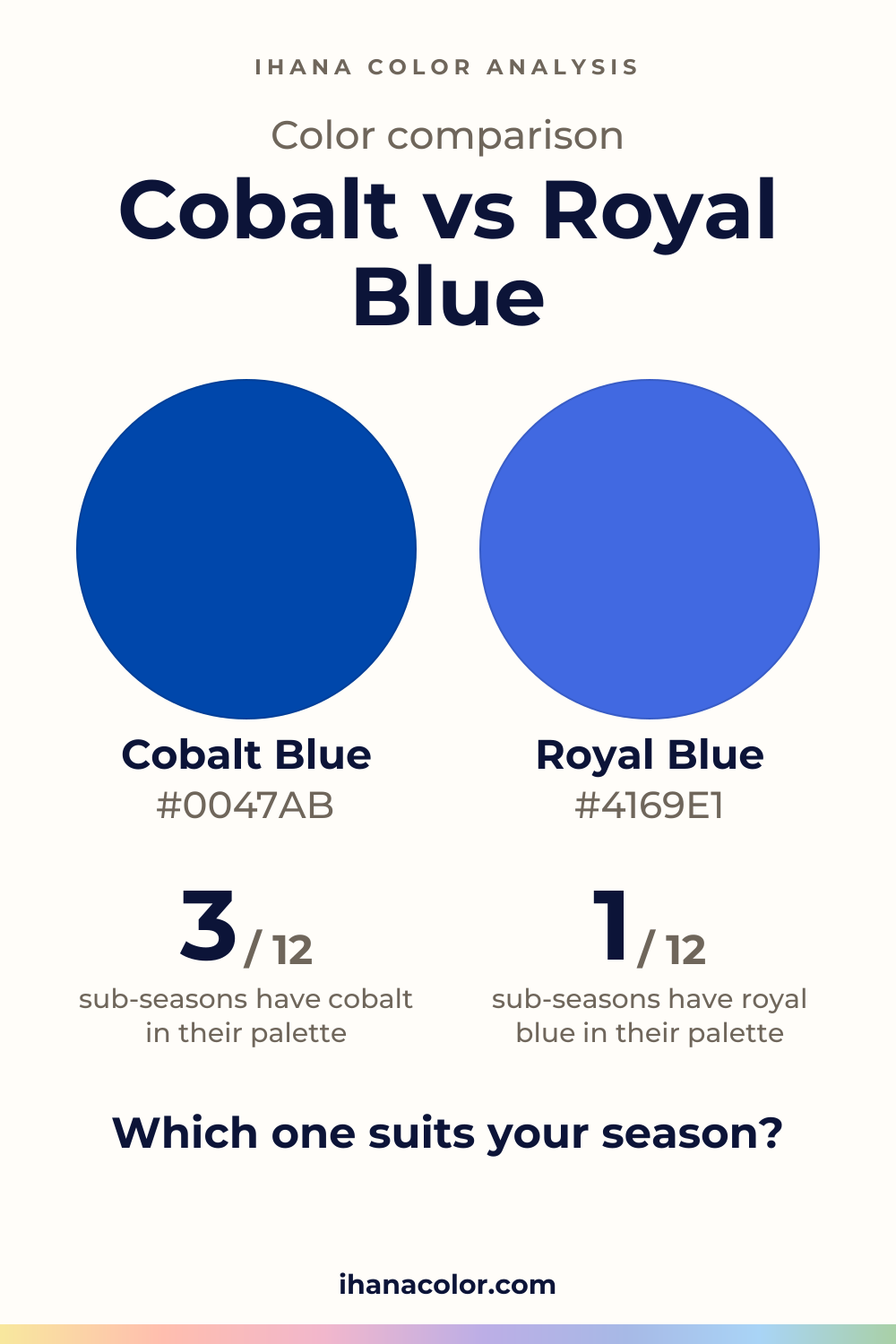
#0047AB#4169E1Side by side
Royal Blue is lighter, and the two are about as vivid as each other; both sit in the blue range.
Cobalt comes in three shades: Cobalt Blue, Egyptian Blue and Cosmic Cobalt. All three are dark, vivid and blue.
From lightest to darkest, the order is Cobalt Blue, Egyptian Blue, Cosmic Cobalt. From most to least intense, it runs Egyptian Blue, Cobalt Blue, Cosmic Cobalt. So the family is tight.
There’s no pastel cobalt and no muted one.
Near a face, that combination puts real weight under the chin. A dark, vivid blue is a strong frame, and the face has to answer it. Some faces do, and the eyes and skin look more awake. On others, the color arrives first and the person second.
Royal blue has three shades too: Royal Blue, Royal Blue (Dark) and Egyptian Blue.
The plain Royal Blue is medium in lightness and vivid. Royal Blue (Dark) goes to very dark and drops to medium intensity, so it is the quietest of the three. Egyptian Blue is the one that appears in both families: dark and vivid, and the most intense shade on either list.
That shared shade matters. If a tag says Egyptian Blue, it could sit in either camp. The plain Royal Blue is the lighter, more open shade, and that is the one set against cobalt here.
Three sub-seasons take cobalt only: Deep Winter, True Winter and Bright Winter. Three take royal blue only: Warm Spring, Bright Spring and Cool Summer. Six take neither.
The Winters are the cobalt group. They’re cool to neutral-cool and high in contrast, so a strong blue has company.
Bright Winter, very bright, has cobalt in its palette, matched with Bright Cobalt. True Winter matches Cobalt Blue with its own Cobalt Blue. Deep Winter has cobalt too, matched with its Royal Blue palette color.
Royal blue is the weaker fit for all three: close for True Winter and Bright Winter, not for you at Deep Winter.
Bright Spring flips it. Royal Blue is in its palette, matched with Bright Royal Blue, and cobalt is only close, through Light Sapphire. Very bright and medium in lightness, it wants the open blue.
Cool Summer is medium and very cool: royal blue is close, through Denim Blue, while cobalt is not for you and Navy stands in. Warm Spring is close on royal blue too, through Warm Periwinkle.
Six sub-seasons take neither, each for its own reason. Light Spring and Light Summer run very light, a long way from a dark or medium vivid blue. Light Cornflower is the closest palette color for Light Spring. Light Summer gets Soft Navy for cobalt and Light Denim Blue for royal blue.
Soft Summer is grayed, and Grayed Navy or Slate Blue stands in. Soft Autumn is on the avoid side for both: each blue sits close to a color that palette avoids, and Warm Denim is the closest palette color, a stand-in, not a match. Warm Autumn lands on Petrol Blue. Deep Autumn gets Dark Petrol Blue or Peacock Blue.
A stand-in is a neighbor, not a match. If you still want the vivid blue, that’s your goal talking, not your palette.
Check each blue at a window, with a bare face, one fabric at a time. The setup is in the guide to color draping at home.
Neither blue has partner colors listed here, so I won’t invent a list. Look for a neighbor that is clearly lighter or clearly softer than the blue, so the blue stays the one loud thing. A second strong color at the same depth makes the pair fight.
If your sub-season takes the other blue, or neither, the palette color is the pick for your face. Wearing the vivid blue in pants or a skirt is a choice you make for your own reasons. Not sure where you land? The free color analysis quiz names a likely season and points to a sub-season you can then check against fabric.
Which one suits you
Each color is checked against the palette of each sub-season, color by color. This is a first hint, not a verdict: see how it looks on your own face.
Neither is for you
Closest in your paletteLight Cornflower
Royal Blue is the one for you
Royal Blue is the one for you
Neither is for you
Closest in your paletteSoft Navy
Royal Blue is the one for you
Neither is for you
Closest in your paletteSlate Blue
Neither is for you
Closest in your paletteWarm Denim
Neither is for you
Closest in your palettePetrol Blue
Neither is for you
Closest in your paletteDark Petrol Blue
Cobalt is the one for you
Cobalt is the one for you
Cobalt is the one for you
Questions
Both. It’s dark, vivid and blue, and it sits in each family. That overlap is why the two names get swapped on tags. The real gap shows in the plain shades: cobalt is dark, royal blue is medium. A label is a starting point only.
Not quite. It’s even darker than cobalt, but only medium in intensity, so it reads quieter than any cobalt shade, which are all vivid. It’s the one royal blue shade that behaves differently from the rest.
It follows the sub-season. Deep Winter, True Winter and Bright Winter take cobalt. Warm Spring, Bright Spring and Cool Summer take royal blue. Don’t know yours yet? Take the free color analysis quiz for a likely season and a hint of your sub-season.
The closest color in your palette. A Warm Autumn has Petrol Blue, for example. It’s a stand-in, not a match for cobalt or royal blue, so keep any vivid blue away from the face.
You can’t, fully. A screen shifts brightness, and dye and room light shift a fabric again. Set the two pieces side by side and ask which one is deeper. The deeper one is closer to cobalt, the more open one to royal blue.
Keep it
The two colors side by side, ready to pin or to keep on your phone.
Download the imageKeep exploring
Royal blue vs navy: one is vivid and medium in depth, the other very dark and muted. I show the difference on a face and which sub-seasons wear which one.
The quiz shows you your likely season and a sub-season hint, with no sign-up. A first hint, not a verdict.
Full palette, capsule wardrobe, makeup, hair and a shopping list for each sub-season. Not on sale yet: join the waitlist.
Twelve sub-seasons instead of sixteen, the three things we look at, and why a quiz is only a first hint.
The free quiz shows you your likely season in two minutes. Then hold both colors up to your bare face, in daylight: a first hint, not a verdict.