
Emerald
#50C878- Illuminating Emerald
- Medium Sea Green
- Sea Green
Color comparison
“They’re both just green.” Hold them side by side and you’ll see otherwise. One lifts your face. The other sits low. And it stays quiet.
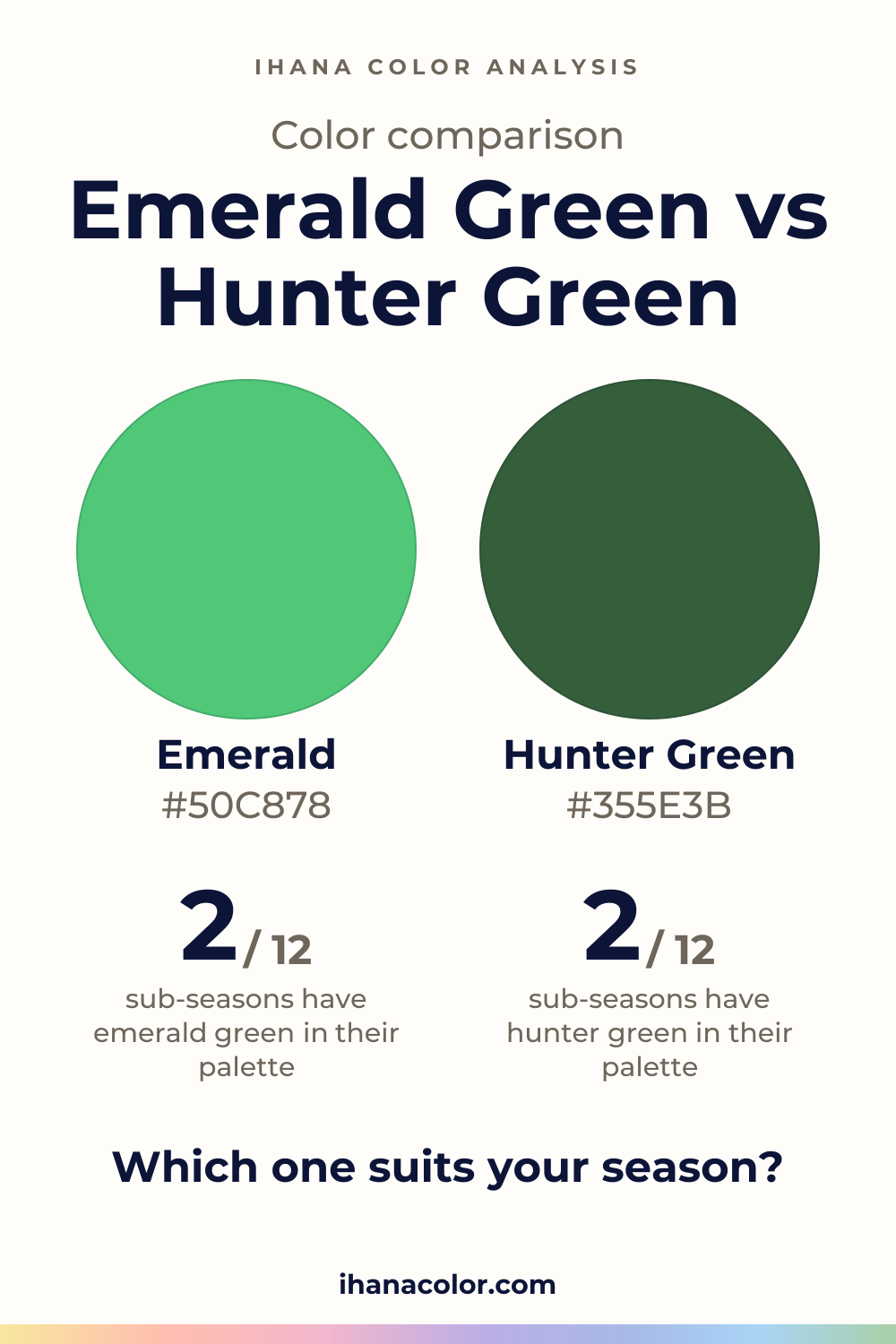
#50C878#355E3BSide by side
Emerald is both lighter and more vivid; both sit in the green range.
Emerald green is the light, vivid one. The Emerald shade is light and vivid, and it sits squarely in the green range.
The family has four shades: Emerald, Illuminating Emerald, Medium Sea Green and Sea Green. Emerald and Medium Sea Green are the lightest. Illuminating Emerald is the odd one out: medium in lightness and intensity, and tilted toward blue-green. Sea Green is the darkest of the four.
Near a face, a light, vivid green throws a lot of color back onto the skin. On the right person that reads as a glow. On the wrong one, the green gets noticed first and the face second.
Hunter green is dark and muted. It doesn’t shout. Its four shades are Hunter Green, Forest Green, Dark Green and British Racing Green, and every one of them is dark.
Three of the four are muted. Dark Green is the exception: it’s vivid, and it’s also the lightest of the family. British Racing Green is the deepest.
Near a face, a dark muted green frames rather than glows. The skin stays in front. The risk goes the other way: held too close, a very dark green can sink and it takes the light with it.
The twelve sub-seasons split into three equal groups, and none takes both.
Emerald only: four. Bright Spring has it in its palette, matched with Light Emerald. Warm Spring does too, matched with Parakeet Green.
Light Spring and Bright Winter are close: a neighbor of emerald, Fresh Apple Green, is in the Light Spring palette, and Bright Mint is in the Bright Winter one. These are light, fresh or very bright colorings, and a vivid green feeds that.
Hunter only: four. Deep Autumn has it in its palette, matched with Bottle Green. Warm Autumn too, with Warm Forest Green.
Deep Winter and True Winter are close: the Deep Winter palette holds a neighbor of hunter, its own Emerald (not the emerald of this page), and True Winter holds Pine Green. Dark, rich or saturated colorings can carry that depth.
Neither: four. Light Summer, Cool Summer, Soft Summer and Soft Autumn.
For emerald, the closest palette colors are Seafoam Green, Soft Emerald, Cool Sage and Sage Green, in that order. For hunter, they’re Soft Navy, Soft Spruce Green, Grayed Spruce and Khaki. Those are stand-ins, not matches. These sub-seasons run light, soft or cool, so a vivid green is too loud and a dark muted one too heavy.
For the home test, hold one green at a time to your bare face by a window, as described in color draping at home.
Emerald has partners to lean on: white, black, camel, gold, baby pink and navy. For the full set of pairings, see what goes with emerald green. If emerald is yours, keep it near the face and let white or camel quiet it down.
Hunter green has no partners listed here, so look for contrast in depth instead. Put something lighter between the green and your skin, or the dark can merge into the dark. Check also that it still reads green on your body and not black.
My advice: if your sub-season lands on neither, try the stand-in from your palette near your face and wear the green lower down. A skirt or a pair of pants asks nothing of your face. And if a green serves your goal that day, wear it anyway.
Which one suits you
Each color is checked against the palette of each sub-season, color by color. This is a first hint, not a verdict: see how it looks on your own face.
Emerald Green is the one for you
Emerald Green is the one for you
Emerald Green is the one for you
Neither is for you
Closest in your paletteSeafoam Green
Neither is for you
Closest in your paletteSoft Spruce Green
Neither is for you
Closest in your paletteGrayed Spruce
Neither is for you
Closest in your paletteSage Green
Hunter Green is the one for you
Hunter Green is the one for you
Hunter Green is the one for you
Hunter Green is the one for you
Emerald Green is the one for you
Questions
No. Emerald green is light and vivid. Hunter green is dark and muted. Both are green in hue, so the difference is lightness and intensity, not a warm or cool lean. Hold them one after the other and the gap shows fast. You’ll see it.
Emerald is both. Hunter has one vivid shade, Dark Green, but even that stays dark. Inside the emerald family, Medium Sea Green is light with only medium intensity. So a single shade can cross the line, which is why you try the fabric itself.
It depends on your sub-season. Four take emerald only, four take hunter only, and four take neither. If you’re unsure which group is yours, the free color analysis quiz gives you a likely season and a sub-season hint. It’s a first hint, not a verdict.
None of the twelve sub-seasons takes both, so pick the one that lifts your face. The other can still live in your wardrobe, away from your neckline, in pants or a skirt where your face doesn’t have to answer to it.
Emerald takes white, black, camel, gold, baby pink and navy. No partners are listed for hunter green, so look for a lighter color to sit between the dark green and your face. Which partner flatters you depends on your sub-season.
Keep it
The two colors side by side, ready to pin or to keep on your phone.
Download the imageKeep exploring
Colors that go with emerald green, and the version each of the 12 sub-seasons can wear. I sort its four shades, then show what to put right next to it.
The quiz shows you your likely season and a sub-season hint, with no sign-up. A first hint, not a verdict.
Full palette, capsule wardrobe, makeup, hair and a shopping list for each sub-season. Not on sale yet: join the waitlist.
Twelve sub-seasons instead of sixteen, the three things we look at, and why a quiz is only a first hint.
The free quiz shows you your likely season in two minutes. Then hold both colors up to your bare face, in daylight: a first hint, not a verdict.