Free: the color analysis quiz. Find your season in 2 minutes →Free quiz: your season in 2 minutes →

PDF guide · 39 pages

The Fabric Guide: Read a Label, Understand a Fabric

Shop knowing exactly what you’re buying. This guide shows you how to read a label, tell 24 fibers and 35 fabrics apart, and care for what you buy.

  • How to read a label
  • US care symbols
  • 24 fibers
  • 35 fabrics

$19.99PDF guide · delivered by email

  • A PDF you keep
  • Easy to read on your phone
  • Printable
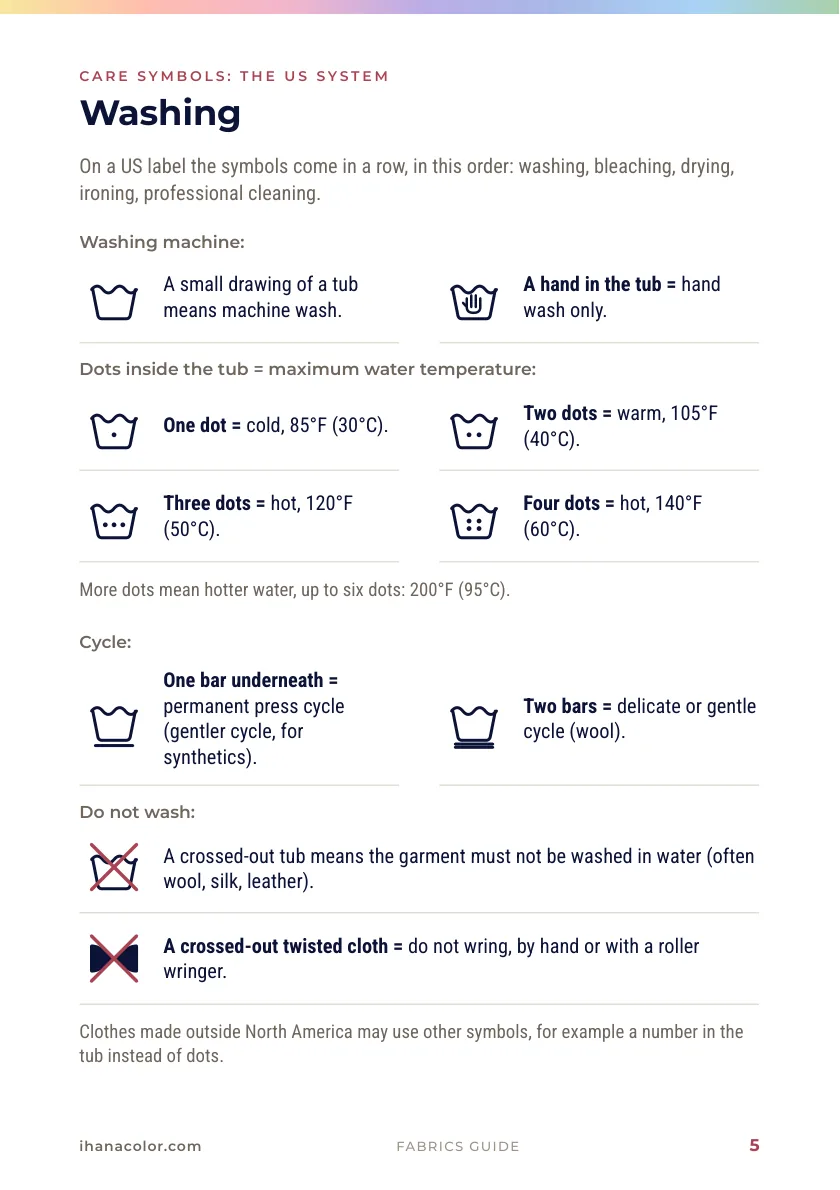
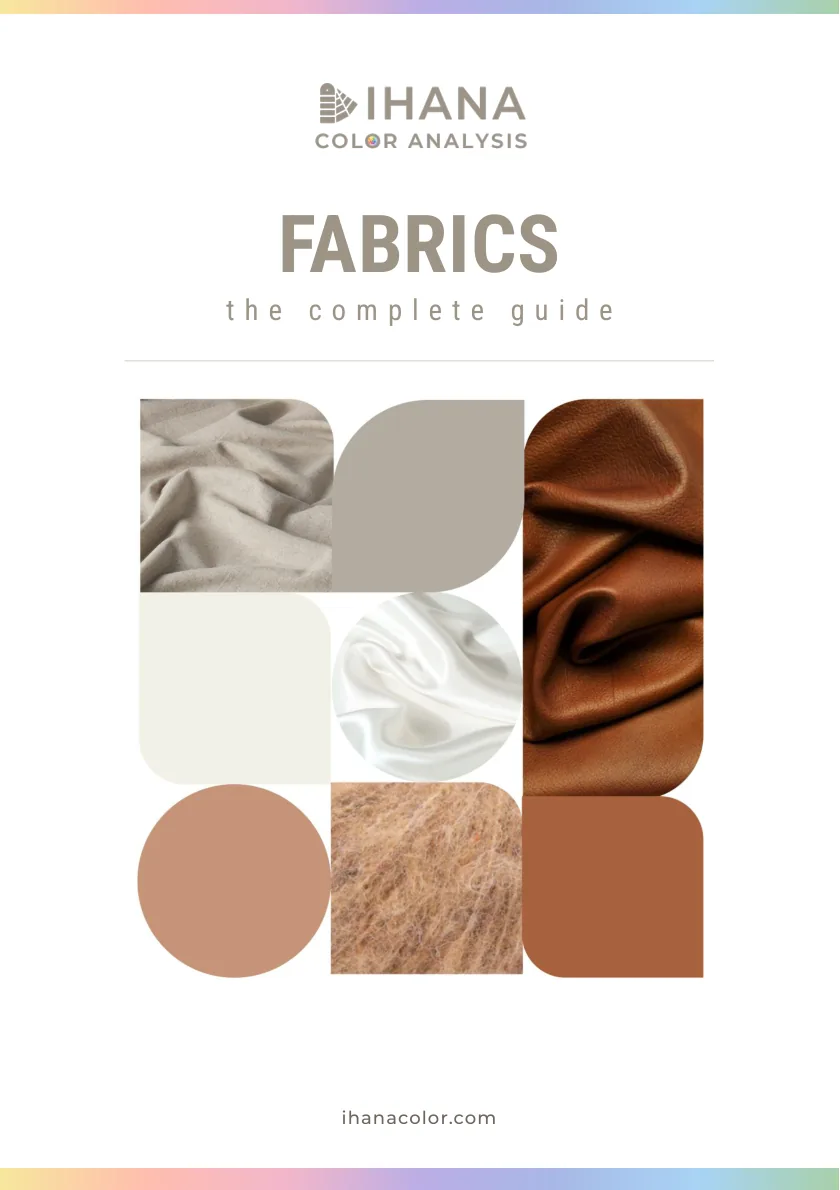
Fabric Guide, page 5: the US washing symbols drawn out (tub, dots, bars, hand, crossed-out tub) with what each one meansFabric Guide, page 20: the rayon (viscose) page, with its characteristics, durability, environmental impact and careCover of the Fabric Guide: Fabrics, the complete guide, Ihana Color Analysis
Three pages from the real guide: the cover, the washing symbols and the page of a fiber.

A note from Lisa

Decoding fabrics

These are the words Lisa opens the guide with.

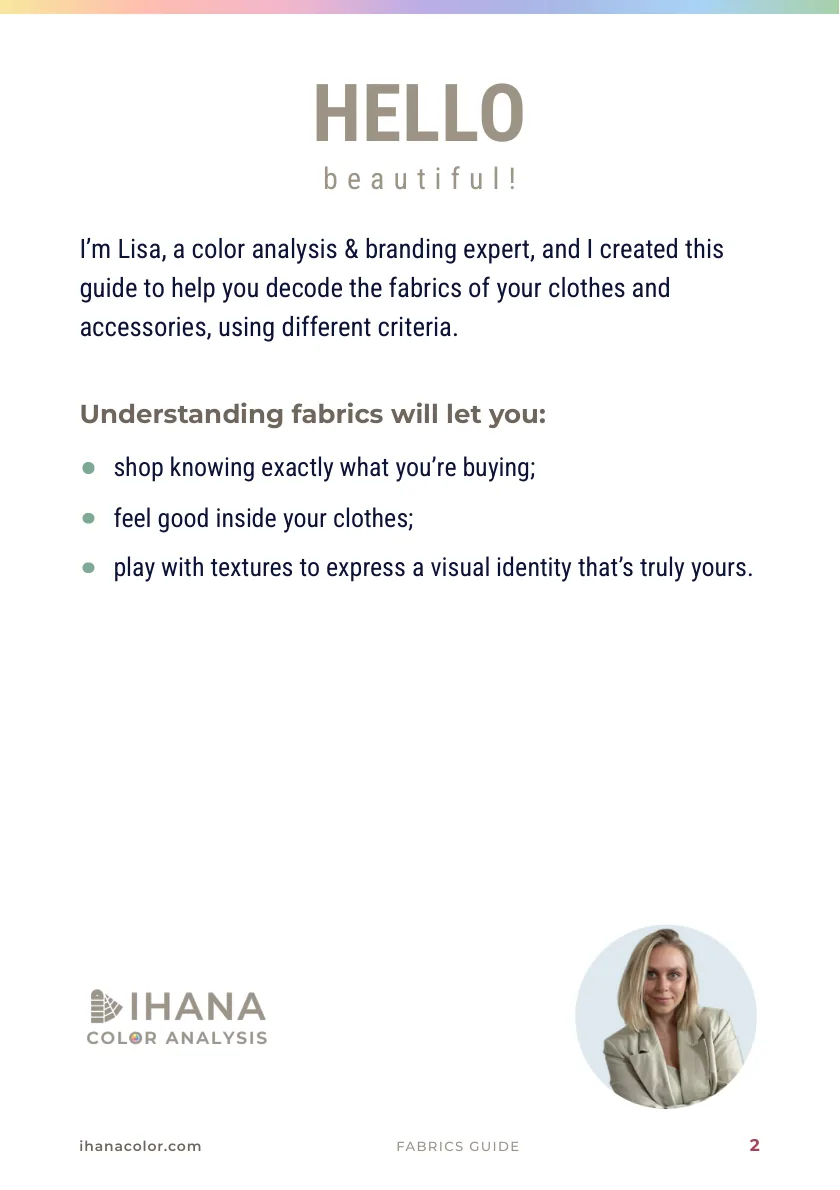
Fabric Guide, page 2: Lisa’s note, with her photo
“I’m Lisa, a color analysis & branding expert, and I created this guide to help you decode the fabrics of your clothes and accessories, using different criteria.”

Understanding fabrics will let you:

  • shop knowing exactly what you’re buying
  • feel good inside your clothes
  • play with textures to express a visual identity that’s truly yours

A look inside · 39 pages

Flip through the guide

Eight pages out of 39: the cover, the label, the washing symbols, the families, three fiber pages and a table of fabrics.

  • Cover of the Fabric Guide: Fabrics, the complete guide, Ihana Color Analysis
    Page 1The cover
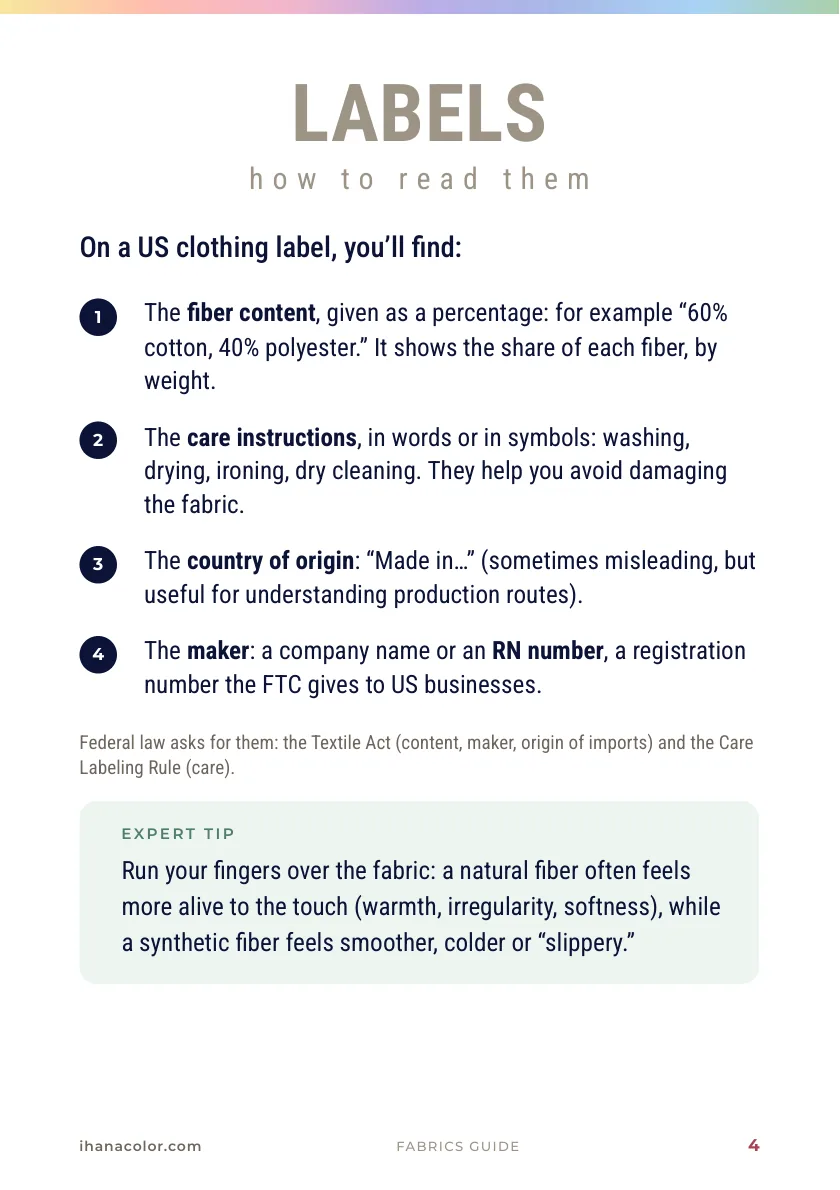
  • Fabric Guide, page 4: how to read a US clothing label, with the fiber content, the care instructions, the country of origin and the maker
    Page 4Labels: how to read them
  • Fabric Guide, page 5: the US washing symbols drawn out (tub, dots, bars, hand, crossed-out tub) with what each one means
    Page 5The washing symbols
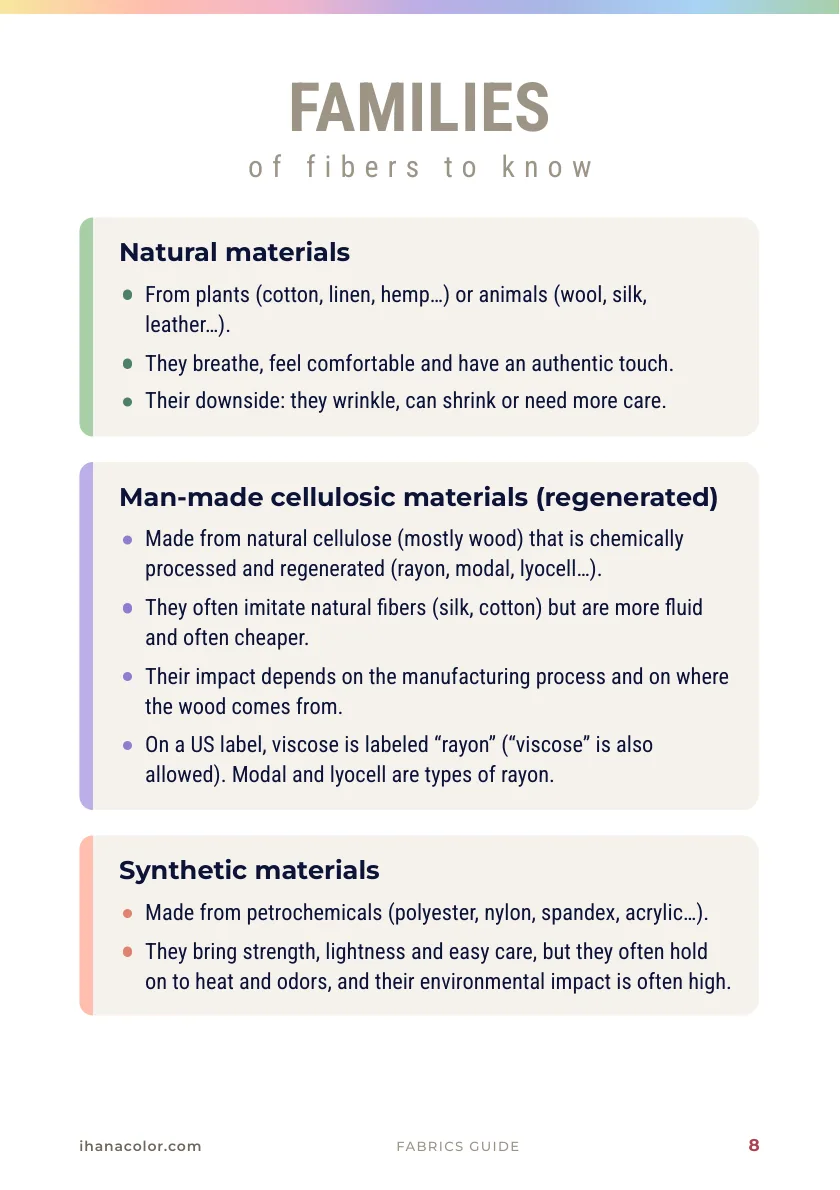
  • Fabric Guide, page 8: the three families of fibers, natural, man-made cellulosic and synthetic
    Page 8The three fiber families
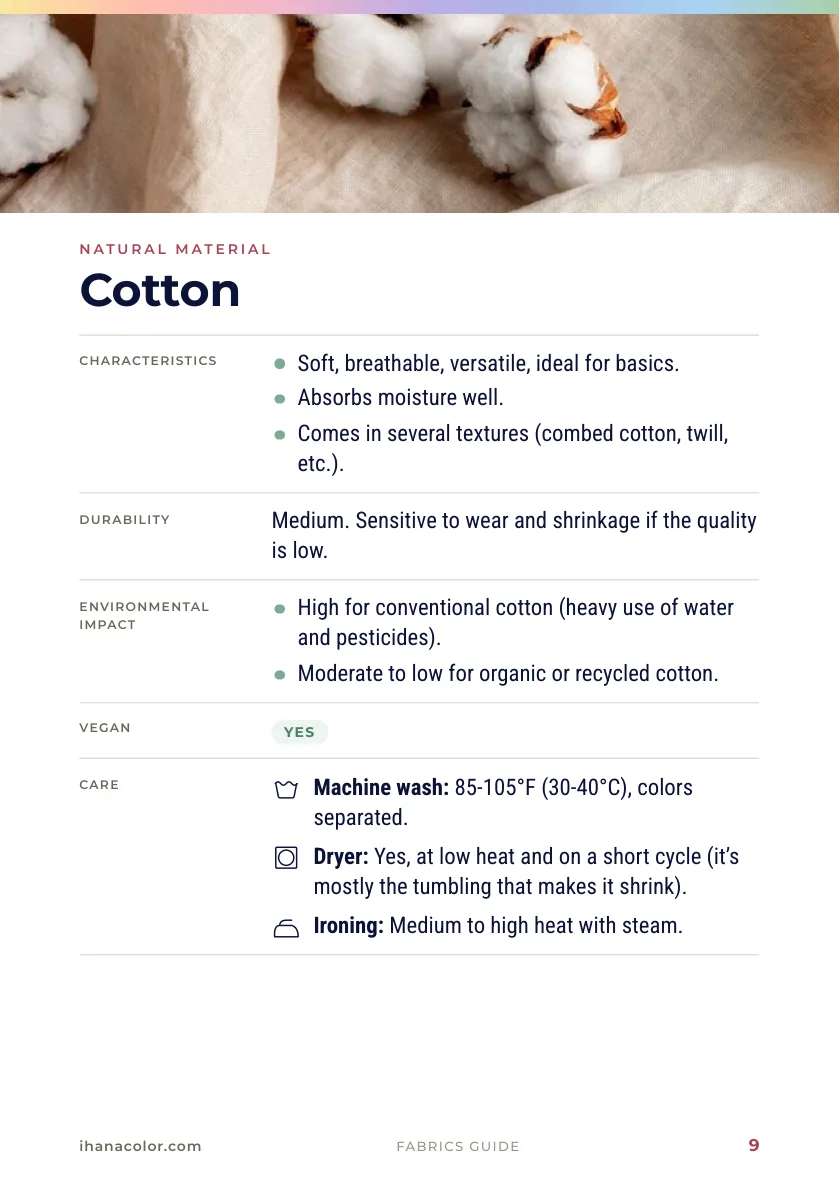
  • Fabric Guide, page 9: the cotton page, with its characteristics, durability, environmental impact and care
    Page 9A fiber page: cotton
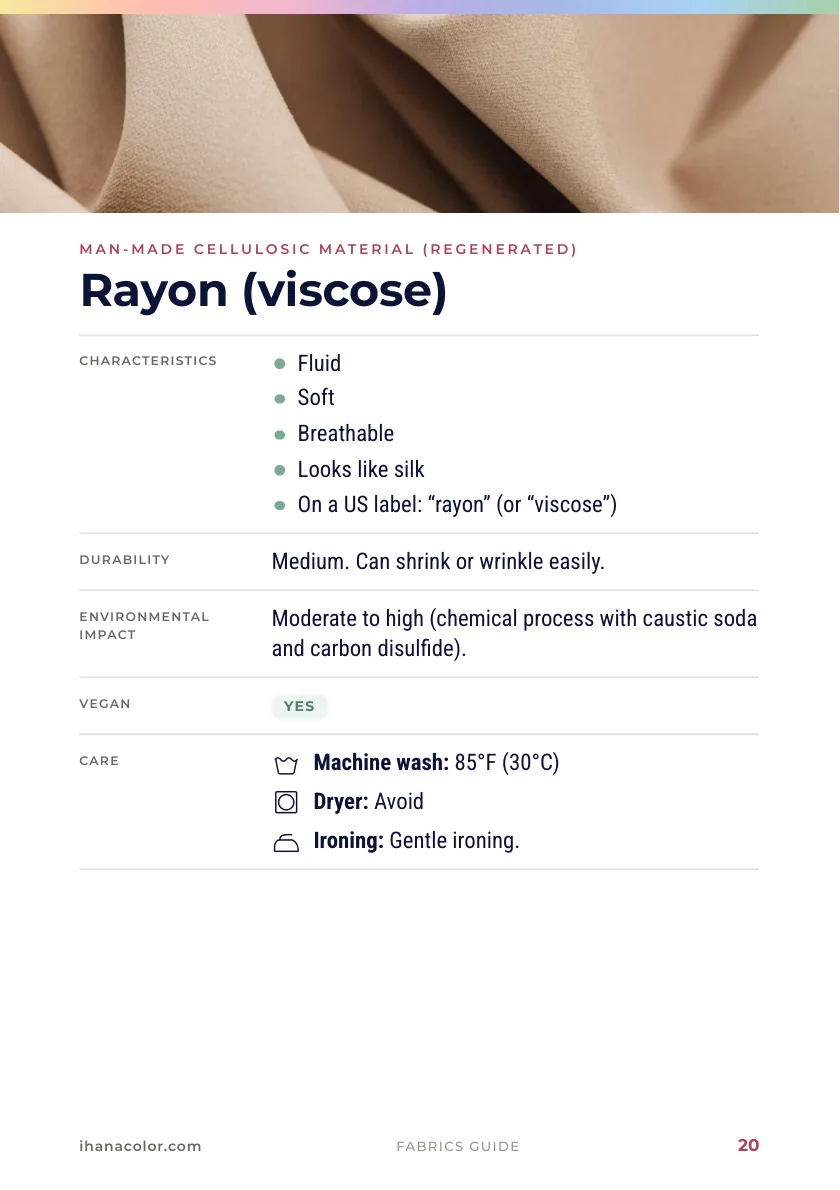
  • Fabric Guide, page 20: the rayon (viscose) page, with its characteristics, durability, environmental impact and care
    Page 20A fiber page: rayon
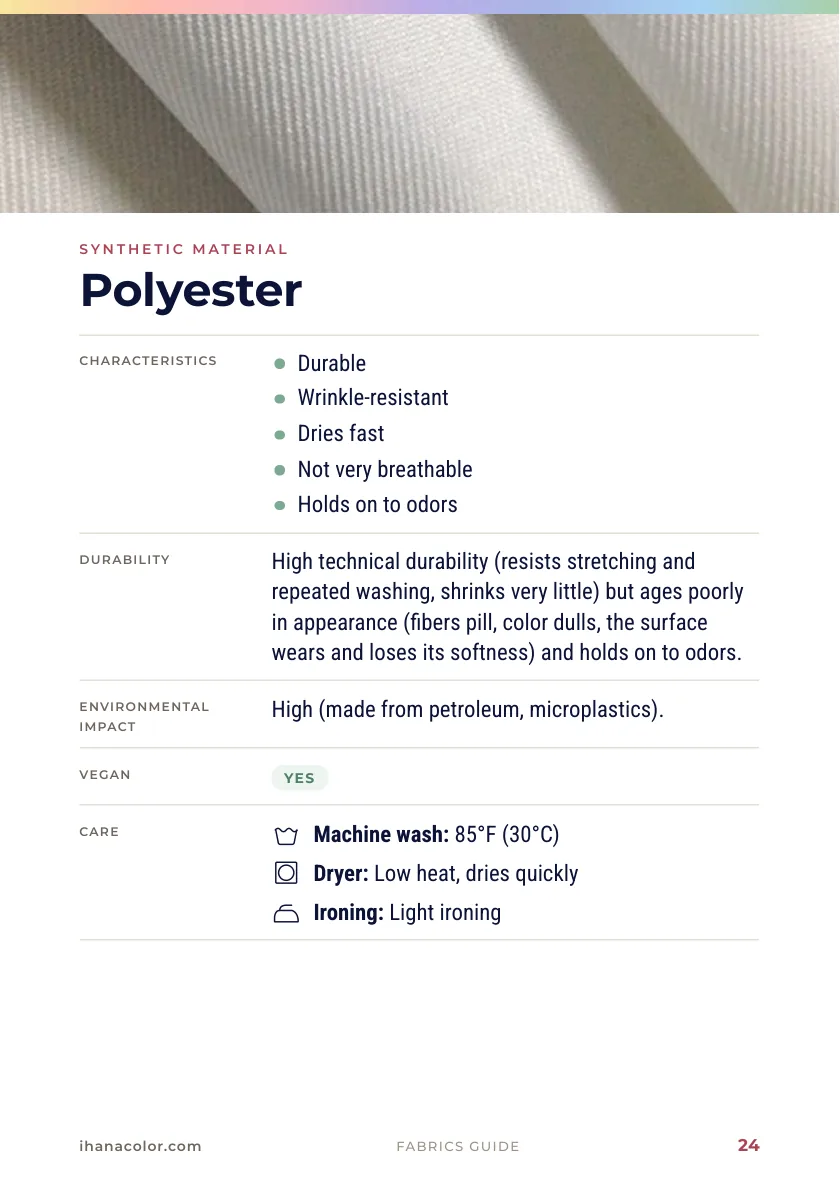
  • Fabric Guide, page 24: the polyester page, with its characteristics, durability, environmental impact and care
    Page 24A fiber page: polyester
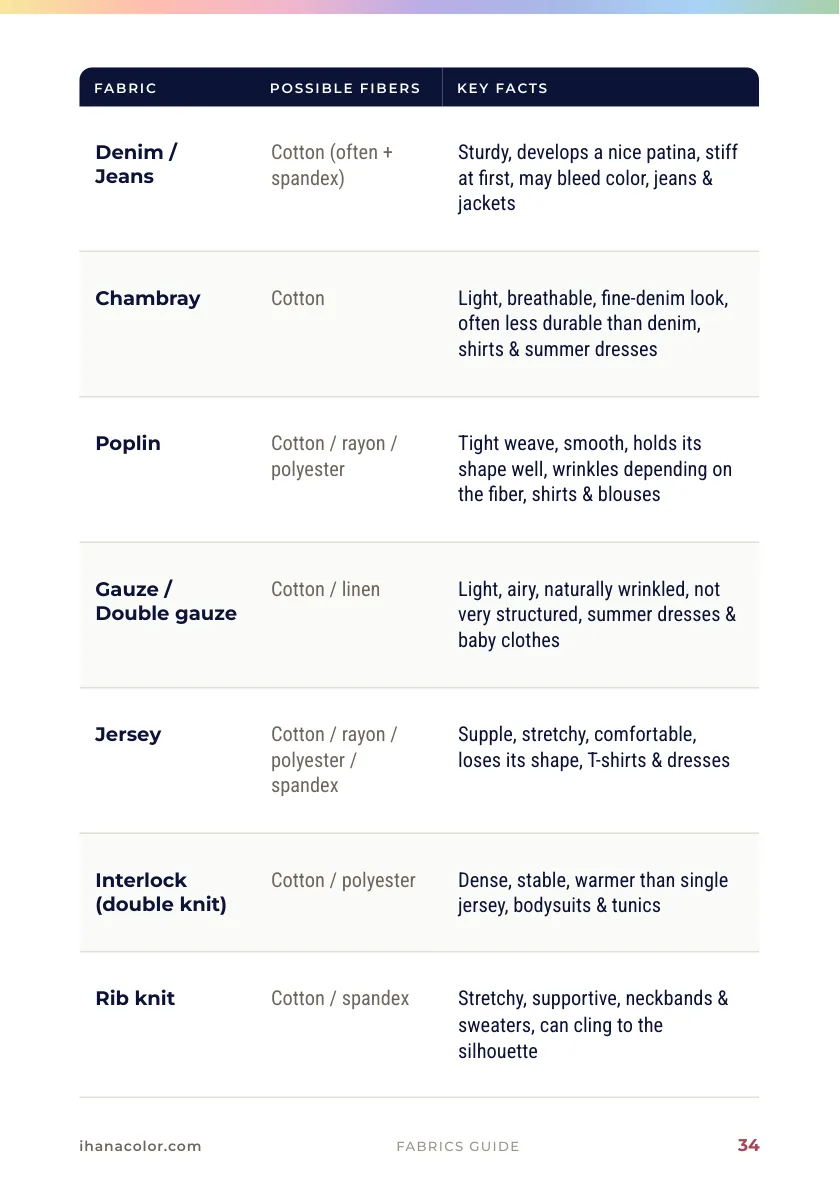
  • Fabric Guide, page 34: the table of fabrics with denim, chambray, poplin, gauze, jersey and interlock
    Page 34The table of fabrics

What’s in the guide

39 pages: labels, care symbols, 24 fibers, 35 fabrics

You start with the label and end with the fabric: one page per fiber, tables for the fabrics.

  • 39A5 pages, to read on a phone or print
  • 24fibers, one page each: from wool to polyester, from cotton to leather
  • 35fabrics in tables, with their possible fibers and key facts

The 39 pages, in order

  • Cover · p. 1
  • Lisa’s note · p. 2
  • Contents · p. 3
  • Labels · p. 4
  • Care symbols · p. 5 to 7
  • Fiber families · p. 8
  • 24 fibers, one page each · p. 9 to 32
  • Fabric types · p. 33 to 38
  • Last page · p. 39
Fabric Guide, page 20: the rayon (viscose) page, with its characteristics, durability, environmental impact and care

How a fiber page reads

Every fiber has its own page, always built the same way. You find the same five landmarks from one fiber to the next.

  1. The characteristics

    The words that describe the fiber: soft, fluid, strong, scratchy…

  2. The durability

    How long it lasts, and what wears it out.

  3. The environmental impact

    Low, moderate or high, with the reason in a few words.

  4. Vegan, or not

    A Yes or No tag, so you can choose by your values.

  5. The care

    Machine, dryer, ironing: three lines, with small symbols.

Page 4

Labels: how to read them

On a US clothing label, you’ll find four things. The guide explains each one.

Fabric Guide, page 4: how to read a US clothing label, with the fiber content, the care instructions, the country of origin and the maker
  1. The fiber content

    Given as a percentage: for example “60% cotton, 40% polyester.” It shows the share of each fiber, by weight.

  2. The care instructions

    In words or in symbols: washing, drying, ironing, dry cleaning. They help you avoid damaging the fabric.

  3. The country of origin

    “Made in…” (sometimes misleading, but useful for understanding production routes).

  4. The maker

    A company name or an RN number, a registration number the FTC gives to US businesses.

Federal law asks for them: the Textile Act (content, maker, origin of imports) and the Care Labeling Rule (care).

Expert tip

Run your fingers over the fabric: a natural fiber often feels more alive to the touch (warmth, irregularity, softness), while a synthetic fiber feels smoother, colder or “slippery.”

Pages 5 to 7

The care symbols, drawn out

On a US label the symbols come in a row, in this order: washing, bleaching, drying, ironing, professional cleaning. Here is what each one means.

Washing machine

  • A small drawing of a tubmeans machine wash.
  • A hand in the tubhand wash only.

Dots inside the tub = maximum water temperature

  • One dotcold, 85°F (30°C).
  • Two dotswarm, 105°F (40°C).
  • Three dotshot, 120°F (50°C).
  • Four dotshot, 140°F (60°C).

More dots mean hotter water, up to six dots: 200°F (95°C).

Cycle

  • One bar underneathpermanent press cycle (gentler cycle, for synthetics).
  • Two barsdelicate or gentle cycle (wool).

Do not wash

  • A crossed-out tubmeans the garment must not be washed in water (often wool, silk, leather).
  • A crossed-out twisted clothdo not wring, by hand or with a roller wringer.

Clothes made outside North America may use other symbols, for example a number in the tub instead of dots.

A red cross always means: don’t. These are the US symbols, the ones used on labels in the United States.

Page 8

Three families of fibers

Natural, man-made or synthetic: knowing which family a piece comes from already says a lot about it.

  • Natural materials

    • From plants (cotton, linen, hemp…) or animals (wool, silk, leather…).
    • They breathe, feel comfortable and have an authentic touch.
    • Their downside: they wrinkle, can shrink or need more care.
  • Man-made cellulosic materials (regenerated)

    • Made from natural cellulose (mostly wood) that is chemically processed and regenerated (rayon, modal, lyocell…).
    • They often imitate natural fibers (silk, cotton) but are more fluid and often cheaper.
    • Their impact depends on the manufacturing process and on where the wood comes from.
    • On a US label, viscose is labeled “rayon” (“viscose” is also allowed). Modal and lyocell are types of rayon.
  • Synthetic materials

    • Made from petrochemicals (polyester, nylon, spandex, acrylic…).
    • They bring strength, lightness and easy care, but they often hold on to heat and odors, and their environmental impact is often high.

Pages 9 to 32

24 fibers, one page each

Pick a fiber to see its card in short. In the guide, each fiber fills a page, with all its landmarks.

Man-made cellulosic materialpage 22 of the guide

Lyocell (Tencel)

Characteristics
  • Soft
  • Silky
  • Breathable
Durability
Very good
Environmental impact
Low to moderate
Vegan
Yes
Care
  • Machine 85°F (30°C)
  • Dryer No (air dry)
  • Ironing Gentle
On a US label
“lyocell” (a type of rayon), with a brand name such as TENCEL next to it
Pages 33 to 38

35 fabrics to know

The guide tells the fiber (cotton, wool, polyester…) from the fabric (denim, jersey, poplin…).

“The fiber mostly determines comfort and durability. The fabric mostly defines drape, hold and use.”

For each fabric, a table gives the possible fibers and the key facts: how it feels, what it does best and what it’s mainly used for.

  • Denim / Jeans
  • Chambray
  • Poplin
  • Gauze / Double gauze
  • Jersey
  • Interlock (double knit)
  • Rib knit
  • Satin
  • Crepe
  • Sheer muslin
  • Chiffon
  • Twill
  • Gabardine
  • Canvas
  • Corduroy
  • Velvet
  • Tweed
  • Flannel
  • Taffeta
  • Organza
  • Voile
  • Eyelet embroidery
  • Lace
  • Tulle
  • Terry cloth
  • Sweatshirt fleece / French terry
  • Polar fleece
  • Neoprene
  • Softshell
  • Ripstop
  • Gore-Tex
  • Faux leather (PU)
  • Microfiber
  • Seersucker
  • Batiste
Fabric Guide, page 34: the table of fabrics with denim, chambray, poplin, gauze, jersey and interlock

Who it’s for

Who it’s for, and how to use it

The guide gives you landmarks on fabrics. The choice is yours.

  1. Read the label before you buy

    Fiber content, care instructions, origin: page 4 tells you where to look.

  2. Open the fiber’s page

    One page per fiber: what it brings, what it asks for, its environmental impact.

  3. Let how it feels be your judge

    A fabric you like on paper has to feel right on your skin too.

Made for you if…

  • you want to understand what’s written on a label
  • you’re torn between two fabrics and want to know what each one brings
  • you want to know how to wash, dry and iron each fiber
  • you want to shop knowing exactly what you’re buying
  • you want to keep these landmarks on your phone, to reopen in front of the rack

Not for you if…

  • you’re looking for your color palette: your colors are in the guides by sub-season
  • you’re looking for cuts for your shape: that’s the job of the body shape guide
  • you’re looking for brands or store addresses: the guide is about fabrics, not stores
  • you want a technical textile manual: the guide stays simple, one page per fiber

Prices and options

Get the Fabric Guide

The guide alone, with the body shape guide, or with everything you need for your wardrobe. Checkout is in US dollars.

The Style Bundle

The Fabric Guide + the body shape guide

$39.99 both guides$4.99 less than buying them separately

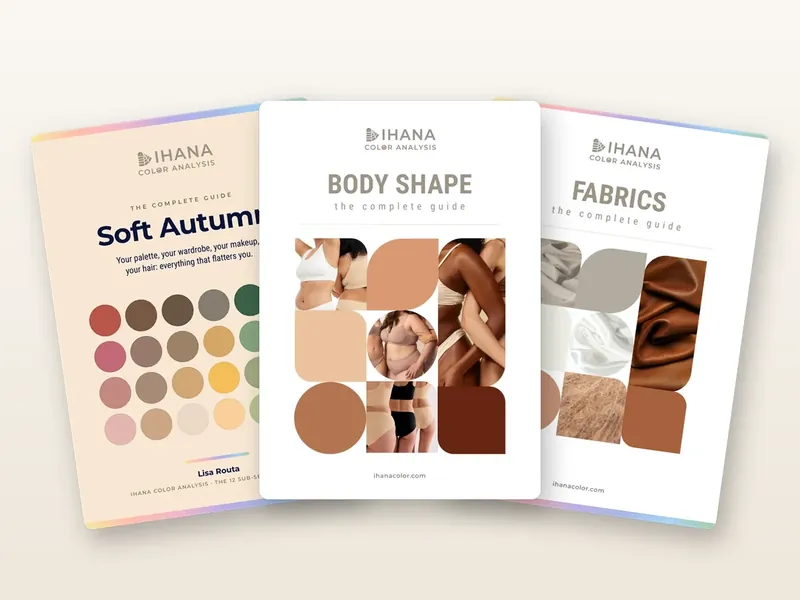
Cover of the Fabric GuideCover of the body shape guide

Fabrics tell you how to choose and how to care. Body shape tells you which cuts bring out your silhouette.

  • The Fabric Guide, 39 pages
  • The body shape guide, 78 pages
Get the bundle · $39.99

The two PDFs arrive by email after checkout.

The Wardrobe Kit

The guide of your sub-season + body shape + fabrics

$59.99 three guides$14.98 less than buying them separately

The three guides of the kit: a sub-season guide, the body shape guide and the Fabric Guide
  • The guide of your sub-season: palette, wardrobe, makeup
  • The body shape guide, 78 pages
  • The Fabric Guide, 39 pages

Not sure of your sub-season? The free quiz gives you a first hint, not a verdict.

Not sure of your sub-season yet? The free quiz gives you a first hint.

Lisa Routa, French color analyst

Who wrote this guide

Lisa Routa

French color analyst and founder of Ihana. Eight years in sales and marketing management in the cosmetics industry, and trained to analyze every skin tone.

“I see image consulting as a tool for one thing above all: creating harmony between your outfits and your DNA. That way, your image serves your personality and your projects, and not the other way around.”

  • Featured in the French newspaper Le Monde in January 2026 (the article is in French)
  • Every skin tone

More about Lisa

FAQ

Fabric Guide: your questions

What’s in the Fabric Guide, exactly?

39 A5 pages. One page on reading a label, three pages of care symbols (washing, bleaching, drying, professional cleaning, ironing), one page on the three families of fibers, then 24 fibers, one page each. Each page gives the characteristics, the durability, the environmental impact, whether the material is vegan and how to care for it. The guide ends with tables of 35 fabrics.

How do I get the guide?

By email, as a PDF, after you check out.

What format is it, and can I print it?

It’s a 39-page PDF with A5-size pages (about 5.8 × 8.3 inches), easy to read on a phone. You can print it at home too.

Is the Fabric Guide sold alone?

Yes, $19.99. The Style Bundle pairs it with the body shape guide, $39.99 for both guides. The Wardrobe Kit adds the guide of your sub-season, $59.99 for the three guides.

Does the guide use the US care symbols?

Yes. The guide draws the US system (ASTM D5489, the set the FTC accepts when symbols stand without words) and tells you that clothes made outside North America may use other symbols, for example a number in the tub instead of dots.

What do “rayon” and “viscose” mean on a US label?

On a US label, viscose is labeled “rayon” (“viscose” is also allowed). Modal and lyocell are types of rayon. The guide gives each of them its own page.

Does the guide replace the label on my clothes?

No. The care advice in the guide is Lisa’s, sometimes more cautious than a manufacturer’s. When in doubt, the label on your garment wins. The guide helps you read it and understand it.

Does the guide say which brands to buy?

No. There is no list of brands and no store addresses: the guide is about fabrics, not stores. It teaches you to read a fiber content and to compare two fabrics.

Does the guide cover the environmental impact of fabrics?

Yes. Every fiber page has an environmental impact line (low, moderate or high, with the reason in a few words) and says whether the material is vegan.

How is it different from the body shape guide and the guides by sub-season?

The body shape guide is about cuts: which shapes of clothes bring out your silhouette. The guides by sub-season are about color: your palette, your capsule wardrobe, your makeup. The Fabric Guide is about what your clothes are made of and how to care for them. The three go together.

Understand what you wear

39 pages, 24 fibers, 35 fabrics. The PDF arrives by email after checkout.

Get the guide · $19.99