
Burgundy
#800020- Claret
- Wine
- Cordovan
- Oxblood
Color comparison
“Burgundy and wine are the same dark red.” Hold them near a face. Look twice. One has a little more bite.
#800020#722F37Side by side
Burgundy is more vivid, and the two are about as light as each other; both sit in the red range.
Burgundy sits dark and red, at medium intensity. Five shades make up its family: Cordovan, Wine, Claret, Burgundy and Oxblood. Cordovan is the lightest and Oxblood the darkest, and it is the only one that reads very dark.
Claret is the one that leans pink-red. The rest stay in plain red.
Burgundy itself is the most intense of the five. That is what you notice first on a sweater: the color holds its ground without shouting. And yes, Wine is on this list. The two families overlap, which is why people mix up the names.
Wine has three shades of its own: Wine Red, Wine and Wine Dregs. Wine Red is the lightest and the only vivid one. Wine Dregs is the darkest, muted, and leans pink-red.
So the family stretches in a different direction. It goes from a clear red to a hushed, dusty one. The middle shade, Wine, is dark, medium in intensity and red, the same description as burgundy itself.
If you pick up a garment tagged “wine,” check which end of the family you are holding. A vivid wine and a muted one behave very differently next to skin.
Less than you’d think. Depth is the same: both are dark. The hue is the same too, red. Neither one leans toward brown or purple in the shades above, so don’t go hunting for that difference.
The gap is intensity. Burgundy itself is the more vivid of the two. The wine family runs wider, from vivid Wine Red to muted Wine Dregs. Near your chin, notice which one you see first: the red, or you.
On a fabric, look for the same gap: burgundy should read a little stronger than a wine of the same depth. Screens and bulbs shift both, so judge on the garment itself.
Deep Autumn takes both. It is dark, rich and intense, and both colors are in its palette, matched with Warm Burgundy. It is the only sub-season where that happens.
Two Autumns take wine only. Warm Autumn reads wine as Warm Eggplant, a true palette color. Burgundy is close to it, a neighbor and not a match.
Soft Autumn is very soft and desaturated, so the quieter red fits. Wine is close to Soft Eggplant, a neighbor in its palette and not a match. Burgundy is not for you there, and Soft Eggplant only stands in for it.
True Winter is the only sub-season that takes burgundy alone. It is saturated and high in contrast, and burgundy is close to Carmine. Wine is not for you there, and Carmine is the stand-in.
Three more sit near both reds without owning either. Cool Summer is close to Soft Cool Burgundy, Soft Summer to Soft Burgundy. Deep Winter is close to Ruby for burgundy and Cool Burgundy for wine.
Five take neither: Light Spring, Warm Spring, Bright Spring, Light Summer and Bright Winter. For Light Summer the closest palette color is Light Raspberry, and for Bright Winter it is Bright Cherry. Both are stand-ins, not matches. If you’re one of the five, the direction is to wear dark reds lower down, unless your goal says otherwise.
Bare face, window light, one red at a time: watch whether your eyes brighten or your skin turns gray. The color draping guide walks through the setup.
Burgundy has six listed partners: cream, navy, olive, baby pink, camel and gray. Cream or baby pink lifts it near the face. Navy and olive make a deep, grounded outfit.
No partners are listed for wine, so I won’t invent any. Look for a lighter color beside it. Two dark colors in a row blur into one patch, and wine, the quieter red, needs that contrast more.
Which one suits you
Each color is checked against the palette of each sub-season, color by color. This is a first hint, not a verdict: see how it looks on your own face.
Neither is for you
Closest in your paletteWarm Candy Pink
Neither is for you
Closest in your paletteGolden Brown
Neither is for you
Closest in your paletteWarm Cherry
Neither is for you
Closest in your paletteLight Raspberry
Both are close to your palette
Both are close to your palette
Wine is the one for you
Wine is the one for you
Both work for you
Both are close to your palette
Burgundy is the one for you
Neither is for you
Closest in your paletteBright Cherry
Questions
Close, but no. Wine is one of the shades inside the burgundy family, and the two share depth and hue. They part on intensity, where burgundy has more. The wine family also stretches to a muted, dusty end, so a tag settles little.
Burgundy carries more intensity than the plain Wine shade. Wine Red, the vivid end of the wine family, can be the louder one. If you can, hold the two garments side by side and compare.
That depends on your sub-season, and only Deep Autumn takes both outright. The free color analysis quiz gives you a likely season and a hint of your sub-season, a first hint, not a verdict.
Yes, if your sub-season takes both, as Deep Autumn does. Three others come close to both. In the other cases, the easier direction is to keep the one that isn’t yours lower down, or in a bag or shoes, away from your face.
Not alone. A code is a reference, and dye, light and your screen all change how a red reads. Check the garment in daylight beside your skin, and treat an online photo as a hint. Tags and screens vary too.
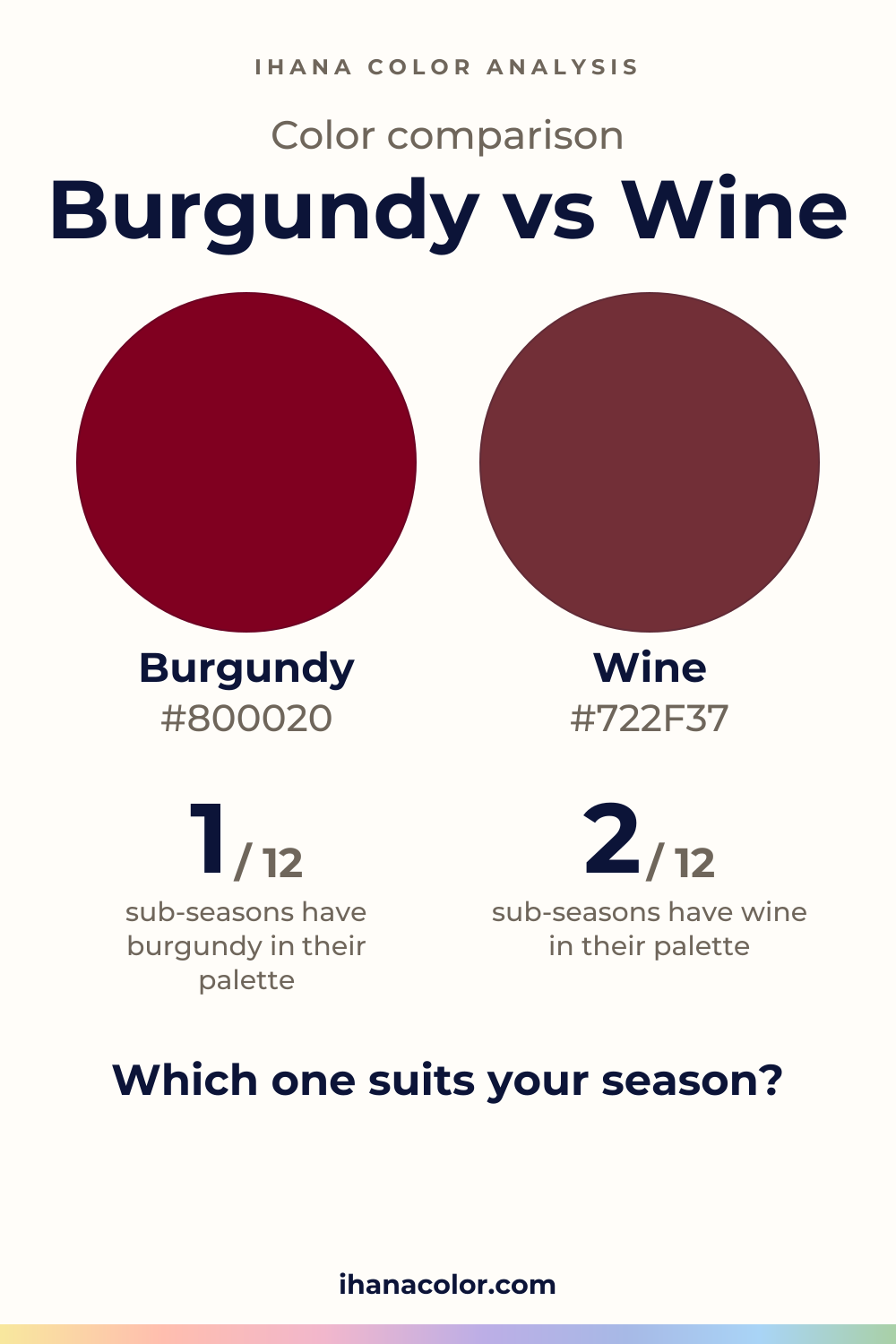
Keep it
The two colors side by side, ready to pin or to keep on your phone.
Download the imageKeep exploring
What colors go with burgundy? I sort its five shades, name the partners that work with it, and show which version belongs to each of the 12 sub-seasons.
Burgundy vs maroon: the gap is smaller than you think. I show how each reads on a face and a fabric, and which sub-seasons wear which, shade by shade.
Burgundy vs red: the real difference is depth and intensity, not hue. Twelve sub-seasons sorted into burgundy, red, both or neither, with the reasons.
The quiz shows you your likely season and a sub-season hint, with no sign-up. A first hint, not a verdict.
Full palette, capsule wardrobe, makeup, hair and a shopping list for each sub-season. Not on sale yet: join the waitlist.
Twelve sub-seasons instead of sixteen, the three things we look at, and why a quiz is only a first hint.
The free quiz shows you your likely season in two minutes. Then hold both colors up to your bare face, in daylight: a first hint, not a verdict.