
Mauve
#AE82C0- Mauvelous
- Opera Mauve
- Mauve Taupe
- Old Mauve
Color comparison
Lay a mauve top and a dusty rose one on a table by the window. Look at the edge of each. One leans violet. The other leans red. That lean decides what they do to a face.
#AE82C0#C9A9A6Side by side
Dusty Rose is lighter, Mauve is more vivid; Mauve sits in the violet range, Dusty Rose in the red range.
Mauve is a family, not a single point. Its main shade is medium in lightness, medium in intensity and sits in the violet range. That’s the mauve people picture.
Then the family moves. Mauvelous is light and leans pink-red. Opera Mauve is medium and muted, between pink and purple.
Mauve Taupe is medium and muted, again pink-red. Old Mauve is the dark one, muted and pink-red.
From lightest to darkest: Mauvelous, Opera Mauve, Mauve, Mauve Taupe, Old Mauve. So when a tag says “mauve,” it may mean a violet with some body or a grayed pink with a taupe edge. Check which one you are holding before you decide you dislike the color.
Dusty rose is light. It’s muted. Its hue is red. It never reaches for violet, and that’s the first thing to notice.
Its family stays close to home. Silver Pink is the lightest and nearly neutral. Rosy Brown is light and muted. Old Rose and Rose Taupe step to medium, and they carry the most color of the five.
From lightest to darkest: Silver Pink, Dusty Rose, Rosy Brown, Old Rose, Rose Taupe. Nothing in it’s loud. Near a face, it reads as a gentle warmth in the cheeks and lips, where mauve reads as a cooler, deeper tint.
They part on two lines. Dusty rose is lighter. Mauve is more vivid. On a sweater, that means mauve holds its ground against a bright window, while dusty rose melts into the light and lets your own coloring lead.
They part on hue too. Mauve sits in the violet range, dusty rose in the red range. Next to the skin, a violet hue can read cooler and a red hue warmer, even when both are soft.
Now the overlap, so you don’t hunt for a gap that isn’t there. Several mauve shades, Mauvelous, Mauve Taupe and Old Mauve, also lean pink-red. Both families run muted, and both include a taupe-tinted shade. A grayed mauve and a deeper dusty rose can sit very close on a rack.
The test is the main shade of each: violet and medium against red and light. If the tag says rose but the fabric leans purple, it is a mauve.
Mauve alone belongs to three sub-seasons. Light Summer and Cool Summer have mauve itself in their palettes. Warm Spring has a neighbor of it, Warm Violet.
Why the Summers? Both lean cool, and a violet-leaning mauve sits easily there. Warm Spring is very warm and medium to light, so it only gets a neighbor of mauve, not mauve itself. Light Summer is slightly cool and very light, and it also has a neighbor of the rose in its palette, Rosy Taupe, but mauve is the pick. Cool Summer is very cool and soft to medium, and its closest rose is Cool Taupe, a stand-in and not a match.
Dusty rose alone belongs to three others. Soft Summer has it in the palette, matched with Tea Rose. Soft Autumn has a neighbor, Warm Dusty Rose. True Winter has another neighbor, Icy Pink. Soft Summer is very soft and grayed, which fits a muted color. Soft Autumn and True Winter only get a neighbor, so the verdict there is “close,” not a match. True Winter is saturated and cool, so the rose gets in only through Icy Pink.
Light Spring is the only one that takes both, and only as neighbors: Light Violet beside mauve, Petal Pink beside dusty rose. The verdict is “close” for each, so neither is a clean match in its palette.
Five take neither: Bright Spring, Warm Autumn, Deep Autumn, Deep Winter and Bright Winter. Their palettes run bright, rich or saturated, and a muted color has little to say there. For mauve, the stand-ins are Iris Violet for Bright Spring, Burnt Coral for Warm Autumn, Tomato for Deep Autumn, Fuchsia for Deep Winter and Bright Candy Pink for Bright Winter. For dusty rose they are Light Gray, Cream, Cream, Pure White and Silver Gray, in the same order. They’re stand-ins, not matches. If you’re one of these five, wear mauve and dusty rose low, away from the face.
Still undecided? Ten questions on the free color analysis quiz point to a likely season and a sub-season. It’s a first hint, not a verdict.
Do the test with a bare face and a window. The setup is in the article on color draping at home. Put one color up, rest your eyes, then the other. Whichever keeps your face lively is your direction.
Mauve has partners to lean on: ivory, light gray, charcoal, navy, olive and camel. Ivory and light gray leave it room to breathe. Charcoal and navy sit darker than any mauve here, so the mauve stands out. Olive and camel pull it toward the earth.
Dusty rose has no partners listed here, so look for a quality instead. Pick a neighbor that sits further from red than it does, in a similar softness, so the rose stays the gentle one in the outfit. Skip anything loud beside it. A strong color can make a muted rose look tired.
The color guides hold the other pairings and comparisons.
Which one suits you
Each color is checked against the palette of each sub-season, color by color. This is a first hint, not a verdict: see how it looks on your own face.
Both are close to your palette
Mauve is the one for you
Neither is for you
Closest in your paletteLight Gray
Mauve is the one for you
Mauve is the one for you
Dusty Rose is the one for you
Dusty Rose is the one for you
Neither is for you
Closest in your paletteCream
Neither is for you
Closest in your paletteCream
Neither is for you
Closest in your palettePure White
Dusty Rose is the one for you
Neither is for you
Closest in your paletteSilver Gray
Questions
No. Mauve’s main shade is a medium violet, while dusty rose is a light, muted red. Some mauve shades lean pink-red, so the two can meet in the middle. If the fabric leans purple, call it mauve. If it stays on the pink side, call it dusty rose.
Dusty rose is lighter, and mauve is more vivid. Dusty rose reads as light and muted, while mauve sits at medium for both lightness and intensity. Next to your face, dusty rose gives a softer, quieter glow, and mauve gives a firmer, slightly cooler one.
It follows your sub-season. Light Summer and Cool Summer favor mauve, Soft Summer favors dusty rose, and Warm Spring, Soft Autumn and True Winter each have a neighbor of one of them. For a quick first hint, take the free quiz, then confirm by trying both near your face.
Yes, and Light Spring has a neighbor of each. For anyone else, wear the one that isn’t yours lower down, in pants, a skirt or a bag. A mauve scarf with a dusty rose top works only if the two differ clearly in depth, otherwise they blur.
Trust the lean, not the label. A screen, a yellow bulb or the dye can push a mauve toward pink and a dusty rose toward brown. Go to a window and look for violet against red. A code is only a reference, so a swatch in daylight tells you more.
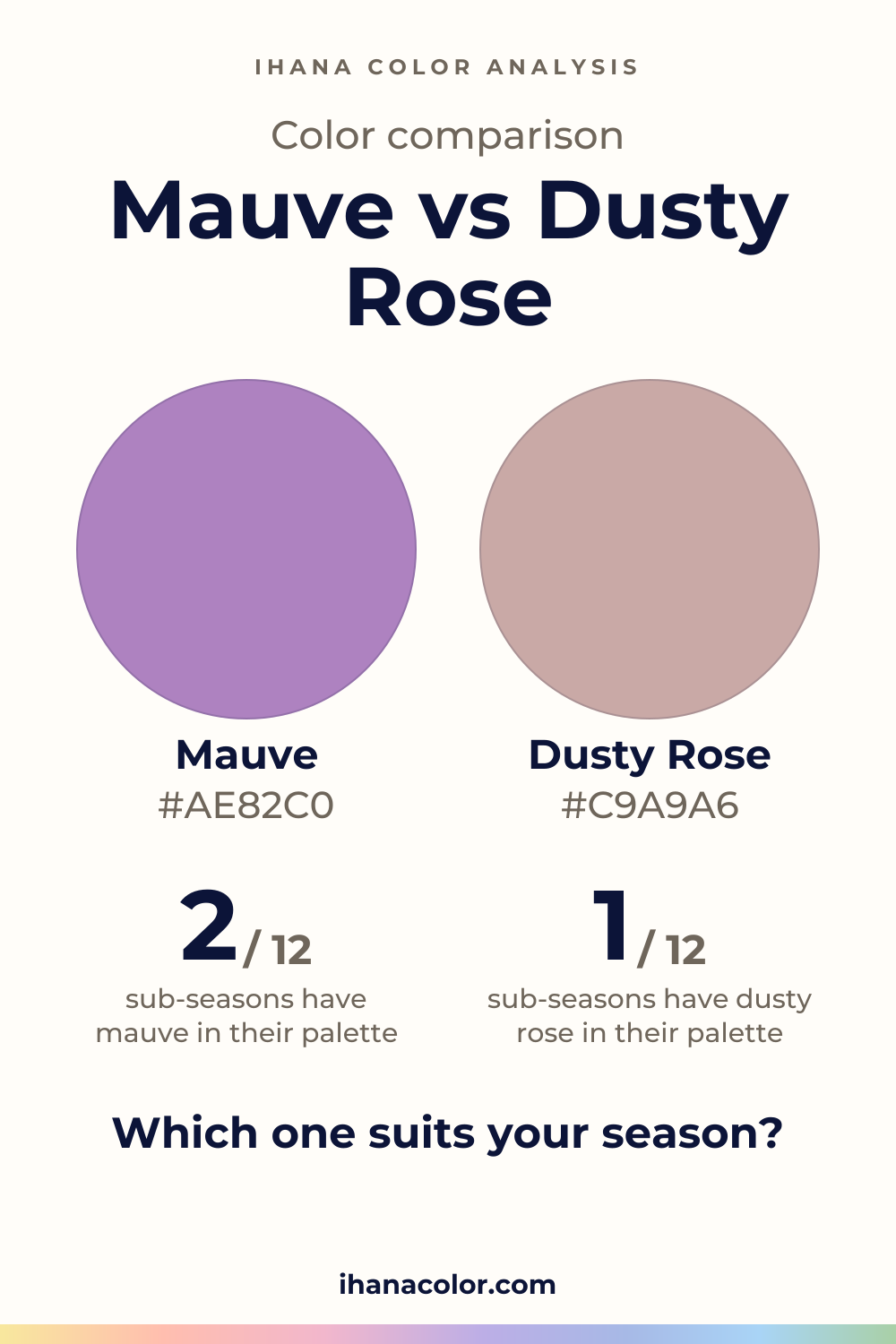
Keep it
The two colors side by side, ready to pin or to keep on your phone.
Download the imageKeep exploring
Colors that go with mauve, from ivory to navy, and which of its five shades belongs to your sub-season. Mauve looks different on every face; see why.
Mauve vs lavender: one leans violet, the other blue. I show how to tell them apart on a face and a fabric, and which sub-seasons take which, or neither.
The quiz shows you your likely season and a sub-season hint, with no sign-up. A first hint, not a verdict.
Full palette, capsule wardrobe, makeup, hair and a shopping list for each sub-season. Not on sale yet: join the waitlist.
Twelve sub-seasons instead of sixteen, the three things we look at, and why a quiz is only a first hint.
The free quiz shows you your likely season in two minutes. Then hold both colors up to your bare face, in daylight: a first hint, not a verdict.