
Mauve
#AE82C0- Mauvelous
- Opera Mauve
- Mauve Taupe
- Old Mauve
Color comparison
“Mauve and lavender are both just light purple.” Hold them side by side and they part ways. One leans violet, the other leans blue.
#AE82C0#C3B3E6Side by side
Lavender is lighter, Mauve is more vivid; Mauve sits in the violet range, Lavender in the blue range.
Mauve is a purple with body. Plain mauve is medium in lightness and medium in intensity, and it leans violet. Not pink, not blue.
The family fans out from there. From lightest to darkest: Mauvelous, Opera Mauve, Mauve, Mauve Taupe and Old Mauve.
Mauvelous is the light one and leans pink-red. Opera Mauve stays muted and drifts toward pink-purple. Mauve Taupe and Old Mauve are muted pink-reds, and Old Mauve is the dark one.
So “mauve” on a tag can mean a clear violet or a quiet, dusty red-purple. Check which shade you’re holding before you decide you don’t like mauve.
Lavender is the lighter, quieter one. Plain lavender is light and muted, and it leans blue: a purple pulled toward the sky.
Lightest to darkest, the family runs Lavender Blue, Thistle, Lavender, Lilac and Floral Lavender. Lavender Blue is very light. Lilac and Thistle lean pink-purple, though both stay muted. Floral Lavender is the odd one out: medium in lightness, vivid, and violet in hue.
If a lavender sweater looks louder than you expected, that’s probably the shade. Most of the family keeps a soft voice, which is why lavender reads gentle near a face.
Three things change. Lightness. Intensity. Hue.
Lightness first. Lavender is lighter, so near the face it reflects more light and sits quietly. Mauve is a step deeper and holds its own against your hair and eyes.
Then intensity. Mauve is the more vivid of the two. On a fabric it looks like a decision. Lavender looks like a mood.
Then hue. Mauve sits in the violet range and lavender in the blue range. Put them under your chin one after the other and lavender feels bluer, airier. Mauve feels fuller.
What they share is just as useful. Both are purples. Both have a pink-purple member (Opera Mauve on one side, Lilac and Thistle on the other). Both have muted shades. And Floral Lavender is violet like mauve, so at that point the gap nearly closes. If you’ve been hunting for a difference between those two, you won’t find much.
This is the part that decides it for you, and it follows the axes.
Lavender only goes to three sub-seasons. Light Spring is very light and low in contrast, and lavender sits in its palette as Light Lilac. Soft Summer is very soft and grayed, so its lavender is Gray Lavender, with Smoky Mauve only a neighbor. True Winter has Icy Lavender close to its palette.
Mauve only goes to two. Cool Summer is medium in depth and very cool, and Mauve sits in its palette as Mauve itself. Warm Spring has a neighbor, Warm Violet, but nothing close for lavender: the nearest color there is Warm Periwinkle.
Light Summer is the one sub-season that takes both, Mauve and Lavender, each as itself. Very light and soft is a gentle enough setting for either.
Six take neither: Bright Spring, Soft Autumn, Warm Autumn, Deep Autumn, Deep Winter and Bright Winter. The colors I name for them are only the nearest in their palettes. Deep Winter’s nearest to mauve is Fuchsia and Warm Autumn’s is Burnt Coral. For lavender, Deep Autumn and Warm Autumn land on Cream, Deep Winter on Pure White and Bright Winter on Silver Gray. Soft Autumn lands on Warm Denim for both. Those are the closest colors in their palettes, nothing more, so trying them beats assuming.
Do the test in daylight with a bare face, one fabric at a time, and read the setup in color draping at home. Watch whether your skin brightens or turns flat.
Mauve has six listed partners: Ivory, Light Gray, Charcoal, Navy, Olive and Camel. Ivory keeps it clean. Charcoal and navy give it depth. Olive and camel pull it toward earth.
Lavender has Sage Green, White, Light Gray, Navy, Cream and Mustard. White and cream keep it airy. Navy gives it an anchor. Mustard and sage give it a bolder, outdoorsy setting.
My advice: if your sub-season takes neither, keep the purple low, in a skirt or a bag, and put your own palette color nearest your face. For the full pairings, see the pages for what goes with mauve and what goes with lavender.
Which one suits you
Each color is checked against the palette of each sub-season, color by color. This is a first hint, not a verdict: see how it looks on your own face.
Lavender is the one for you
Mauve is the one for you
Neither is for you
Closest in your paletteLight Gray
Both work for you
Mauve is the one for you
Lavender is the one for you
Neither is for you
Closest in your paletteWarm Denim
Neither is for you
Closest in your paletteCream
Neither is for you
Closest in your paletteCream
Neither is for you
Closest in your paletteFuchsia
Lavender is the one for you
Neither is for you
Closest in your paletteSilver Gray
Questions
No. They’re neighbors in the purple family, not twins. Mauve is medium and more vivid, and it leans violet. Lavender is lighter and more muted, and it leans blue. A few shades overlap: Floral Lavender is violet, and Opera Mauve and Lilac both lean pink-purple.
Lay both on a white sheet. Lavender reads soft and airy, while mauve looks a step deeper and fuller. Lavender Blue is the lightest shade of either family, Old Mauve the darkest. Near your face, the deeper one shows more fabric.
Start with the free ten-question quiz. It gives you a likely season and a sub-season hint, but it can’t watch your skin react. Then hold both purples near your face and see which one leaves you looking rested.
Light Summer takes both, so nothing to solve there. If neither is in your palette, keep the purple in a skirt or a bag, and put a color from your own palette nearest your face.
Display settings, room light and dye all shift a purple, so a swatch online is only a reference. Check the tag, then judge the real fabric by eye: does it lean violet and full, or blue and light?
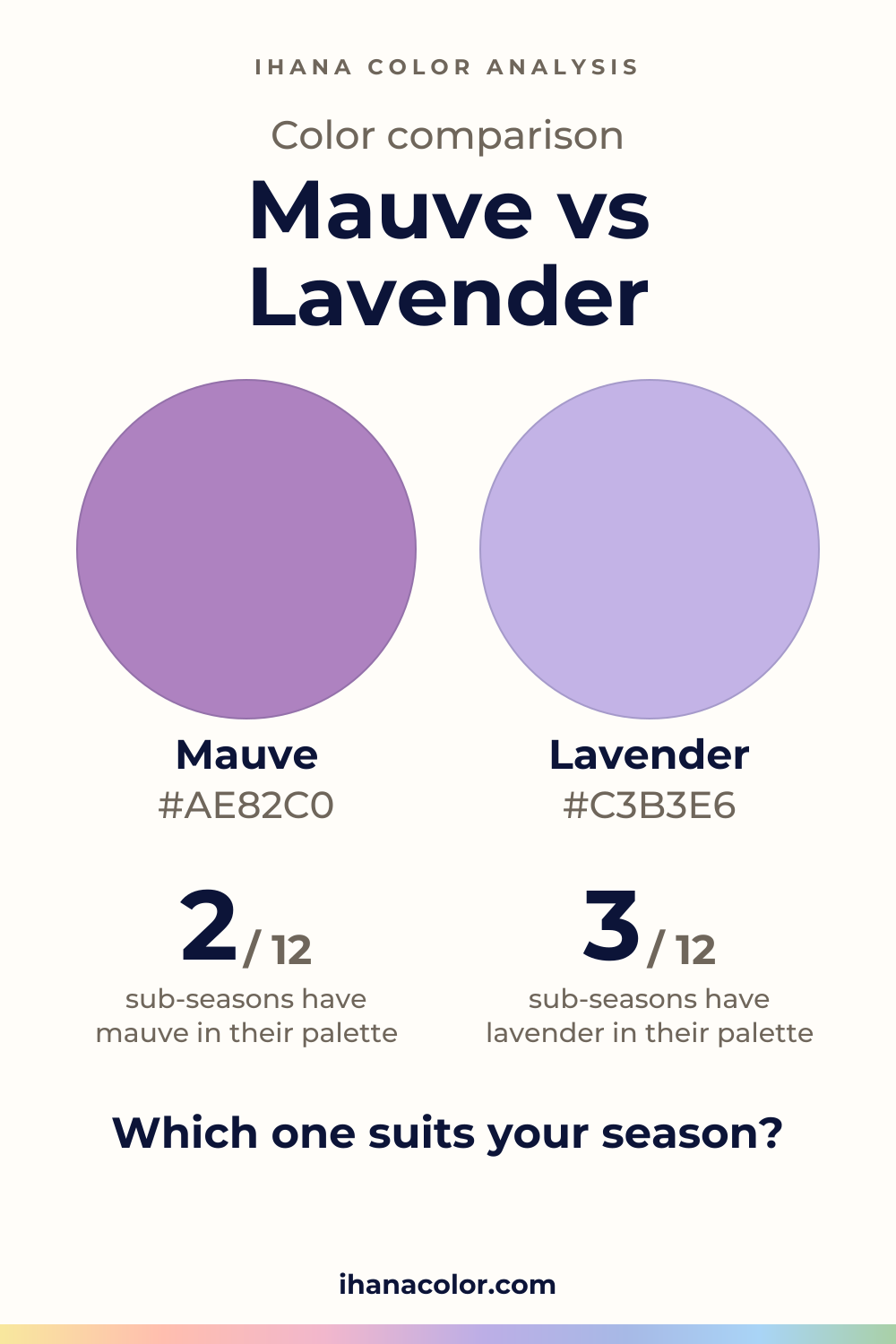
Keep it
The two colors side by side, ready to pin or to keep on your phone.
Download the imageKeep exploring
Colors that go with mauve, from ivory to navy, and which of its five shades belongs to your sub-season. Mauve looks different on every face; see why.
Colors that go with lavender, from white and navy to sage green, plus which of its five shades belongs to your sub-season and which pairings to avoid.
Mauve vs dusty rose: one leans violet and is more vivid, the other is lighter, softer and leans red. I show which one fits each of the 12 sub-seasons.
The quiz shows you your likely season and a sub-season hint, with no sign-up. A first hint, not a verdict.
Full palette, capsule wardrobe, makeup, hair and a shopping list for each sub-season. Not on sale yet: join the waitlist.
Twelve sub-seasons instead of sixteen, the three things we look at, and why a quiz is only a first hint.
The free quiz shows you your likely season in two minutes. Then hold both colors up to your bare face, in daylight: a first hint, not a verdict.