
Purple
#800080- Royal Purple
- Grape
- Amethyst
- Medium Purple
Color comparison
“Violet is just a lighter purple.” It isn’t. The two are equally dark. Equally vivid. Only the lean differs, and your face notices it.
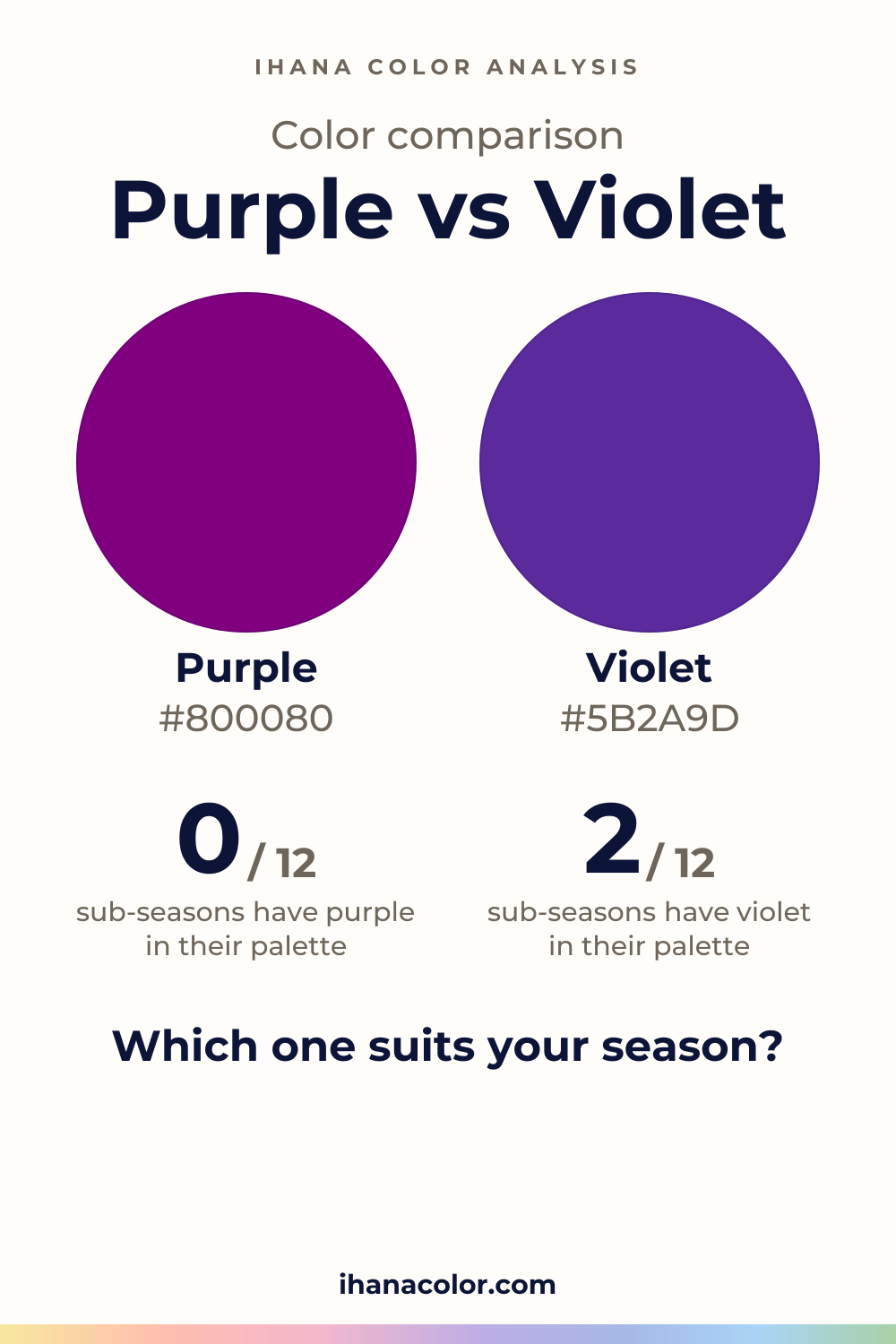
#800080#5B2A9DSide by side
The two are about as light and as vivid as each other; Purple sits in the pink-purple range, Violet in the violet range.
The shade simply called Purple is dark, vivid and pink-purple in hue. That pink note sets the mood of the whole family.
Five shades share the name. From lightest to darkest: Medium Purple, Amethyst, Royal Purple, Grape and Purple. Grape is the most intense of the five, Royal Purple the least.
The hue words split them. Purple leans pink-purple. Grape and Amethyst lean violet. Royal Purple and Medium Purple lean blue.
So a “purple” sweater can sit on either side of the family, and the tag won’t tell you which. Look at the lean before you look at the depth.
Violet is dark and vivid too, with a violet hue. The five shades run from lightest to darkest: Light Violet, Warm Violet, Iris Violet, Violet and Deep Violet.
This family stretches further. Light Violet is the only light shade across both lists, and it leans blue. Iris Violet is the only very vivid one.
Deep Violet is dark but only medium in intensity, which makes it the quiet member. Warm Violet sits at medium depth, vivid, with a violet hue.
If you want a color that whispers, start with Deep Violet. If you want one that carries across a room, Iris Violet is the shade to try.
Less than you’d think. The main shade of each is dark. Both are vivid. The two weigh the same on a hanger, and there’s no gap in depth or strength to hunt for.
The gap is the lean. Purple sits in the pink-purple range, Violet in the violet range. On a face, hold each one near your chin and see which lean your skin answers to: the pink-purple of Purple or the violet of Violet.
On fabric, the gap is range. Violet has a light shade, Light Violet, and a very vivid one, Iris Violet. Purple has neither: its lightest is medium and its strongest is vivid. If you want a lighter color near your face, only the violet family offers one.
In my view, the lean matters more than the name. Two pieces sold as “purple” can be further apart than one purple and one violet.
Eight of the twelve take neither. Three take Violet only. One takes Purple only. No sub-season has both in its palette.
Deep Winter and True Winter are the clearest cases. Deep Winter is dark and True Winter is medium to dark, and both are saturated and high in contrast. Violet is in both palettes, as Deep Violet for Deep Winter and as Violet itself for True Winter. Purple stands next to those same colors, so it is close, not in.
Bright Spring has Violet close to its Bright Violet. Purple is not for you there, and Bright Violet is only a stand-in for it.
Bright Winter flips the family. Its pick is Purple, close to Magenta. Violet is not for you there, and Bright Violet is only a stand-in.
The other eight have neither. Soft Autumn is very soft and desaturated, and its closest palette color is Soft Eggplant. Deep Autumn is dark, rich and intense, and its closest is Eggplant.
Soft Summer stands in with Soft Plum for Purple and Grayed Navy for Violet. Cool Summer uses Light Plum and Navy. These are stand-ins, not matches. Wear them by your face.
The home test takes one sentence: sit by a window with a bare face, hold one color under your chin at a time, and follow the setup in color draping at home.
Purple has six partners: cream, light gray, charcoal, mustard, olive and camel. Cream and light gray are lighter than a dark purple, so they give it room. Charcoal stays quiet beside it. Mustard, olive and camel set it against warmer colors.
Violet has no partner listed, so choose by a rule. Pick a neutral clearly lighter or clearly quieter than the violet, so the two don’t melt into one dark block. My advice: try it against the neutrals of your own palette, on your season page.
If your sub-season takes neither, I would start with the stand-in from your palette near your face. The color itself is yours to try lower down.
Which one suits you
Each color is checked against the palette of each sub-season, color by color. This is a first hint, not a verdict: see how it looks on your own face.
Neither is for you
Closest in your paletteLight Violet
Neither is for you
Closest in your paletteWarm Violet
Violet is the one for you
Neither is for you
Closest in your paletteSoft Navy
Neither is for you
Closest in your paletteNavy
Neither is for you
Closest in your paletteGrayed Navy
Neither is for you
Closest in your paletteSoft Eggplant
Neither is for you
Closest in your paletteWarm Eggplant
Neither is for you
Closest in your paletteEggplant
Violet is the one for you
Violet is the one for you
Purple is the one for you
Questions
Not quite. The main shade of each is equally dark and equally vivid, which is why people swap the words. The difference is the lean: Purple sits in the pink-purple range and Violet in the violet range. Violet also has a light shade and a very vivid one that Purple’s list never reaches.
Neither, in their main shades: both are dark and vivid. The difference sits lower in the lists, where only Violet has a light shade and a very vivid one. For a paler color near your face, look in the violet family.
It depends on your sub-season. If you don’t know yours yet, the free color analysis quiz asks ten questions, then names a probable season and points toward a sub-season. It’s a first hint, not a verdict, so check the colors against your own skin in daylight.
Yes, you can. No sub-season has both in its palette, but a palette is a direction, not a law. For Deep Winter and True Winter, Violet is the pick and Purple sits close to the same palette color. I would put the pick near your face and try the other lower down.
Cream, light gray, charcoal, mustard, olive and camel. Cream and light gray lighten it, charcoal grounds it, and the other three bring an earthier mood. The purple color page lists what goes with purple and the version of each sub-season.
Don’t trust a code or a photo. Screens, bulbs and dye all move a color, so a violet can pass for a purple. Judge the lean in daylight: pink-leaning is Purple, a purer violet is Violet. When the shop photo and the piece in your hand disagree, believe the piece.
Keep it
The two colors side by side, ready to pin or to keep on your phone.
Download the imageKeep exploring
What colors go with purple? Its five partners, the pairings to skip, and which version of purple belongs to your sub-season, from Grape to Medium Purple.
Lavender vs purple: one is light, muted and blue, the other dark, vivid and pink-purple. See which belongs to your sub-season, and how to wear each one.
The quiz shows you your likely season and a sub-season hint, with no sign-up. A first hint, not a verdict.
Full palette, capsule wardrobe, makeup, hair and a shopping list for each sub-season. Not on sale yet: join the waitlist.
Twelve sub-seasons instead of sixteen, the three things we look at, and why a quiz is only a first hint.
The free quiz shows you your likely season in two minutes. Then hold both colors up to your bare face, in daylight: a first hint, not a verdict.