
Lips
- Brick
- Warm burgundy
- Warm plum
- Dark tomato red
Deep Autumn · makeup · also called Dark Autumn
What makeup suits a Deep Autumn? “Warm and brown” is only half of it. Your face carries depth and contrast. Your color has to carry weight.
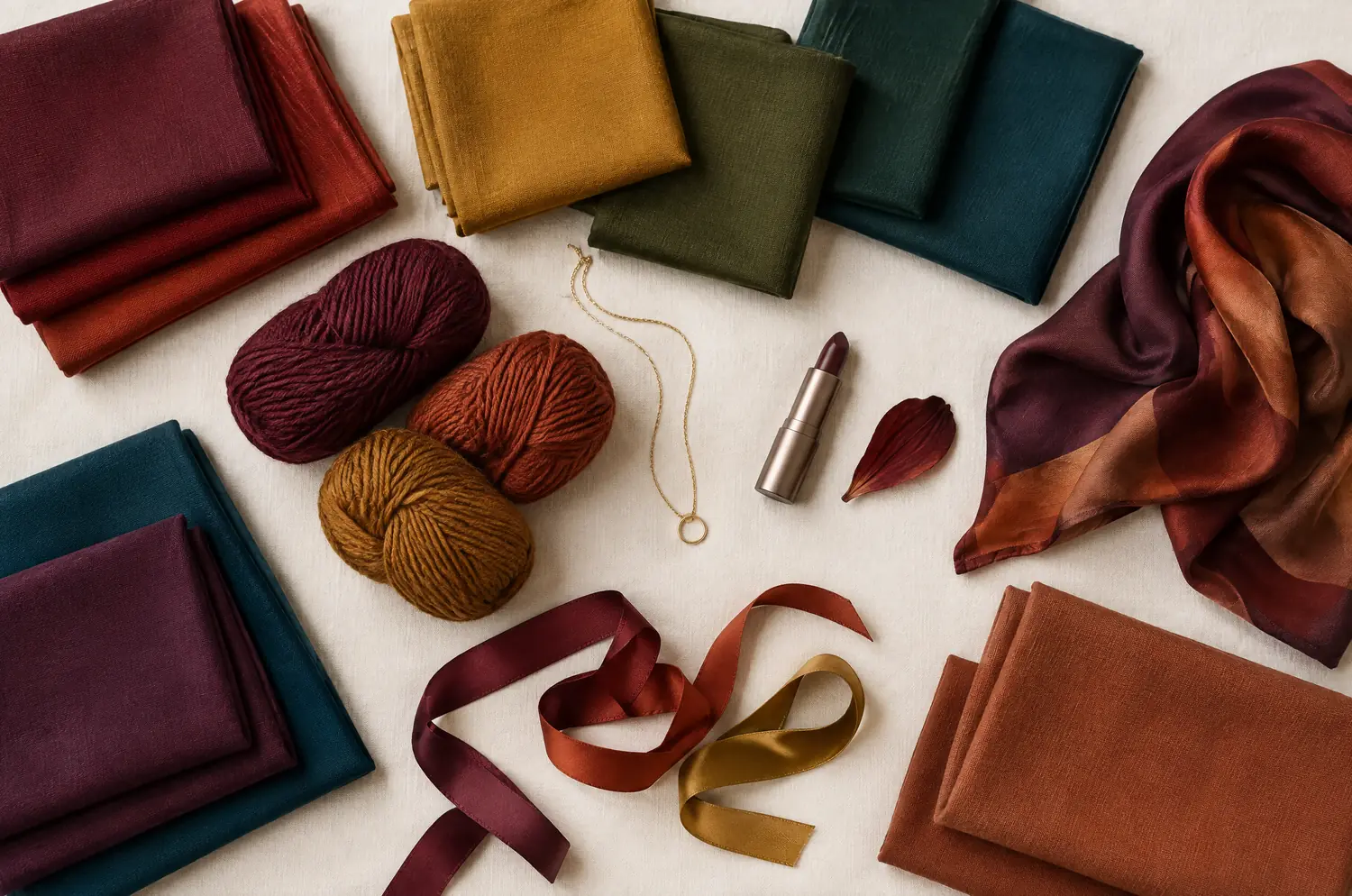
At a glance
Start here. A dot of color shows when the shade is one of your palette colors.
Black mascara.
Start with brick. It’s a red with warmth and depth in it, which suits a face that’s neutral to warm and high in contrast. Try it and watch your skin. The other reds of your Deep Autumn palette show you what to wear beside it.
Warm burgundy and warm plum are the wine family. Dark tomato red is the plain red of the group. Your contrast is high, so any of them can stand up beside your hair and eyes.
Mind the finish. Your coloring is rich and intense, so try a satin or a matte before a sheer tint, and blend the edge with a fingertip. Watch whether the color holds its own beside your hair and eyes.
Dark bronze, chocolate, eggplant and deep khaki. All four are warm and dark, and they keep the lid from looking bare next to your brows and lashes.
Pick one as the base and let a second deepen the outer corner. Bronze with eggplant is a good pairing to try. Chocolate with khaki is another.
Mascara is black. Liner can be black too. You handle black better than the other Autumns.
Want a gentler line? Smudge chocolate along the lashes. Skip pale, frosted lids. They have no weight next to your lashes.
Terracotta or soft brick. Both give the cheek a warm flush that matches your lips instead of competing with them.
Press the color on and build it in thin layers until it holds up beside your hair and eyes.
A bronzer follows your temperature, which is neutral to warm. Choose one with warmth in it, not a gray-brown. If a bronzer looks gray on you, try a warmer one.
The base follows your skin, not your palette. Test two shades on your jaw in daylight and keep the one you stop seeing.
Undertone, the tone under the surface of your skin, is what you’re matching. Yours leans neutral to warm. A base that pulls cool or pink will drag you toward Deep Winter and fight your lip.
Because lips and eyes carry the strength here, keep the base even and skin-like. A fair complexion with auburn hair and a deep one with espresso hair can both be Deep Autumn. The base changes. The warm, rich color on top does not.
Pull from the palette: Warm Burgundy, Dark Terracotta, Eggplant, Spruce Green. They’re as dark and warm as your lipstick, so hands and face look like one decision.
Spruce Green is the surprise worth trying. Dark Mustard is the playful one.
Baby Pink, Sky Blue, Pearl Gray and Cool Fuchsia are the four to leave on the shelf. They lack the weight your coloring carries.
The common trap is reaching for pastels to look softer. They wash you out. Your softness comes from terracotta on the cheeks or lips instead.
Black is allowed on you. Chocolate simply gives you more warmth, so try it on the liner and see which one your eyes prefer.
What to skip
Yellow gold, bronze, dark copper. Garnet, dark amber.
A direction, not a law: hold the metal near your bare face in daylight and watch your skin.
Too light or too cool: they don’t have enough weight for you.
#F8C8DC#BFE0F5#C9CCD3#C2187ANothing is off-limits. If you love one of these, wear it away from your face.
Keep exploring
The most intense Autumn: dark, rich colors with strong contrast.
Deep Autumn hair color is dark, warm and rich: chocolate, mahogany and deep auburn. Here is how to choose, what to skip and what to tell your colorist.
Bright Spring vs Deep Autumn: two differences matter, two things are shared, and a drape test with Bright Coral and Warm Burgundy settles where you land.
Deep Autumn vs Deep Winter share the same depth. Two things separate them: warmth and crispness. Here is how they look on a face and how to test it at home.
Soft Autumn vs Deep Autumn: three differences, what each looks like on your face, and a quick drape test to settle it if you sit somewhere between the two.
Warm Autumn vs Deep Autumn: four differences, a quick drape test, and how to read a result that sits between the two. Here is what each looks like on a face.
Questions
Brick, warm burgundy, warm plum and dark tomato red are your four. All are deep and warm-based. Try satin or matte first, since your coloring is rich and your contrast high, and compare a sheer one on the same lip. Check each shade by a window before you buy.
Yellow gold, bronze and dark copper are your direction, and garnet or dark amber stones sit well beside them. It’s a lean, not a law. If a silver piece looks fine on you, wear it, then check how your skin reads beside it.
Yes. Black mascara is on your list, and you handle black better than the other Autumns. Chocolate gives a warmer, softer line if black feels heavy. Keep the liner thin enough that your eyes stay the center of attention, not the line.
Compare Warm Burgundy with a cool burgundy under your chin. If the warm one wins, you lean Deep Autumn. The free color analysis quiz can suggest where to start, but it can’t see your skin react, and it can’t pick a lipstick. If depth is your doubt, read the Soft Autumn comparison.
You’ll find it on the Deep Autumn hair color page. It covers the browns and the deep auburn that agree with your coloring, plus notes on gray hair and on what to tell a colorist, so your hair and your makeup pull the same way.
Check it. The free quiz shows you your likely season in two minutes, and the two-color test on the palette page helps you tell it from its neighbor: a first hint, not a verdict.