
Lips
- Burgundy
- Cherry
- Plum
- Deep red
A dark lip comes naturally to you.
Deep Winter · makeup · also called Dark Winter
The “safe” nude? Not on a Deep Winter face. The dark lip is the easy choice. The pale one is the risk.
At a glance
Start here. A dot of color shows when the shade is one of your palette colors.
A dark lip comes naturally to you.
Black liner and mascara.
Applied lightly.
Because depth is your leading trait, and a lip with weight matches it.
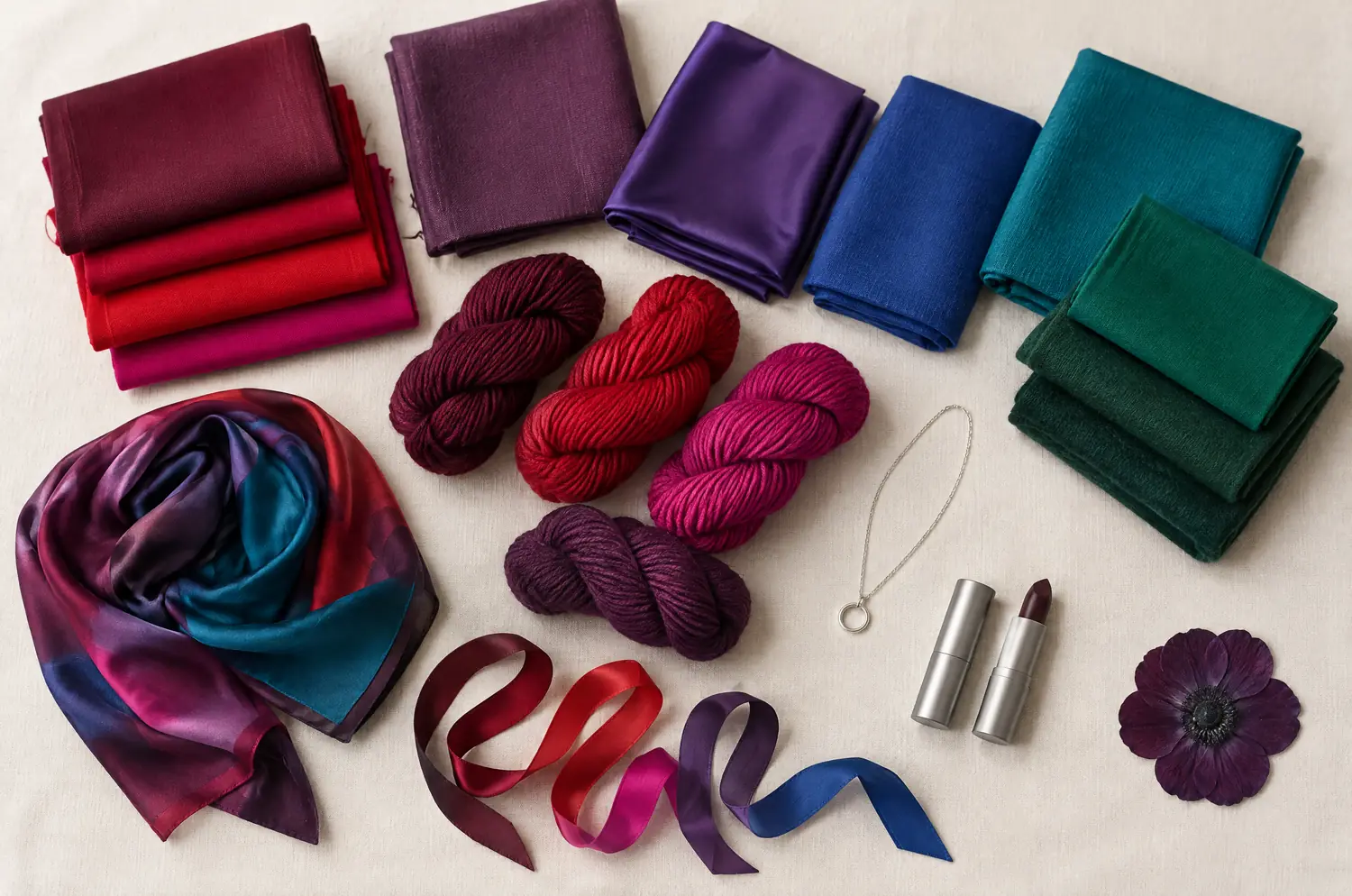
Your lip family is burgundy, cherry, plum and deep red. Pick one and try the others another day. If a dark mouth still feels like a leap, begin with the shade closest to a color you already wear.
Light, powdery colors make you look pale, so a pale nude is the one to test with care. For the finish, try matte or satin with a clean edge, and see if it matches the crisp, saturated feel of your coloring.
Your neighbor Deep Autumn wears warmer lips, brick and warm burgundy. Yours stay cool.
Unsure which side you’re on? The Deep Autumn against Deep Winter comparison walks through the drape test.
Black liner and black mascara are yours, and black is one of your neutrals.
Charcoal, plum, navy and deep cool brown are the shades to try. Hold each one near your eyes in daylight and keep the one that makes them look clearer.
If you reach for another eye shade, keep it in that cool family.
Raspberry pink, applied lightly, is the shade. With a dark lip and defined eyes, the cheeks play a supporting part.
Keep the hand light, as the shade itself asks. Add a little, look in daylight, and stop when the cheek looks lit rather than colored.
If you use a bronzer, keep it neutral to cool, the same temperature as the rest of you. Sweep it along the cheekbone. If it pulls golden, pick another.
Choose a base for the skin you have, not for the palette. Try two or three along the jawline in daylight and keep the one you can’t see.
What’s specific to you is the cast. Your temperature is neutral to cool, so check that the base doesn’t pull strongly golden or peachy against your neck. Here you’re matching your undertone, the tone under the surface of your skin.
Fair skin with black hair, olive skin and deep brown skin all show up in Deep Winter. The base changes from one face to the next. The dark, cool lip stays the same.
Then keep the base even and light-handed. Your color is concentrated in the lips and eyes, and a base that looks like skin lets them lead.
Stay inside the palette. Cool Burgundy, Cherry Red and Plum are a direction if you want your nails to echo your lips. Deep Violet, Midnight Blue and Emerald are there when you don’t want red.
Black is one of your neutrals, so black polish is fair game. Peach and golden beige are on your avoid list, so leave them on the shelf.
Golden Beige, Rust, Mustard and Peach are the ones to leave alone. Next to your coloring they turn the skin yellow and take away your crisp definition.
In makeup, keep warm and light tones away from your face. Powdery pastels belong on the list too, because they make you look pale.
If black feels like too much, don’t run to camel or warm brown to soften it: they dull you. Navy on the eyes or a burgundy on the lips lowers the volume without warming you.
Dressing around your makeup? The Deep Winter outfits page takes it from there, and the full Deep Winter palette shows every shade in one place.
What to skip
Silver, platinum, white gold. Onyx, garnet, sapphire.
A direction, not a law: hold the metal near your bare face in daylight and watch your skin.
Too warm or too light: they turn your skin yellow and take away your crisp definition.
#E6D2B0#A8451F#D4A017#FFCBA4Nothing is off-limits. If you love one of these, wear it away from your face.
Keep exploring
The darkest Winter: deep, crisp, very intense colors.
Deep Winter hair color means cool darks: black, very dark brown, cool dark brown. Here is how to choose well, what to skip and what to say to your colorist.
Deep Winter outfits from eight capsule pieces: what to buy first, formulas for office, weekend and evening, and how to wear the colors that don’t suit you.
Bright Winter vs Deep Winter: three differences, one shared cool base, and a quick drape test with Fuchsia and Cool Burgundy to find where you really land.
Cool Summer vs Deep Winter: all four axes differ. I show what each difference looks like on a face and how a quick drape test settles the question for you.
Deep Autumn vs Deep Winter share the same depth. Two things separate them: warmth and crispness. Here is how they look on a face and how to test it at home.
Questions
Burgundy, cherry, plum and deep red. A dark lip comes naturally to this sub-season, so you don’t have to treat it as a special-occasion move. Test one against your jaw in daylight, and pick the version that keeps your skin clear rather than yellow.
Yes. Black liner and black mascara are part of the makeup for this sub-season, and black is one of your neutrals. For eyeshadow, charcoal, plum, navy and deep cool brown are the place to start.
Silver, platinum and white gold are the direction for you, with onyx, garnet and sapphire as stones. Treat that as a lean, not a rule. Try a silver piece and a gold one under your chin, and see which keeps your skin looking clean.
Cool dark brown, black and very dark brown sit well with this palette. Golden and coppery tones work against it. The Deep Winter hair color page covers the shades, plus gray hair and how to brief a colorist.
Compare black with chocolate near your face, then a cool burgundy with a warm one. If the cool ones give you more definition, you lean Deep Winter. The free color analysis quiz shows you where to start, in ten questions. For the cool neighbor, read the Deep Winter against True Winter comparison.
Check it. The free quiz shows you your likely season in two minutes, and the two-color test on the palette page helps you tell it from its neighbor: a first hint, not a verdict.