
At the office
Black blazer, pure white shirt, charcoal pants, cool burgundy scarf
Deep Winter · outfits · also called Dark Winter
You stand at the mirror with a black coat on one arm and a camel one on the other. One sharpens your eyes. The other makes you look tired. You already know which.
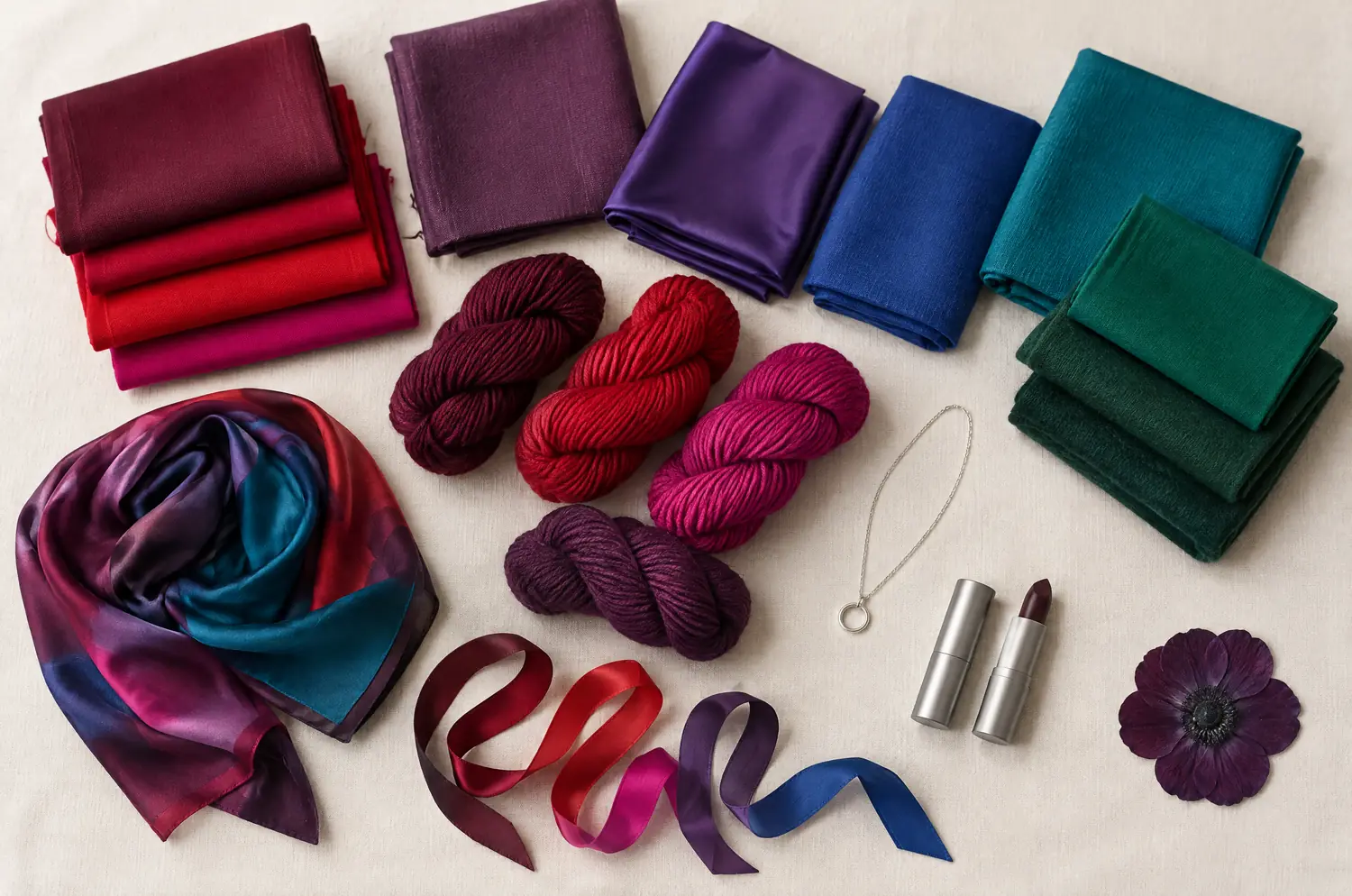
At a glance
Three outfits, the eight pieces to start with, and the pairings that always work.
Black blazer, pure white shirt, charcoal pants, cool burgundy scarf
Cool spruce green sweater, dark jeans, navy coat
Cherry red or deep violet dress, silver
Eight pieces to start with, all of them mix and match.
Crisp, high-contrast prints: black and white stripes, houndstooth, florals on a dark background. Smooth, dense fabrics: worsted wool, black leather, satin, velvet.
Start with the pieces closest to your face that carry the most contrast.
The black coat comes first. Black suits you, even near your face, so the coat frames you every time you step out. Then the black pants and the dark jeans: they anchor everything you put above them.
Next, the pieces that touch your chin. The pure white shirt gives you crisp definition. The charcoal T-shirt is the quieter choice for days when white feels like a lot.
The cool burgundy sweater comes fourth. It’s your signature color, and it does what a neutral can’t: it adds color without softening you. The full Deep Winter palette shows the family it comes from.
The navy blazer and the emerald dress come last. They lift an outfit rather than build one.
In my view, a capsule is a way of ordering, not of limiting. Each piece should work with at least two others.
Think in three parts: one or two neutrals, one color, one accent.
At the office, you wear a black blazer, a pure white shirt and charcoal pants. The cool burgundy scarf is the color, and it sits right where the outfit meets your face.
On the weekend, the cool spruce green sweater is the color. Dark jeans and a navy coat are the neutrals. Everything stays cool and dark, so nothing competes with your own contrast.
Evening is a dress and one metal. Pick cherry red or deep violet, then let silver be the only accent. A dark lip finishes it; the Deep Winter makeup page has the shades.
Two more you can build from the same pieces:
Each one keeps a dark element and a crisp element side by side. That’s what your face needs from an outfit.
Black is yours. So are charcoal, navy and pure white.
Use black where you want the most definition: the coat and the pants. Charcoal is the quieter base for pants and T-shirts. Navy suits the blazer and the coat, and it pairs well with pure white.
Pure white is not a color to fear. It’s crisp, and crisp is what you want.
The real mistake is running away from black. Camel and warm brown look like the gentle alternative, but they dull you. When you want a change, reach for cool burgundy, spruce green or navy instead.
You wear them away from your face, or you leave them.
They’re too warm or too light for you. Near your face they turn your skin yellow and take away your crisp definition. Warm earthy colors like rust sit closer to your neighbor, Deep Autumn. To see where the two split, read Deep Autumn against Deep Winter.
If you love one of them, move it down. Golden beige as pants, rust as shoes, mustard as a bag. Keep a cool dark piece between the color and your chin, then watch what the mirror says.
Light colors are a separate question. You can wear them, but make them icy: pure white, icy pink, glacier blue. Pair them with something dark so the contrast holds. Powdery pastels are the ones that make you look pale.
Look for crisp and dense.
Your prints are high-contrast: black and white stripes, houndstooth, florals on a dark background. Your fabrics are smooth and dense: worsted wool, black leather, satin, velvet. If you doubt a textured knit, hold it to your bare face in daylight and watch your skin.
The three pairings of your palette make a good shopping list: black with cherry red, navy with pure white and emerald, charcoal with plum. Buy one half of a pairing when you already own the other.
When a shade is close but not quite right, don’t return it right away. Wear it as pants, a skirt or shoes, where it doesn’t touch your face.
Before you buy, take the fabric to a window and hold it to your bare face. If you’re still unsure of your sub-season, the free color analysis quiz points you to a likely one in about two minutes. The PDF guide for Deep Winter isn’t out yet; you can join its waitlist.
What to skip
The base of your wardrobe: coats, pants, bags and shoes.
#0A0A0A#33363B#101B3A#FFFFFFToo warm or too light: they turn your skin yellow and take away your crisp definition.
#E6D2B0#A8451F#D4A017#FFCBA4Nothing is off-limits. If you love one of these, wear it away from your face.
Keep exploring
The darkest Winter: deep, crisp, very intense colors.
Deep Autumn vs Deep Winter share the same depth. Two things separate them: warmth and crispness. Here is how they look on a face and how to test it at home.
Deep Winter vs True Winter comes down to two axes: how dark you are and how cool. Here is what each looks like on a face and how to test it for yourself.
Questions
You don’t have to replace it, because black suits you. If you want variety, use charcoal, navy, cool burgundy or cool spruce green. Each one keeps the dark, cool base your face is built on.
Eight is a good place to begin. Past that, add a piece only when it joins outfits you already wear, not because it’s on sale.
Yes, if they are icy. Pure white, icy pink and glacier blue work for you. Put one next to a dark piece, such as navy or charcoal, so your contrast stays strong.
Try it with sweaters. With your hair covered, put on a cool burgundy one, then a warm burgundy, and watch your eyes and jawline. If the cool one keeps your definition, you lean Deep Winter. If the warm one wins, read Deep Autumn against Deep Winter.
No. Your palette stays the same. The reading is made on your skin and eyes with the hair covered, so gray or white hair doesn’t move you to another sub-season. For the hair itself, see the Deep Winter hair color page.
Check it. The free quiz shows you your likely season in two minutes, and the two-color test on the palette page helps you tell it from its neighbor: a first hint, not a verdict.