
Best hair shades for Cool Summer
- Ash tones: ash blonde
- Ash brown
- Cool brown
Gray or white hair looks naturally good on you.
Cool Summer · hair color · also called True Summer
“Any cool shade will do.” It won’t. A cool color can still be too icy or too harsh. Cool Summer hair color has to be cool and soft at the same time.
At a glance
The shades that go with your coloring, and the palette colors that sit next to them.
Gray or white hair looks naturally good on you.
Your palette, next to your hair
#C73866#E57BA2#E0607E#B5364F#A777B8#8E5A8E#9E8FD1#8FBDE3They’re cool, and they’re quiet. No gold, no flash. That suits your coloring: very cool, medium in depth, soft to medium in intensity.
Don’t read the three as separate looks to choose between by taste. Pick the one nearest to the color you grew, and move only within ash.
Hair color alone never puts you in a season or rules you out. Brunette, blond or red, the question is the same. The skin decides: with your hair covered, a cool raspberry should flatter you and an orange should muddy you.
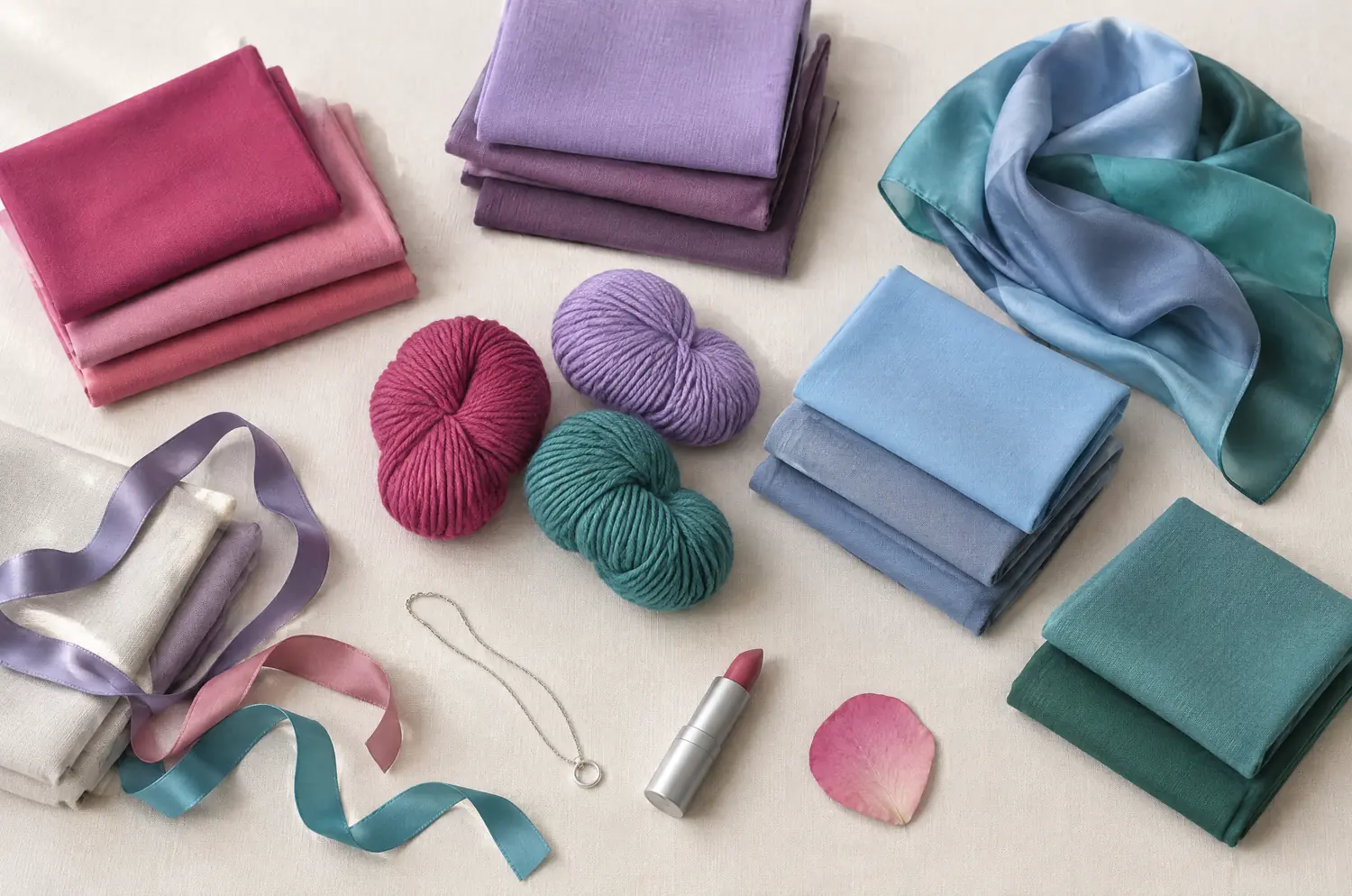
The Cool Summer palette shows the colors that will frame your hair: raspberry, mauve, denim blue. Look at them before you choose a shade.
Your season comes from your skin and your eyes, judged with the hair covered. So a dye can’t move you from one sub-season to another. Gray, dyed or untouched, you are the same Cool Summer.
But hair doesn’t stay covered in daily life. Whatever sits beside your cheek sends its color back onto your skin. A golden dye throws a yellow glow on a very cool complexion. An ash shade returns something calm and clean.
If your natural color is already ash or cool brown, you have nothing to correct. If it leans warm, the dye is where you decide.
Unsure that your skin is cool? The free color analysis quiz asks ten questions, with nothing to sign up for, and points to a likely season, which you then check with fabrics at your jaw.
When your hair changes, your lipstick may need a second look. The Cool Summer makeup page covers lips, eyes and blush shades, and what to skip.
Warming up the hair with gold or copper is the usual wrong turn. It feels friendly, but any orange-leaning color muddies your complexion, and copper sits in that family.
Black is a different problem. It’s too harsh for you, and your palette leaves it out for that reason. Next to your face, it competes instead of framing.
Take True Winter, your neighbor. It shares your coolness but carries more contrast and more saturation. You’re softer, so a hard, dense shade pulls against your face. If you can’t decide where you stand, the page on Cool Summer against True Winter has a drape test for that pair.
If your natural hair is very dark, cool brown keeps the depth with less weight than black.
Gray or white hair suits this sub-season naturally. It fits beside silver, white gold, platinum and the gray blues of your palette. Look at how your own gray sits next to those colors. If it leans cool, you may have no reason to cover it.
Highlights follow the base. Keep them ash and cool rather than golden, and blend them softly, since your intensity is soft to medium.
Say it in plain words, and print it if you like:
“I want a cool, soft ash brown, close to my natural level. No gold, no red, no copper. If you add highlights, keep them ash blonde and blend them softly.”
If you start lighter, swap “ash brown” for “ash blonde” and keep the rest.
Ask to check the result in daylight before you leave, because indoor light changes how a color reads. The Cool Summer PDF guide isn’t out yet, though you can join the waitlist on that page.
What to skip
Silver, white gold, platinum. Gray pearls, amethyst, aquamarine.
A direction, not a law: hold the metal near your bare face in daylight and watch your skin.
Too warm or too harsh: they clash with your cool undertone.
#F26B1D#E0A91E#B5542E#0A0A0ANothing is off-limits. If you love one of these, wear it away from your face.
Keep exploring
Cool made gentle: blues, pinks and raspberries without any harshness.
Cool Summer makeup comes down to cool tones and soft edges: raspberry lips, gray and plum eyes, cool pink cheeks. Here is what to try first and what to skip.
Cool Summer outfits built on eight pieces: navy, gray, raspberry and soft white, how to wear them, and what to do with orange and black. Start with navy.
Cool Summer vs Bright Winter: the three differences that matter, what each looks like on your face, and a drape test with Raspberry and Fuchsia to settle it.
Cool Summer vs Deep Winter: all four axes differ. I show what each difference looks like on a face and how a quick drape test settles the question for you.
Cool Summer vs Light Summer: all four axes differ, so the answer is on your face. Here is what each difference looks like and how to settle it at home.
Questions
A cool, soft ash: ash blonde, ash brown or cool brown. Choose the one closest to your natural level, since a moderate-contrast face doesn’t need a big jump. The hair should sit beside your skin without a trace of gold, so the whole face reads cool and calm.
Yes, if your skin says so. Blond hair doesn’t decide your season, and it doesn’t rule this one out. If you want to stay blond, ash blonde is the direction, and the same test applies: cover your hair, hold a raspberry near your face and see how your skin takes it.
Yes. Dark hair doesn’t close the door, and neither does a deep skin tone. What counts is how your skin handles cool, softened colors versus orange ones. If you color dark hair, cool brown keeps the depth without the weight of a harsh black.
Hair color alone never rules out a season, red included. Cover your hair and compare a raspberry with an orange-leaning red near your face. If the raspberry lights you up and the orange muddies your complexion, your skin is telling you something your hair isn’t.
Silver, mostly. Silver, white gold and platinum lean the right way for your very cool coloring. Take that as a direction, then hold one of each at your jaw. Keep the metal that makes your skin look clear and rested.
Check it. The free quiz shows you your likely season in two minutes, and the two-color test on the palette page helps you tell it from its neighbor: a first hint, not a verdict.