Free: the color analysis quiz. Find your season in 2 minutes →Free quiz: your season in 2 minutes →

Gold or Silver Jewelry for Your Skin Tone? Start With Your Season

Gold or silver jewelry for your skin tone? Your season points the way, and a test near your face confirms it. Metals for all 12 sub-seasons, in a table.

Lisa Routa, color analyst

By Lisa RoutaPublished · 9 min read

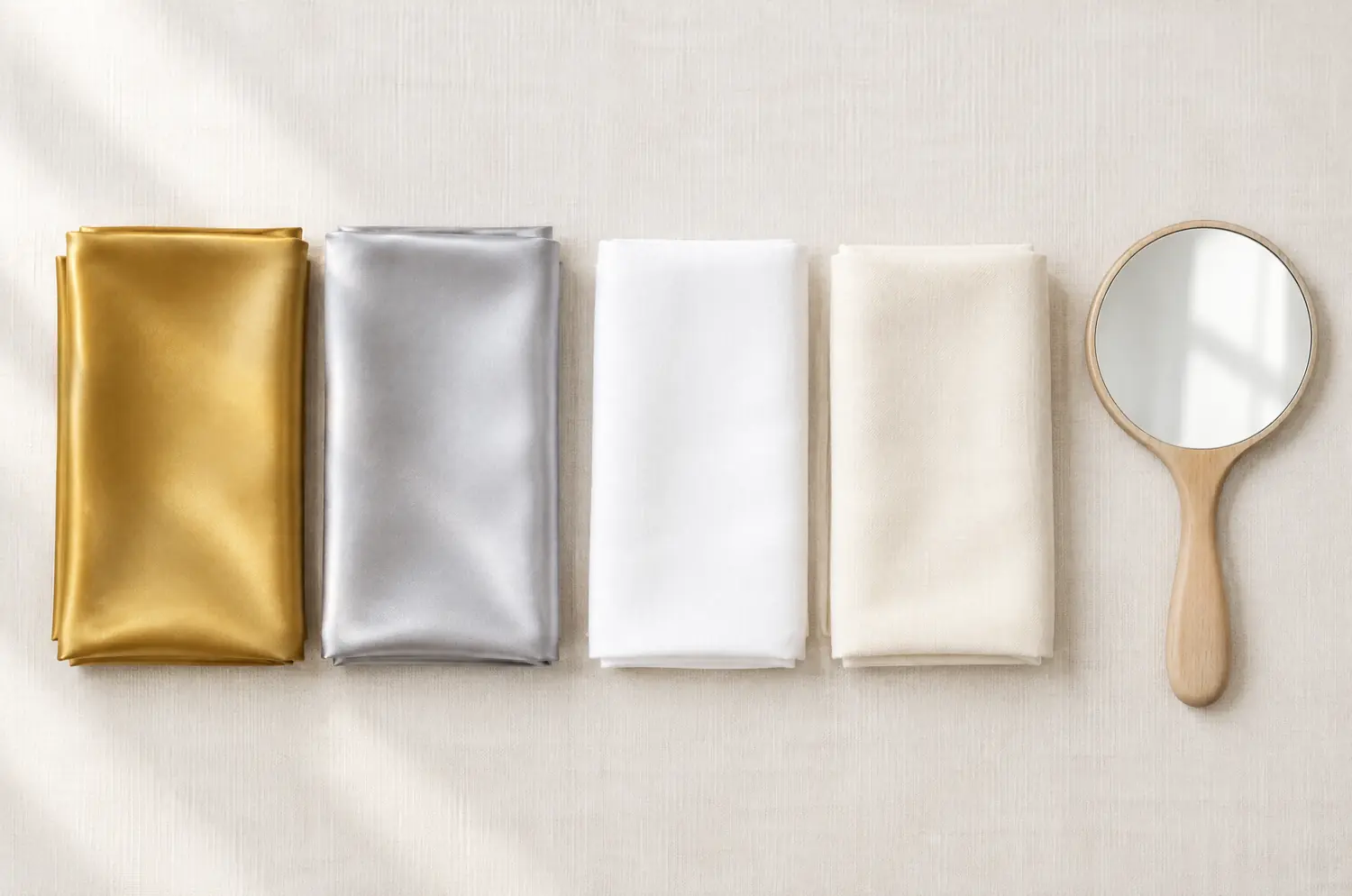
Folded gold, silver, pure white and off-white fabrics next to a wooden hand mirror, for testing your undertone at home
On this page10 sections
  1. Why can a metal change the way your face looks?
  2. Which metals go with which sub-season?
  3. Why does finish matter as much as the metal?
  4. What do Soft Autumn and Deep Winter show about the range?
  5. What if your undertone is neutral or olive?
  6. How do you run the jewelry test, and where does it fall short?
  7. Can you mix gold and silver in the same outfit?
  8. What if your favorite piece is the wrong metal?
  9. Your questions
  10. What you’ll notice when you clasp the chain

Take off your earrings and your necklace.

Find one gold piece and one silver piece. A chain, a hoop or a ring will do.

Gather your hair off your face, stand by a window and hold the gold piece under your chin. Stay still for a few breaths. Then do the same with the silver.

One of them may leave your face calm and even. The other may bring a shadow under your eyes, or a yellow or gray cast to your skin.

Note which one calmed your face.

Don’t decide yet.

A polished piece bounces light into your face, and your eyes tire fast.

Why can a metal change the way your face looks?

Metal near your face reflects its color back onto your skin. Yellow gold throws a warm glow. Silver and white gold throw a cool, clear one.

Skin that agrees with that glow looks rested. Skin that doesn’t looks flat, or tired.

The agreement depends on your undertone, the tone under the surface of your skin. If the word is new, read what undertone is first.

But undertone is only temperature, and temperature is one of three axes. The other two are lightness and intensity: how light or deep your coloring is, and how bright or soft.

That’s why “warm means gold, cool means silver” breaks down so fast. Two warm people can need different golds. A metal rule that ignores lightness and intensity misses two of the three axes.

Which metals go with which sub-season?

Every sub-season page lists its metals. Here they are side by side, grouped by family so the pattern shows.

Season Metals by sub-season Finish and stones
Spring Light Spring: light yellow gold, rose gold. Warm Spring: yellow gold, golden brass. Bright Spring: bright yellow gold Light: delicate pieces. Warm: cream pearls, turquoise, coral. Bright: graphic pieces, vivid stones
Summer Light Summer: silver, white gold, very pale rose gold. Cool Summer: silver, white gold, platinum. Soft Summer: brushed silver, rose gold, white gold Light: pearls, moonstone. Cool: gray pearls, amethyst, aquamarine. Soft: matte or satin finishes
Autumn Soft Autumn: matte gold, rose gold, soft copper, brushed brass. Warm Autumn: yellow gold, copper, bronze, brass. Deep Autumn: yellow gold, bronze, dark copper Soft: matte and brushed. Warm: amber, tiger’s eye, turquoise. Deep: garnet, dark amber
Winter Deep Winter and True Winter: silver, platinum, white gold. Bright Winter: shiny silver, platinum Deep: onyx, garnet, sapphire. True: diamond, sapphire, emerald. Bright: graphic pieces, brilliant stones

Now look at the neighbors. Soft Autumn and Soft Summer both carry rose gold. Deep Autumn takes yellow gold and Deep Winter takes silver: same depth, but Deep Autumn is warmer and Deep Winter cooler and crisper.

A metal is rarely the only thing that separates two neighbors. It’s one more place where they overlap.

Why does finish matter as much as the metal?

Read the last column again. The soft sub-seasons, Soft Autumn and Soft Summer, get matte, brushed or satin finishes. The bright ones, Bright Spring and Bright Winter, get shine and graphic lines.

That’s intensity at work. A soft coloring has no sharp edges, so a mirror-polished piece can sound louder than the person wearing it. A bright coloring is crisp, and a hazy finish can blur it.

Lightness shows up too. Light Spring gets delicate pieces and Light Summer very pale rose gold. Deep Autumn gets garnet and dark amber, and Deep Winter gets onyx, garnet and sapphire, stones as deep as the coloring itself.

My advice: if neither metal wins, change the finish before you change the metal. A brushed gold and a polished gold are two different tests.

What do Soft Autumn and Deep Winter show about the range?

Take two sub-seasons far apart.

Soft Autumn is neutral to warm, medium in lightness, very soft and desaturated. Its page notes you sometimes go back and forth between gold and silver. That makes sense, because neutral to warm sits between the two.

The answer there is matte gold, rose gold, soft copper and brushed brass. Not a high-shine yellow chain. Picture matte gold with a Soft Petrol Blue or Soft Eggplant dress, the evening pairing on that page.

Deep Winter (also called Dark Winter) is the other end: neutral to cool, dark, saturated, with high contrast. Its metals are silver, platinum and white gold, with onyx, garnet and sapphire. Think of Cherry Red or Deep Violet with silver, the evening look on its page.

Yellow gold isn’t on the Deep Winter list. Start with the metals that are.

Neither answer comes from hair or skin tone. A fair, olive, tan or deep skin tone can sit in Autumn or in Winter, so skin tone alone doesn’t choose your metal.

What if your undertone is neutral or olive?

Neutral and olive undertones don’t lean clearly warm or cool. That’s why a metal rule fails them first.

Look at where the data puts them. Soft Autumn, Deep Autumn and Bright Spring are neutral to warm. Soft Summer, Deep Winter and Bright Winter are neutral to cool. Their metals still differ: matte gold and rose gold for Soft Autumn, yellow gold and bronze for Deep Autumn, shiny silver and platinum for Bright Winter.

So neutral to warm doesn’t mean one metal, and neutral to cool doesn’t either. Lightness and intensity do part of the sorting.

Olive isn’t warm or cool by default. If you read olive, test yellow gold, silver and rose gold with the same care as anyone else, in daylight and with your hair covered. Then check the result against the metals on the page of the sub-season you suspect.

Warm undertones aren’t a single answer either. A Warm Spring leans to yellow gold and golden brass, a Warm Autumn to yellow gold, copper and bronze, and a Soft Autumn to matte gold and brushed brass.

How do you run the jewelry test, and where does it fall short?

Start with the quick version from the top, then slow it down.

  1. Tie your hair away from your face or wrap it in a plain cloth.
  2. Start with a clean face, or at least no blush or lipstick.
  3. Wear a plain, neutral top, or drape a cloth over what you have on.
  4. Face a window in the middle of the day and hold one piece under your chin at a time.
  5. Hold each piece long enough to see your skin settle, swap pieces and rest your eyes in between.
  6. Repeat with a second pair of pieces, then again on another day.

Watch the skin under your eyes, around your mouth and along your jaw. A metal that suits you evens everything out. One that doesn’t shows shadows, a sallow cast or a gray tint.

Now the limits.

Shine can fool you. A polished piece bounces light into your face, and you may be judging glare instead of color. If you own a matte piece in each metal, compare those too.

Size matters. A stud covers a tiny area, so hold a larger piece, like a chain or a cuff, up to your jaw.

Two metals are not enough. Rose gold, brass, copper and platinum all sit on the longer list above. If neither gold nor silver wins, you may belong with rose gold or a softer finish.

If the same metal keeps winning, you have a lean. Your eyes also adapt fast, so a test you rush can flip on the next try.

In my view, the jewelry test points you in a direction and goes no further. Veins and jewelry are the two tests that often mislead, as the warm vs cool undertone guide explains, and no single test settles it.

The same idea works with fabric. Color draping at home covers the setup and the order of colors.

Can you mix gold and silver in the same outfit?

“Never mix gold and silver.” People say it. You can mix them, with a little order.

Let one metal lead near your face: earrings, a necklace, a pendant. Let the second sit farther away, on a wrist or a finger. Repeat each metal at least twice, so the mix looks chosen and not accidental.

Add a bridge. A two-tone chain works. So does rose gold, which sits between yellow and white. It appears on the lists for Light Spring, Soft Summer and Soft Autumn, which makes it useful if you hover between Soft Summer and Soft Autumn.

Match the finish too. Three matte pieces in two metals blend better than one mirror-polished piece among matte ones.

Some examples from the metal lists:

  • Soft Autumn: matte gold earrings with a rose gold ring
  • Soft Summer: a brushed silver necklace with a rose gold ring
  • Deep Winter: silver earrings with a white gold ring

What if your favorite piece is the wrong metal?

Keep it, if it means something. A wedding band, a family piece or a gift can outrank a palette.

Sometimes the right choice is the one that serves your goal, not the one on your list. A meaningful ring is a good reason to break the rule.

Then move the work to the neckline. Wear a neutral or palette color closest to your face, such as Cream or Sage Green for a Soft Autumn, or Navy or Cool Burgundy for a Deep Winter. The cloth sits closer than a ring and covers more of your face’s surroundings than a pair of studs.

Before you buy anything new, hold it near your face in natural light at the store door. Then decide.

Your questions

How do I check my undertone with jewelry?

Hold a gold piece and a silver piece under your chin, hair covered, facing a window. Whichever one calms your skin points to a direction. Treat it as one clue, because shine and size can sway it. Add a second test, such as a white held against a cream, before you trust it.

Gold or silver if I’m neutral or olive?

It depends. Neutral and olive undertones don’t lean clearly one way, so the metal’s name tells you less than your season does. Run the chin test with yellow gold, silver and rose gold, hair covered, and note which one keeps your skin even. Repeat on another day.

Is gold off-limits if I’m a Deep Winter?

No. Nothing is off-limits. Silver, platinum and white gold lead on the Deep Winter page, so start there. A gold piece you love can stay in rotation: put a neutral or palette color at your neckline, and hold it under your chin once before you decide.

Can AI tell me my skin tone?

An app or AI can give you a rough guess from a photo, but it can’t watch your skin respond to a metal, and photo light shifts every color. Use it as a starting point, then test in person. The guide on where AI and apps go wrong explains why.

How do I find my color season?

Check your undertone, lightness and intensity, then hold colors under your chin one pair at a time, with your hair covered and your face clean. The step-by-step version is in finding your color season. Compare what you see across several days, not one sitting.

What you’ll notice when you clasp the chain

The next time you fasten a necklace, watch the skin under your eyes and along your jaw. When the metal suits you, your face looks rested and even, and the jewelry reads as part of you. When it doesn’t, you notice the chain before you notice the face.

Not sure where you land? Answer ten questions in the free color analysis quiz, no sign-up, about two minutes. You get a probable season and a page listing its metals, palette and makeup.

Then fasten the chain and watch the skin along your jaw. If it stays even and rested, the metal is working.

With all my heart and passion, Lisa

Free quizWhat’s your color season?10 questions, no sign-upTake the quiz

Go further

A closed cream booklet on linen, surrounded by fabric squares and paper chips in a pastel gradientPDF guides by sub-seasonOne guide for each of the 12 sub-seasons: palette, outfits, makeup and hair.Coming soon
A closed cream booklet on linen, surrounded by fabric squares and paper chips in a pastel gradient

Free

Get Lisa’s color advice by email

New articles from Lisa, and a note when the PDF guides open.

Keep reading

Read next

Seasons mentioned in this article

Ready to find your colors?

Take the free quiz for a first hint of your season, then explore the 12 seasons to see your palette.

Free quizThe 12 seasons