What Is My Color Season? How to Find It Without Guessing
What is my color season? Check undertone, depth and clarity, drape colors in natural light, avoid the common traps, then confirm it with the free quiz.
You’re in a fitting room. The light is flat and slightly green.
You hold a coral top up to your chin. Your friend says, “That’s so you.”
You look in the mirror. All you see is a shadow under each eye.
Last week a quiz told you you’re a Soft Summer. Today a sweater is telling you something else.
Nobody is lying. You’re all judging different things, in different light.
What does your closet already say?
Five checks get you to a likely season: your closet, undertone, depth, clarity, then the drape. The first one needs no mirror.
Open your closet. Which pieces still have tags on? Which colors bring compliments?
Which ones make people ask if you’re tired? Do you reach for black because it feels safe?
None of that gives you a season. It gives you something to test. In my view, your closet is the most honest evidence you have, because you made those choices before any method told you what to think.
How do you read your undertone when veins and jewelry mislead?
Undertone is the warm or cool cast beneath your skin’s surface color. Two people with the same skin tone can have different undertones. Two people with very different skin tones can share one.
Warm leans golden or peachy. Cool leans pink or bluish. Neutral sits in between, as neutral-warm or neutral-cool, and olive is a reading of its own.
You’ve probably heard the shortcuts. Blue veins mean cool, green veins mean warm. Gold suits warm, silver suits cool.
Veins are hard to judge, because they look different in different light and against different skin. And the metal you reach for often reflects habit or taste, not what your skin prefers.
Compare colors instead. With your hair tied back, hold a coral and then a bluish raspberry pink near your bare face. The coral is warm. The raspberry pink is cool.
The one that evens out your skin and softens the shadows under your eyes shows your lean. If both look fine, you may sit in the neutral middle.
How do you tell light from deep, and soft from bright?
These are the other two axes. Depth (also called lightness) is how light or dark your coloring looks as a whole. Clarity (also called intensity) is how saturated a color can be before it overpowers you.
For depth, look at your hair, eyes and skin together, never one of them alone. Hold a pale blue, then a dark navy blue. A light coloring wears the pale blue easily, while the navy sits on top like a heavy frame. A deep coloring does the reverse: the pale blue looks faint, the navy looks right. Medium depth can wear both.
Depth pulls you toward the light end (Light Spring, Light Summer) or the dark end (Deep Autumn, Deep Winter).
Clarity works the same way. Soft means muted, as if a little gray had been stirred in. Bright means clear and vivid. Hold a muted dusty pink, then a vivid hot pink. On a soft coloring, the hot pink takes over the face and the dusty pink melts in. On a bright coloring, the dusty pink can leave you looking dull while the hot pink wakes everything up.
Soft Summer is very soft. Bright Spring and Bright Winter are very bright. You may sit somewhere in between, and that’s fine.
How do you run the drape test, one pair at a time?
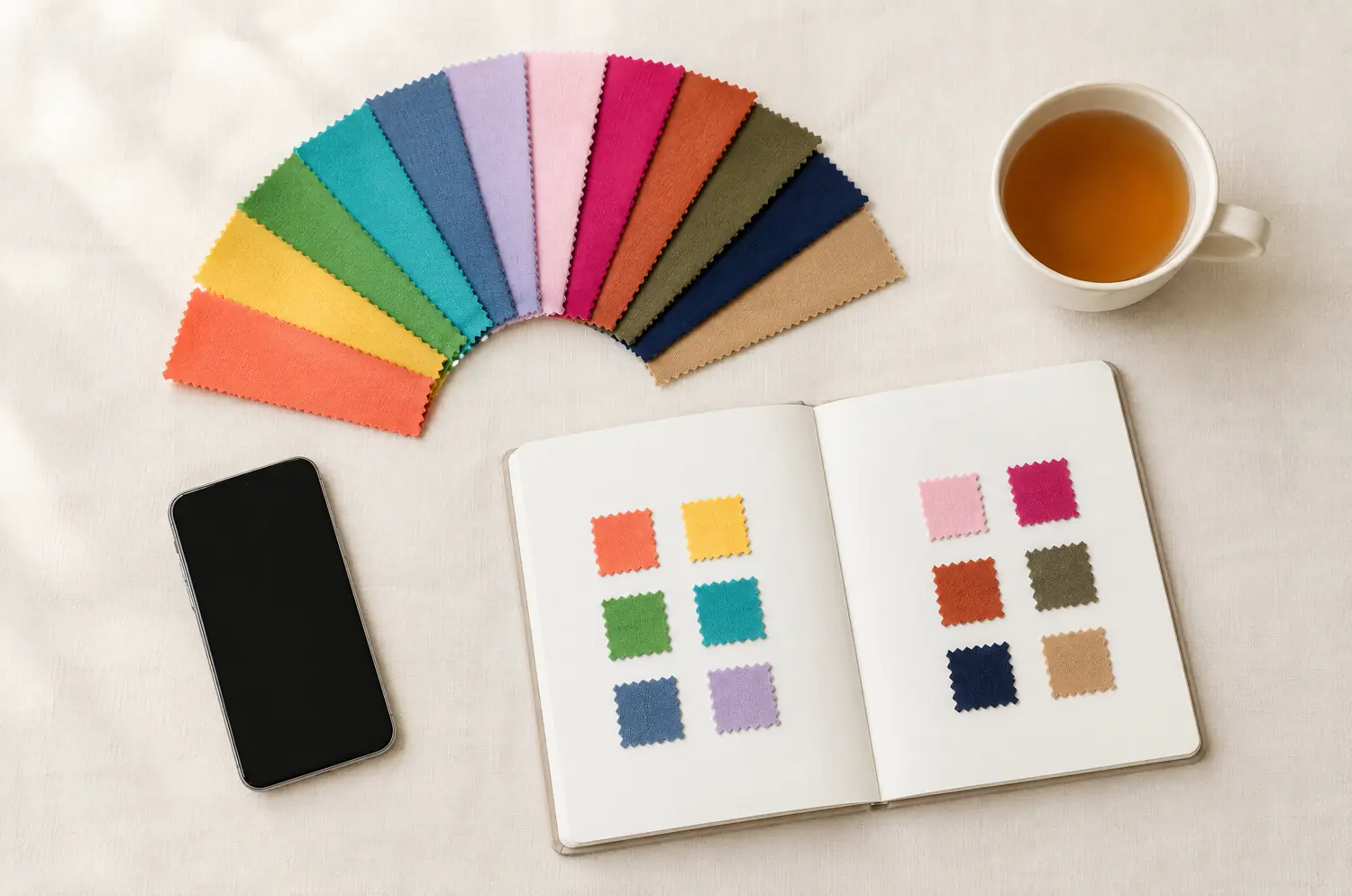
Draping means holding colors near your face and watching how your skin, eyes and shadows react. It’s the core of a professional analysis, and you can borrow its logic at home.
My advice: always compare pairs. One color alone tells you very little. Two colors side by side show a difference.
Wash off your makeup and stand facing a window, with indirect daylight on your face.
Tie your hair back and cover it with a plain white or light gray cloth.
Wear a plain neutral top, or bare shoulders. Hold one color at a time under your chin so it frames your face.
Look at your skin, your eyes and the shadows under them, not at the fabric.
Rest your eyes for a few seconds between tries by looking at something neutral.
Write down the winner of each pair, then redo the whole round the next day.
A winner evens out your skin, softens dark circles and gives your eyes some sparkle. A loser turns your skin gray or yellow and deepens the shadows.
Check
Compare
What the winner suggests
Temperature
A coral and a bluish raspberry pink
The coral leans warm, the raspberry pink leans cool
Depth
A pale blue and a dark navy blue
The pale blue leans light, the navy leans deep
Clarity
A muted dusty pink and a vivid hot pink
The dusty pink leans soft, the hot pink leans bright
Contrast
Your hair, eyes and skin side by side
Low, moderate or high: a clue, never the answer
You don’t need a stack of fabrics to begin. For setup, mirror and order of colors, see color draping at home.
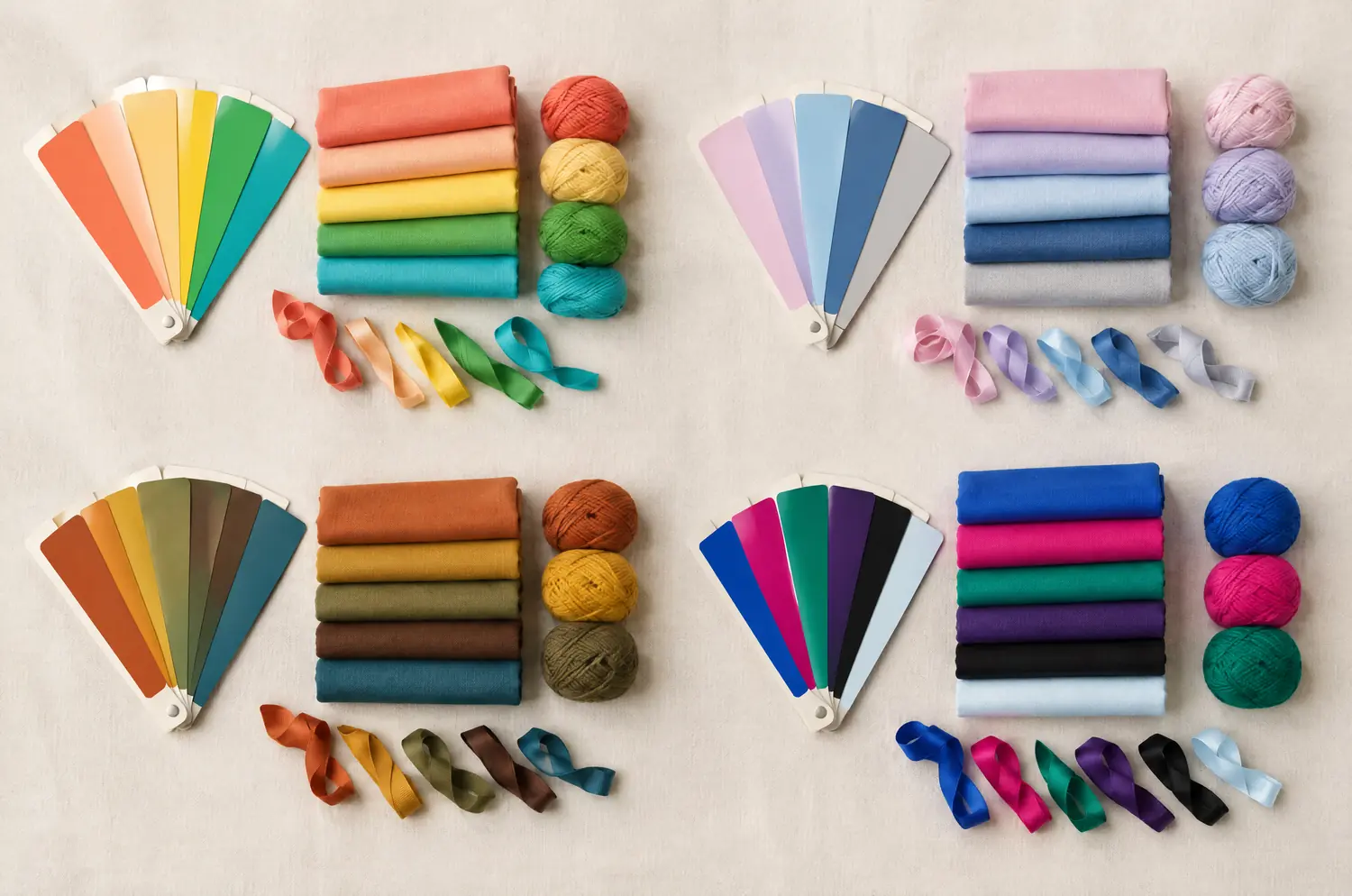
Then read your winners together. Warm, light and clear colors point to Spring. Cool, muted and light colors point to Summer. Warm, dark and muted colors point to Autumn. Cool, bright and dark colors point to Winter. Browse the twelve sub-seasons to see which page feels familiar.
What skews your result, and why doesn’t one trait settle it?
Most wrong answers at home come from the setup, not from you.
Testing with makeup on. Foundation and blush add their own color to your face.
Testing under a lamp. Artificial light shifts every color you hold up.
Wearing a colored top. It bounces its own color back onto your skin.
Choosing the color you love. Loving a color doesn’t mean it flatters you.
Stopping after one round. A single pass can mislead you.
Then there’s the shortcut that fails most often: judging by one trait. “Redheads are Autumns.” “Blondes are Summers.” “Deep skin means Winter.” None of them holds.
Hair, skin and eye color depend on systems that are partly independent, so they don’t travel as a set. A fair-skinned person can be a Winter. A deep-skinned person can be a Spring. I never place anyone from a single trait. During the drape, your hair stays covered because it reflects its own color onto your face.
Contrast, the gap between your hair, eyes and skin, is a useful clue. As a tendency, Spring and Summer lean low to moderate, and Autumn and Winter lean moderate to high. It adds to the picture and never decides alone.
What if you land between two seasons?
It happens, and it doesn’t mean you did anything wrong. Neighboring sub-seasons share two of the three axes.
Soft Autumn and Soft Summer, for instance, are both medium in depth and very soft. Temperature is what separates them: Soft Autumn is neutral to warm, Soft Summer neutral to cool. If your coral and raspberry pink round was a tie, that’s where you may sit.
Each sub-season page on this site names its neighbor, so you can read both and see which one matches your mirror. The logic behind all twelve is on the seasonal color analysis page.
I work with 12 sub-seasons, not 16. Splitting each season in four gives finer shades, but they’re harder to use day to day, and more shades means more places to get lost. Twelve are enough to be precise.
Quiz, photo app or analyst: what can each one tell you?
A quiz asks questions about your coloring. It can’t see your skin react to colors. The quiz on this site takes about two minutes, needs no sign-up and points to a likely season.
A photo tool works from a picture. The picture decides most of the outcome. Daylight, no filter, no makeup and hair covered give it something honest to read. A filter changes the colors before any tool sees them. Even then, the answer is a pointer. For the details, read about AI and your selfie.
A trained eye watches how your skin, eyes and shadows respond to each color, and picks a palette from what it sees. That’s the part no form can copy. It also explains why you can’t easily do it alone: you’re too used to your own face.
Questions people ask
How do I know what season my coloring is?
Work through temperature, depth and clarity, then hold pairs of colors near your bare face with your hair covered. Notice which ones even out your skin and brighten your eyes. Put the winners together and you get a direction. A quiz or a trained eye can then confirm it, since nobody sees their own face from the outside.
Is there a color that works in every season?
No color is safe for everyone, but most hues come in many versions. There are warm pinks and cool pinks, soft blues and electric blues. So don’t ask whether blue suits you. Ask which blue does. Hold two versions near your face and see which one smooths your skin.
Does hair color affect your color season?
It affects how your coloring reads, mostly through contrast, but it never decides your season. Hair reflects its color onto your face, which is why you cover it while you test. Your skin’s reaction comes first. After a big dye change, redo the drape, because your contrast may have shifted.
Will gray hair change my color season?
Not by itself. Going gray changes the contrast around your face, but your skin still decides. Cover your hair, repeat your pairs in daylight and see what your skin does. Skin and eyes shift slowly over time, so a fresh round now and then is reasonable.
Which AI does the best color analysis?
No ranking would hold up, because the photo matters more than the tool. It needs daylight, no filter, no makeup and your hair covered. Even then, one picture can’t show your skin react to colors held beside it. Treat any answer, whatever prompt you write, as a first hint.
Run one pair of colors today, then take the quiz
Take the first pair from the table above and run it today, hair covered, in plain daylight. Write the winner on a piece of paper.
Then take the free quiz. It asks ten questions and gives you a likely season with a sub-season hint. Compare it with your note. If they agree, open that season’s page. If they don’t, read both pages and hold the colors up again.