Free: the color analysis quiz. Find your season in 2 minutes →Free quiz: your season in 2 minutes →

What to Wear to a Wedding for Your Color Season

Wedding guest colors by season, from a Soft Autumn dress to a Soft Summer one. See which shades, fabrics and metals suit you, and which to leave on the rack.

Lisa Routa, color analyst

By Lisa RoutaPublished · 9 min read

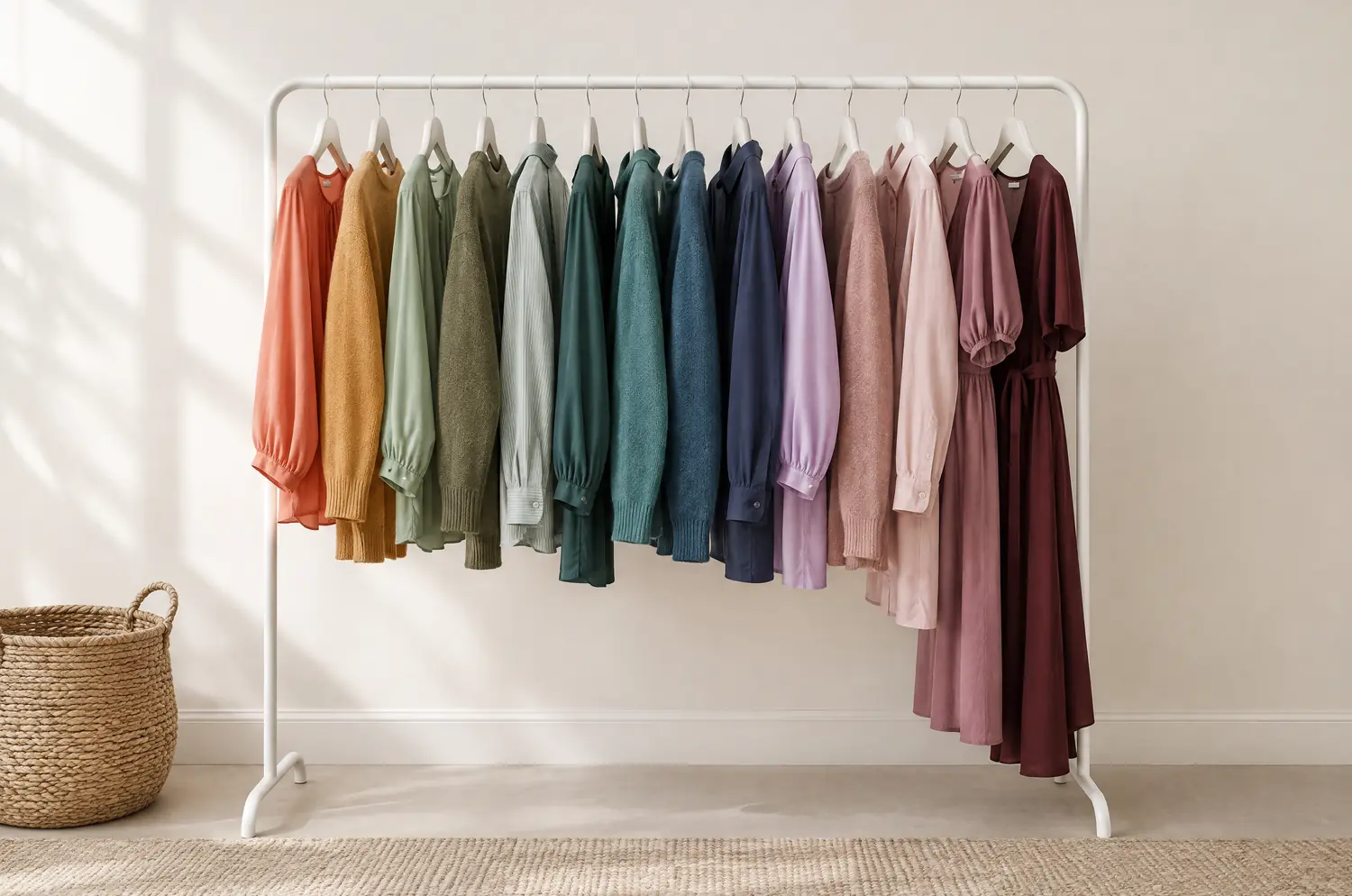
A clothing rack sorted by color, from warm shades to cool shades, in a bright room
On this page9 sections
  1. Why doesn’t the dress code choose your color?
  2. What should a Soft Autumn wear to a wedding?
  3. What changes in a Soft Summer dress, and how do the two neighbors compare?
  4. What do the other ten sub-seasons reach for?
  5. Which colors should you leave on the rack?
  6. What if the couple asks for a color you don’t wear?
  7. How do you test a dress before you buy it?
  8. Questions people ask
  9. Take your dress shade to a window today

People think the dress code picks your color.

It picks your hemline.

Your face picks the color.

Two decisions, not one.

“Cocktail attire” tells you how dressed up to be. It says nothing about whether a dress warms your skin or leaves a shadow under your chin. You find that out in the fitting room, under a bad light.

Why doesn’t the dress code choose your color?

Because a dress code is about the room. “Black tie,” “cocktail,” “garden party”: each one sets how formal you should be, and nothing more.

Color is about your face. The same cocktail dress can brighten your complexion in one shade and drain it in another.

So split the decision in two. The dress code picks the cut, the length and the fabric. Your palette picks the shade.

Inside your palette, depth gives you room to move with the hour. Lighter, softer shades suit an afternoon ceremony. Deeper ones suit an evening reception.

Your season doesn’t change between the two. You just walk along your own palette. The same logic works for a gala, an anniversary dinner or a christening.

In my view, a palette is a starting point, not a uniform.

What should a Soft Autumn wear to a wedding?

Soft Autumn is neutral to warm, medium in depth, very soft and desaturated, with low to moderate contrast. In plain words: your colors look warm but filtered, like wheat, sage and clay seen at the end of a summer day.

A Soft Autumn dress is a quiet dress. Bright colors make you look like you’re wearing a costume, and a wedding is a room full of cameras.

For a daytime wedding, reach for:

  • Sage Green
  • Soft Salmon
  • Warm Dusty Rose
  • Faded Peach

For an evening wedding, go deeper:

  • Soft Petrol Blue
  • Soft Eggplant
  • Grayed Teal
  • Smoky Plum

Light Terracotta is your signature color. A dress in that shade works at a barn wedding, a vineyard or a backyard, because it looks lit from within without shouting.

Fabric matters as much as the shade. Your palette likes matte, textured materials: linen, suede, cable knit, corduroy. For a wedding, that means a linen dress by day, and suede shoes or a suede clutch at night. A glossy, high-shine fabric works against the softness of your coloring.

Prints stay natural and blended: foliage, faded flowers, soft plaids. For metal, choose matte gold, rose gold, soft copper or brushed brass.

Makeup follows the same logic: rosy peach, apricot or warm rosewood on the lips, soft bronze or moss green on the eyes, and brown mascara.

One trap: Cream is one of your neutrals, and it’s lovely as a shirt or a shawl. As a full dress at a wedding, it can read as bridal. Keep it as the supporting layer.

For a Soft Autumn man: a Warm Taupe suit, a Cream shirt and a Sage Green tie. Chestnut or Khaki shoes and belt do better than black. For a Soft Summer man: a Grayed Navy suit, an Off-White shirt and a Dusty Rose tie. The color analysis for men article follows the same twelve seasons for shirts, suits and ties.


What changes in a Soft Summer dress, and how do the two neighbors compare?

Soft Summer is the neighbor. It shares the softness, and its base is cooler: neutral to cool, medium in depth, very soft and grayed, with low contrast. Think of a beach at the end of the day: pebbles, driftwood, heather.

For a daytime wedding, a Soft Summer dress can be:

  • Tea Rose
  • Cool Sage
  • Gray Lavender
  • Gray Blue

For an evening wedding:

  • Soft Plum
  • Soft Burgundy
  • Slate Blue
  • Grayed Mauve

Dusty Rose is your signature color. And here is some good news for a formal event: gray suits you very well. A Dove Gray dress with a Dusty Rose wrap is one of your pairings, and it makes a calm, complete outfit.

Your fabrics are soft and matte: cashmere, boiled wool, washed linen, fine velvet. Fine velvet suits a formal evening reception.

Prints should be quiet, like faded florals or tone-on-tone stripes. Your metals are brushed silver, rose gold and white gold, in matte or satin finishes.

Soft Summer has a classic trap. Your palette can feel sad on a hanger, so you add a bright color to cheer it up. Then people see the bright color, not you.

Here is how the two compare side by side.

Soft Autumn Soft Summer
Temperature Neutral to warm Neutral to cool
Daytime dress Sage Green, Soft Salmon Tea Rose, Cool Sage
Evening dress Soft Petrol Blue, Soft Eggplant Soft Plum, Slate Blue
Metals Matte gold, rose gold Brushed silver, rose gold
Fabrics Linen, suede, cable knit Cashmere, washed linen, fine velvet
Leave on the rack Black, optic white, fuchsia, electric blue Black, bright orange, bright yellow, electric fuchsia

If you go back and forth between the two, you’re not doing it wrong. They touch.

Try one evening pair: Soft Eggplant against Soft Plum, then matte gold earrings against brushed silver ones, both held near your face. The side that smooths your skin is your direction. The color draping at home guide explains the setup.

What do the other ten sub-seasons reach for?

Your sub-season may not be either of those two. Here is a starting point for the rest, all taken from each palette. The twelve sub-seasons each have their own page with the full set of shades.

  • A Light Spring can go Peach or Mint by day, Light Periwinkle at night.
  • A Warm Spring has Coral and Meadow Green, then Poppy Red.
  • A Cool Summer reaches for Cool Sky Blue, then Raspberry.
  • A Warm Autumn wears Terracotta or Olive Green, then Petrol Blue.
  • A Deep Winter goes from Royal Blue to Cool Burgundy or Midnight Blue.
  • A Bright Winter moves from Azure Blue to Shocking Pink.

Notice how the same idea of “pink” changes. It’s Tea Rose on a Soft Summer, Warm Dusty Rose on a Soft Autumn and Shocking Pink on a Bright Winter. Same hue family, three very different dresses.

Which colors should you leave on the rack?

Start with white. At a wedding, white and ivory are best left to the bride, so check with the couple. That’s a courtesy point, not a palette one. It happens to line up for Soft Autumn, where optic white is already on your avoid list.

Then look at your own list. For Soft Autumn it’s black, optic white, fuchsia and electric blue: too sharp or too cool, they break the blended harmony of your coloring. For Soft Summer it’s black, bright orange, bright yellow and electric fuchsia: too saturated, they overpower the softness of your face.

A few other lists, for comparison. A Warm Spring does not do well in Cool Fuchsia or Blue Gray. A Deep Autumn looks drained in Baby Pink or Sky Blue. A Deep Winter loses color in Golden Beige, Rust, Mustard and Peach.

Black deserves its own line. It’s a true neutral for the Winters, so a black dress is a fine choice for them. For Soft Autumn, Soft Summer, Light Spring, Warm Spring, Light Summer, Cool Summer and Warm Autumn, it sits on the avoid list. Soft Autumn does better with Chestnut or Khaki. Soft Summer does better with Grayed Navy and Off-White. My advice: if you want a darker anchor for an evening wedding, look at your neutral colors by season before you reach for black.

Nothing is off-limits, though. If a black dress is the one that makes you feel ready to walk into that room, wear it. Then bring a shade from your palette up to your face: a wrap, earrings, a lip color. The color closest to your face does the talking.

What if the couple asks for a color you don’t wear?

It happens. The invitation says “dusty blue and sage,” or “jewel tones,” and your palette doesn’t quite agree.

You have three moves. First, look for your own version of the hue. Sage Green belongs to Soft Autumn, and Cool Sage to Soft Summer. Same family, different base. Second, wear the requested color away from your face: shoes, a clutch, a jacket worn open. Third, let the day decide. If you’re giving a toast, or you want to disappear into the theme, the color that serves that goal can beat the color in your palette.

Skip the one move that backfires: forcing a shade just because it matches the table linens. Nobody photographs the linens next to your face.

How do you test a dress before you buy it?

My advice: take the decision out of the fitting room and decide in daylight. Here’s how.

  1. Sit by a window, with no makeup on and your hair tied back or covered.
  2. Hold the dress, or a piece of fabric in the same shade, under your chin.
  3. Watch what happens to your skin. Do dark circles soften, and does your skin even out? Or does a shadow settle under your jaw and your skin turn gray or yellow?
  4. Hold a second shade next to it and compare. Two colors side by side tell you more than one alone.
  5. Redo it another day, at another hour.

Neckline matters more than people think. A color only works on your face if it sits close to it. A strapless dress puts the shade far from your face, so the earrings, wrap or lipstick have to carry your palette.

Makeup also changes the picture, so test bare and then add your lip. Finally, remember that candlelight and string lights at the reception will warm things further. Choose your color in daylight, and let the venue do what it does.

Questions people ask

What’s the quickest way to work out my season?

Start with the ten-question quiz for a likely season. Then check it against two shades near your face, since only your skin can confirm it.

What colors are for all seasons?

None, strictly. Every hue comes in several versions, and each version belongs to a different palette. Pink is a good example: Dusty Rose, Warm Dusty Rose and Shocking Pink are three different answers. The useful question is which version of a color is yours.

Does hair color affect color season?

Hair is one clue among several. Two people with the same hair can belong to different seasons, because skin and eyes carry just as much weight. Hair color alone never rules a season in or out.

Will gray hair move me into another season?

Not by itself. Your season is read from how your skin and eyes react to colors, not from your hair. If your hair has changed, retest with it covered, and compare shades in pairs near your face. Gray or white hair looks naturally good on a Cool Summer and a True Winter.

Can a Soft Autumn wear black to a wedding?

Yes, nothing is forbidden. But black looks harsh on a Soft Autumn, so it works against the soft blend of your coloring. Chestnut, Soft Eggplant or Soft Petrol Blue suit your coloring and run deeper than your daytime shades. If you do choose black, add a warm shade near your face.

Take your dress shade to a window today

Pick two things from your closet in the shades you’re considering, or two fabric scraps. Carry them to a window and hold each one under your chin. Keep the one that brings out your eyes and evens out your skin.

The PDF guides, one for each sub-season, aren’t out yet, and I don’t have a date to give you. You can join the waitlist from the guides page.

With all my heart and passion, Lisa

Free quizWhat’s your color season?10 questions, no sign-upTake the quiz

Go further

A closed cream booklet on linen, surrounded by fabric squares and paper chips in a pastel gradientPDF guides by sub-seasonOne guide for each of the 12 sub-seasons: palette, outfits, makeup and hair.Coming soon
A closed cream booklet on linen, surrounded by fabric squares and paper chips in a pastel gradient

Free

Get Lisa’s color advice by email

New articles from Lisa, and a note when the PDF guides open.

Keep reading

Read next

Seasons mentioned in this article

Ready to find your colors?

Take the free quiz for a first hint of your season, then explore the 12 seasons to see your palette.

Free quizThe 12 seasons