Laundry Symbols and What They Mean on Your Care Label
Laundry symbols explained: the tub, triangle, square, iron and circle on a US care label, and what each dot, bar and cross means before you wash anything.
That’s what the row of tiny drawings on your clothing tag usually gets.
Then the sweater comes out a size smaller.
The blouse loses its drape.
The dress isn’t the one you bought anymore.
Those drawings aren’t a puzzle. They’re a short language, and once you know its five shapes you can read almost any label.
What is on a US clothing label, and in what order?
Look at the tag inside the garment. On a US label you find four things.
The fiber content, by weight, for example “60% cotton, 40% polyester.”
The care instructions, in words or in symbols.
The country of origin: “Made in…”
The maker, shown as a company name or an RN number, a registration number the FTC gives to US businesses.
Federal law asks for these. The Textile Act covers the content, the maker and the origin of imports. The Care Labeling Rule covers the care.
The care instructions can be words, symbols or both. Symbols are optional when the instructions are also written on the label. So a tag with no drawings is not a mistake, and a tag with only drawings is following the rules too.
When symbols appear, they come in a row. Washing, bleaching, drying, ironing, professional cleaning. Read from left to right and you never lose your place.
Three habits decode most of the row:
Dots count heat. More dots, more heat.
Bars ask for gentleness. More bars, a gentler cycle.
A line through a symbol, or a solid black shape with an X, says no.
What do the tub, its dots and its bars mean?
The tub is a small drawing of a washbasin. It covers everything that happens in water.
A plain tub means machine wash. A hand inside the tub means hand wash only. On US labels the hand-wash symbol may only be used with 105°F (40°C) or 85°F (30°C) water.
The dots inside the tub give the maximum water temperature.
Dots in the tub
Water
Maximum temperature
One
Cold
85°F (30°C)
Two
Warm
105°F (40°C)
Three
Hot
120°F (50°C)
Four
Hot
140°F (60°C)
Up to six
Hotter still
200°F (95°C) at six
The dots give the maximum water temperature. It’s a ceiling, not a target.
Bars under the tub set the cycle.
One bar: permanent press cycle, a gentler cycle meant for synthetics.
Two bars: delicate or gentle cycle, the one wool asks for.
Two symbols say no. A crossed-out tub means the garment must not be washed in water, which is often the case for wool, silk and leather. A crossed-out twisted cloth means do not wring, neither by hand nor with a roller wringer.
Put it together. A tub with one dot and one bar reads “machine wash cold, permanent press cycle.” A tub with two dots and two bars reads “machine wash warm, delicate cycle.”
Which bleach can you use on a triangle?
The triangle is about bleach. It has only three states, so it’s the easiest family to learn.
An empty triangle: bleaching is allowed, any bleach, when needed.
A triangle with two diagonal lines: gentle bleaching only. Use non-chlorine bleach, also called oxygen bleach. No chlorine bleach.
A solid black triangle with an X: no bleaching at all, neither chlorine nor oxygen bleach.
The solid black triangle is the one to spot first. It shuts the door on every bleach.
How do the square and its circle work?
The square is about drying. The circle inside it means the tumble dryer.
Drying symbol
What it means
Square with a circle
Tumble dry allowed, any heat
One dot in the circle
Low heat
Two dots in the circle
Medium heat
Three dots in the circle
High heat
Solid black circle
No heat, air only
Square with a crossed-out circle
Do not tumble dry
Bars work here too. One bar under the square asks for the permanent press cycle. Two bars ask for the delicate or gentle cycle.
If the square has no circle, the label is talking about drying without a machine. Four marks cover it.
A curved line at the top: line dry. Hang the garment damp from a line or a bar.
Three vertical lines: drip dry. Hang it dripping wet.
One horizontal line: dry flat. Lay it out horizontally.
Diagonal lines in a corner: dry in the shade. This one is added to the other three.
Notice that the dryer symbols give no degrees. The US chart does not give any, so low, medium and high are all you get.
What do the iron’s dots say?
The iron is the drawing of an iron, and the dots are the maximum heat setting.
Iron symbol
Heat
Fibers it’s paired with
One dot
Low, 230°F (110°C)
Synthetic fibers
Two dots
Medium, 300°F (150°C)
Wool, silk, rayon
Three dots
High, 390°F (200°C)
Linen, thick cotton
Crossed-out iron
Do not iron
The iron symbol on its own means dry or steam ironing. If you see lines crossed out under the iron, that means no steam, in any form.
For polyester, my advice is light ironing. The label of your garment decides.
What does the circle ask of a dry cleaner?
The circle is professional cleaning. An empty circle means dry cleaning is allowed. A crossed-out circle means do not dry clean.
A letter inside the circle is a note for the cleaner, not for you. It names the solvent.
A: any solvent.
P: any solvent except trichloroethylene.
F: petroleum solvent only.
Short lines at the edge of the circle add extra instructions, such as a short cycle, reduced moisture, low heat or no steam finishing.
Newer labels may drop the A and add a W, which stands for professional wet cleaning.
For you, two readings are enough. Empty circle: a cleaner can handle it. Crossed-out circle: keep it away from one.
Where does the label end and my advice begin?
The label of your garment always comes first. If the tag says one thing and I say another, follow the tag.
My own care lines per fiber are advice, and several are stricter than what manufacturers print. Here are four for fibers you meet often on labels.
Fiber
Machine wash
Dryer
Ironing
Polyester
85°F (30°C)
Low heat
Light ironing
Rayon (viscose)
85°F (30°C)
Avoid
Gentle ironing
Wool
Wool cycle or cold wash
Dry flat
Gentle, with steam
Silk
Hand wash or dry cleaning
Avoid
Gentle, on the wrong side
Rayon deserves a word, because the name on the tag may surprise you. On a US label, viscose is labeled “rayon,” and “viscose” is also allowed. Modal and lyocell are types of rayon. If you want to know how each one feels and wears, read what viscose is, how modal behaves and what lyocell and Tencel are.
What if a label looks different from this?
It happens. Clothes made outside North America may use other symbols, for example a number in the tub instead of dots.
When a symbol puzzles you, go back to the three habits near the top: heat, gentleness, no.
If you’re still unsure, my advice is to check the fiber lines above, and the label of your garment always comes first.
Frequently asked questions
What do the dots in the washing symbol mean?
Dots set the ceiling for the water. One means cold, two mean warm, and hot starts at three, with every extra dot allowing more heat. The dots are a maximum: cooler stays within the label, hotter does not.
What does a square with a circle mean on a clothing tag?
It is the tumble dryer. A plain circle in the square means the dryer is allowed at any heat. Dots narrow it down: one for low, two for medium, three for high. A solid black circle means air only, and a crossed-out circle means skip the dryer.
What does a crossed-out triangle mean?
Look at what’s drawn inside the shape. Solid and crossed with an X, it rules out every bleach. Two diagonal lines leave only the oxygen kind. Empty, it leaves the choice to you.
What does the iron symbol with one dot mean?
It’s the low setting, the one that goes with synthetic fibers. Dots on the iron are the maximum heat, so stay at or under it. If the whole iron is struck through, skip ironing. Struck-through lines beneath it mean no steam, in any form.
What does a circle with a letter inside mean?
That letter is written for the dry cleaner, not for you. It tells the cleaner which solvent is allowed: A for any, P for any except trichloroethylene, F for petroleum only. A newer label may show a W instead, meaning professional wet cleaning.
Are care labels required on clothes in the United States?
Yes, for clothing. The Care Labeling Rule covers textile wearing apparel, and the label must be permanent, stay legible and be visible when you buy.
It has to say whether to wash by hand or by machine. Shoes, gloves and hats are exempt. Symbols are optional when words are also on the label.
Read one label tonight, then wash with it
Pick a garment you wash on autopilot. Turn it inside out and find the row of symbols. Say them out loud in order: tub, triangle, square, iron, circle.
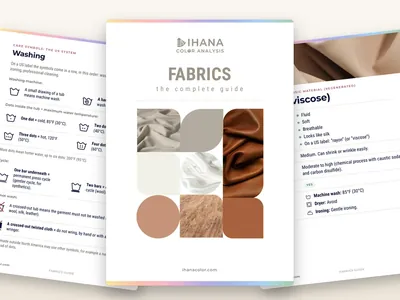
Then compare the row with how you usually wash and dry that piece. If a label has ever left you guessing, or a sweater came out of the wash smaller, my Fabric Guide is made for that. It helps you read labels, care for your clothes without guessing and choose fabrics you feel good in.
Does your usual routine match the row? Judge for yourself.
With all my heart and passion, Lisa
Go further
Fabric Guide (PDF)Know what a fabric will do in the wash and on your skin before you buy it.$19.99See the guide