
Best hair shades for Soft Summer
- Ash brown
- Ash dark blonde
- Soft brown
Very blended highlights rather than strong contrasts.
Soft Summer · hair color
The most flattering hair on a Soft Summer is the hair nobody remarks on. Quiet. Ashy. A little blended. If people notice the dye first, it went too far.
At a glance
The shades that go with your coloring, and the palette colors that sit next to them.
Very blended highlights rather than strong contrasts.
Your palette, next to your hair
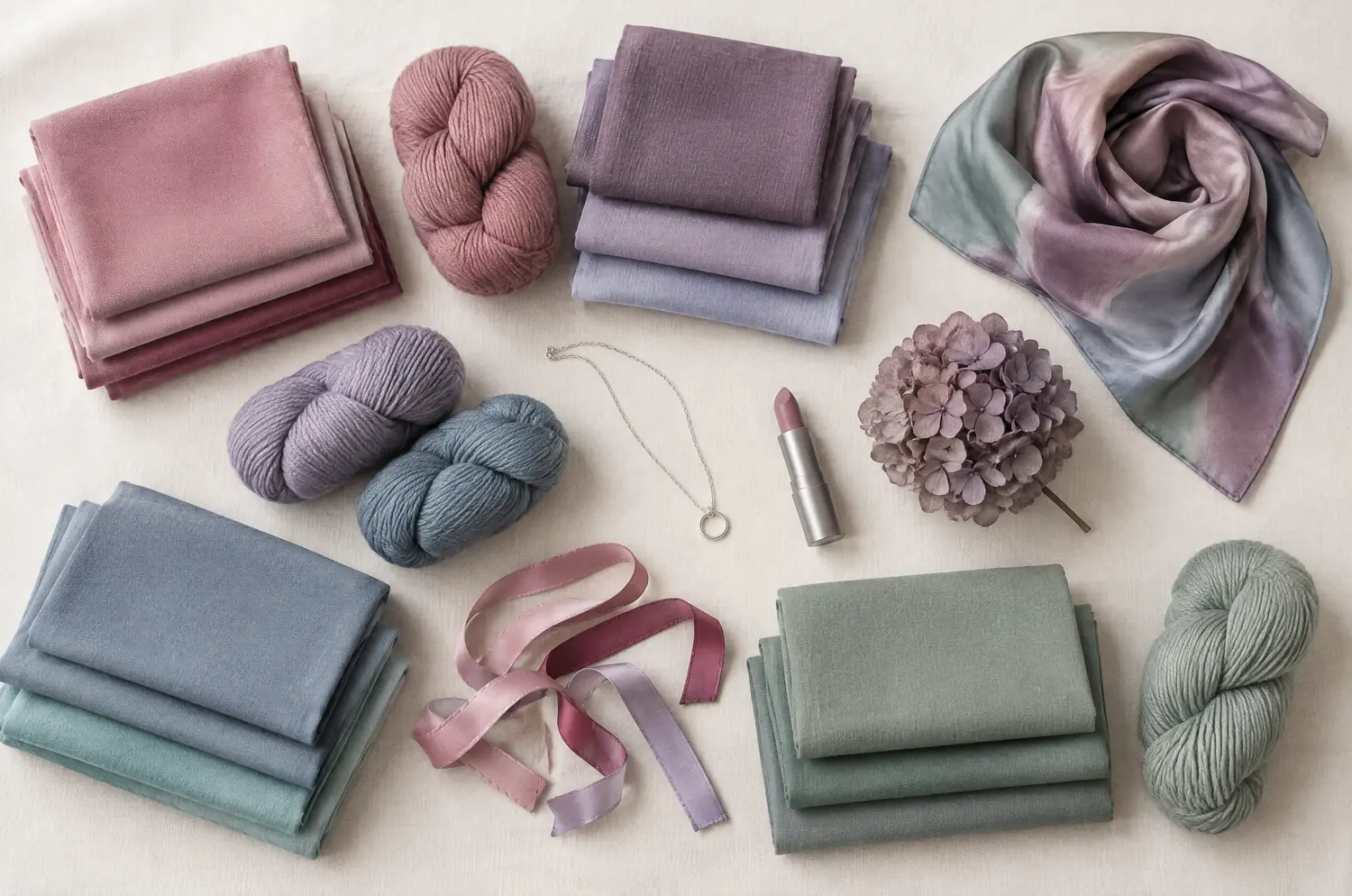
#C48A94#D9A8AE#A85068#8A4756#7B5871#A690A8#A9A6C9#8198AEThree shades: ash brown, ash dark blonde and soft brown. Look at what they share. Each sits at medium depth, leans neutral to cool, and has a gray haze in it instead of a shine of gold or red.
That suits a face with low contrast. Your hair, skin and eyes sit close together in depth, so hair that stays close to them reads as part of the face. Hair that jumps away starts to compete with it.
Choose by family, not by rank. If your base is already light, stay in the blond family. If it’s deeper, stay in the brown one. In either, pick the version where the ash is still visible in daylight.
Brunette, blond or red, your natural color belongs here only if your skin agrees when you hold the Soft Summer palette near your face. The hair is not the judge.
Your season doesn’t change when you dye your hair. It’s read on your skin and eyes, with the hair tied back or under a scarf, so a new color can’t move you to another season.
But dye does change the picture. Hair frames your face all day and reflects its color onto your skin. Golden or coppery tones can warm your complexion, and a hard dark shade can sharpen it.
So the rule is simple. If your natural hair already sits in the ash-brown or ash-blond family, you may not need to touch it. If you dye, let the dye follow the palette above, not the other way around.
Not sure Soft Summer is yours? Take the free color analysis quiz for a first hint at your season and sub-season, then test the shades against your skin.
Most mistakes come from the same instinct: adding energy. Your palette is quiet, so it feels like it needs a spark. It doesn’t.
Your own avoid list says why. Bright Orange, Bright Yellow and Electric Fuchsia are too saturated and too sharp, and they overpower the softness of your face. Hair does the same thing when it goes there: a vivid copper, a loud yellow blond, a fashion pink or magenta tint.
The warm golden family is the other trap. Honey blond, golden light brown and caramel belong to your neighbor, Soft Autumn, who is warmer where you are cooler. Hold them next to your face in daylight and watch what they do to your skin.
Then there is weight. A flat, very dark color or a stark platinum is a sharp edge next to a soft face. Try it and watch your skin. Ask what you want people to see first: you, or the dye.
Gray is part of your palette, with Dove Gray and Pebble Gray. Hold your own gray hair beside those shades and see whether it looks cool and soft next to them. If it looks yellowish, ask a colorist about toning. That’s about how the gray looks, not a way to read your season.
Highlights should follow the temperature of your base, so lean ash rather than gold. Keep them very blended and close to the base shade, not striped.
If you can see where the highlight starts, it is probably too strong for a face this soft.
Bring words, not just a photo. Say it or print it:
“I want an ash brown, soft and a little cool, with nothing golden or red in it. If I add highlights, I want them very blended and close to my base color. I would rather it look quiet than bright.”
If you lean blond, swap the first line for “ash dark blonde.” If you want a gentler brown, ask for “soft brown.” Those are the words from your palette, so you know what you’re asking for.
Before you leave, step to a window. Check the color in daylight, next to your face, with a scarf in dove gray or dusty rose. Salon lights flatter almost everything.
Next, see how your hair works with your Soft Summer makeup. The PDF guide for your sub-season is on a waitlist, not out yet.
What to skip
Brushed silver, rose gold, white gold. Matte or satin finishes.
A direction, not a law: hold the metal near your bare face in daylight and watch your skin.
Too saturated or too sharp: they overpower the softness of your face.
#0A0A0A#FF6A00#FFD400#FF1F8ENothing is off-limits. If you love one of these, wear it away from your face.
Keep exploring
The most blended season: grayed, hushed colors with a quiet elegance.
Soft Summer makeup comes down to haze, not color: rosewood lips, taupe eyes, tea rose cheeks. See what to wear, what to skip and why it works on your face.
Soft Summer outfits made simple: eight capsule pieces, the order to build them, outfit formulas and the neutrals that replace black. Begin near your face.
Cool Summer vs Soft Summer comes down to three differences: coolness, softness and contrast. Here is how they look on a face and how to settle it at home.
Light Summer vs Soft Summer comes down to three axes: temperature, lightness and intensity. Here is what each looks like on a face and how to settle it.
Soft Autumn vs Soft Summer: two sub-seasons that share softness and split on temperature and contrast. Here is how to tell them apart on your own face.
Questions
Ash brown, ash dark blonde or soft brown. They are the shades in the Soft Summer data, and they share a neutral-to-cool, medium-depth, softly grayed look. Choose the one closest to your natural base, so the change stays subtle and the color still looks like yours.
Yes. Blond hair doesn’t rule out any season, and it doesn’t prove one either. Your skin does the deciding when you hold soft, cool, grayed colors near your face. If you are Soft Summer, ash dark blond is the direction, with a muted, cool glow instead of bright gold.
Yes, if your skin responds to the palette. Soft brown or ash brown is the family to look at. Very dark hair can raise the contrast of the face, so judge the whole picture, not the hair alone.
You may go back and forth, because your undertone is close to neutral. The data points to brushed silver, rose gold and white gold, in matte or satin finishes. Treat that as a direction, then hold both metals near your face and see which one calms your skin.
Yes. Gray hair says nothing about your season, since the reading is made on skin and eyes.
What matters is how the gray looks beside your palette. Hold it next to Dove Gray and Dusty Rose. If it looks yellowish, ask your colorist about toning.
Check it. The free quiz shows you your likely season in two minutes, and the two-color test on the palette page helps you tell it from its neighbor: a first hint, not a verdict.