
At the office
Camel blazer, cream shirt, chocolate pants, rust scarf
Warm Autumn · outfits · also called True Autumn
How many clothes do Warm Autumn outfits really take? Fewer than you think. Eight pieces. Camel, chocolate, cream. Bought in the right order.
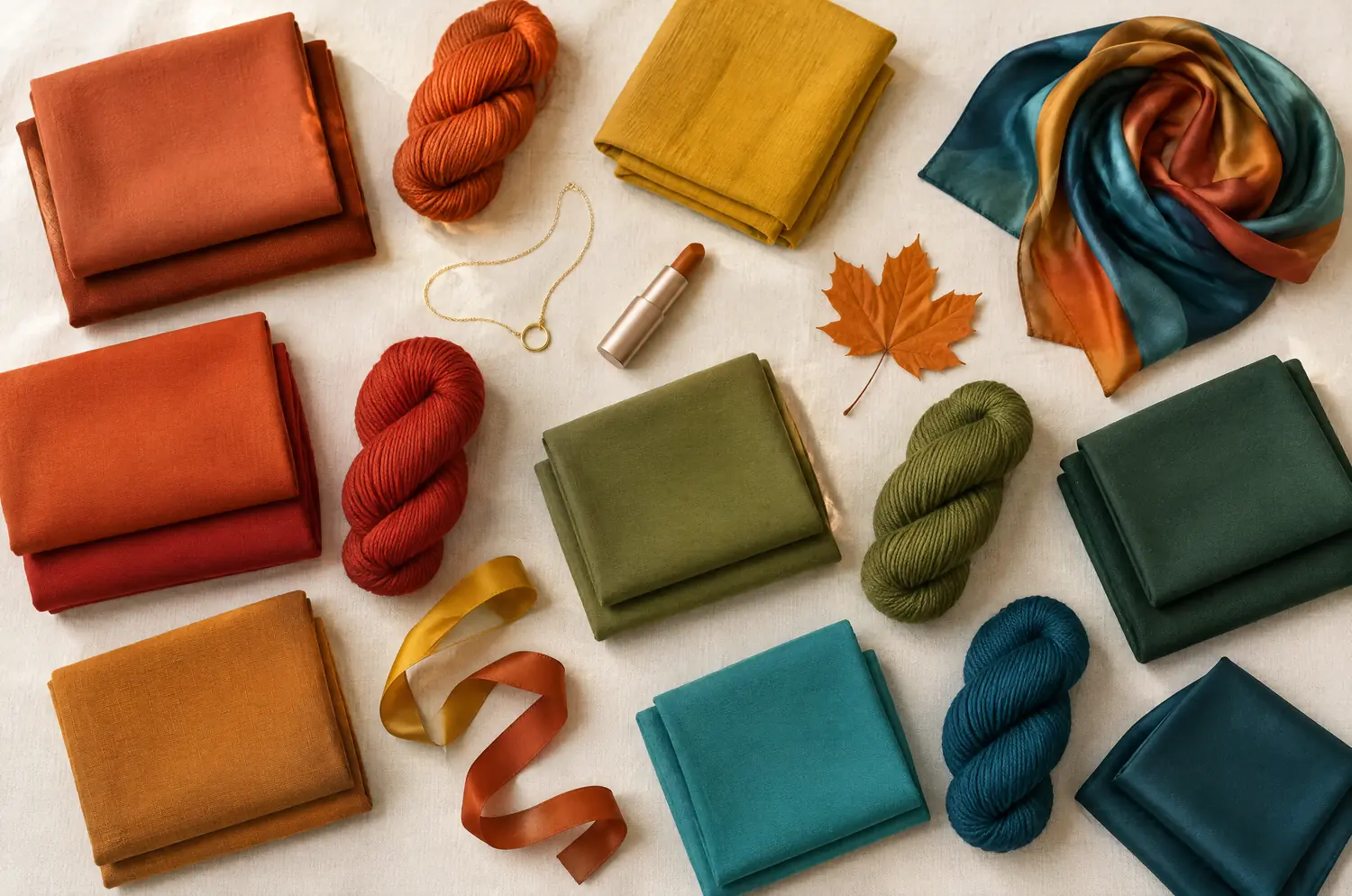
At a glance
Three outfits, the eight pieces to start with, and the pairings that always work.
Camel blazer, cream shirt, chocolate pants, rust scarf
Mustard sweater, petrol blue jeans, khaki jacket
Forest green or terracotta dress, yellow gold
Eight pieces to start with, all of them mix and match.
Rich prints: paisley, foliage, warm tartans, leopard. Fabrics with texture: tweed, suede, tan leather, corduroy, wool.
Start with what already hangs in your closet in these colors. Then fill the gaps in this order.
First, the pieces that frame your face: the camel trench coat and the chocolate blazer. They do the job black used to do, in colors that belong to your Warm Autumn palette. Next comes the cream shirt, the light note under both.
Then the lower half: camel pants and dark jeans. They sit far from your face, so they are the easy, low-risk buys.
Only now add color. The rust sweater is sixth, on purpose. Rust is your signature color, so let the neutrals around it stay quiet.
The khaki T-shirt follows as a quiet layer under the blazer. The forest green dress comes last. It’s one piece for evenings, and it doesn’t need the others to make sense.
In my view, neutrals first and color second is the order that keeps a wardrobe easy to wear.
One neutral base, one rich color, one warm accent. Your contrast is moderate, so nothing in the outfit needs to shout.
At the office, camel blazer, cream shirt and chocolate pants are all neutrals. The rust scarf is the only color, and it sits right next to your face, where it counts.
On the weekend, the mustard sweater and petrol blue jeans make a pairing that looks bold and still stays inside your palette. The khaki jacket calms it down.
For an evening out, the forest green or terracotta dress is the whole outfit. Yellow gold is the accent. It’s your direction for metals, so check it against your skin.
Two more you can build from the same pieces:
Each works because every color shares the same warm base. Nothing cool interrupts it.
Because each one has a job.
Chocolate is the dark one. Use it where you would normally reach for black: coat, pants, shoes, bag. Camel suits the trench and the pants, and it sits in one of your own pairings with rust. Khaki sits between them, in a jacket or a T-shirt. Cream is the light one, so put it near your face, in shirts and knits.
If you reach for black “because it goes with everything,” swap in chocolate, dark khaki or warm forest green. Too much black near the face kills the black. Chocolate gives you the same depth, with warmth.
You can mix the four freely. Camel with chocolate, khaki with cream, chocolate with khaki: all of it holds together.
For the neutrals of every sub-season, read neutral colors by season.
They share one problem. They’re too cool for you, so they bring out redness and gray out your complexion.
That’s a reason to move them, not to throw them out.
All four go in the same places: away from the neckline. Black works in pants, shoes or a belt. Fuchsia can live in a bag or a skirt. Cool gray and glacier blue suit pants, a skirt or a bag too. If you want one closer, try it and watch your skin.
My advice: if your goal calls for a black suit, wear the black suit. Then bring warmth back near your face with a cream shirt or a gold chain.
Texture first. Tweed, suede, tan leather, corduroy and wool all have the richness, slightly muted, that your coloring carries well.
Then prints: paisley, foliage, warm tartans and leopard. Check what the print is made of. A tartan built from rust, olive and mustard belongs to you. One with a cool gray or fuchsia thread near the neckline doesn’t.
Shop in pairs. Mustard with petrol blue. Olive green with terracotta. Cream with rust and camel. If an item has no partner in your closet, leave it.
When a color is almost right, take it away from your face and wear it as pants, a skirt or a bag. If you’re torn between Warm Autumn and a nearby sub-season, the Soft Autumn against Warm Autumn page shows you how to tell them apart.
Judge a fabric in daylight, held against your bare neckline. The Warm Autumn PDF guide is on a waitlist and isn’t out yet.
What to skip
The base of your wardrobe: coats, pants, bags and shoes.
#F5E6C8#B5894E#6E6A3D#4E2F1EToo cool: they bring out redness and gray out your complexion.
#0A0A0A#D4127C#8D99A6#CFE6F5Nothing is off-limits. If you love one of these, wear it away from your face.
Keep exploring
The heart of Autumn: colors of spices, leaves and fire.
Soft Autumn vs Warm Autumn: softness leads in one, warmth in the other. Here are the three differences you can see on a face and a quick test to settle it.
Warm Spring vs Warm Autumn share their warmth. Two things set them apart: lightness and intensity. Here is what that looks like on a face, and how to decide.
Questions
Chocolate is the first stop, since it’s one of your neutrals. When you want a color rather than a neutral, dark khaki or warm forest green does the same work of anchoring an outfit. Try each near your face and watch how your skin reacts.
Hold a rust and a bright coral to your face. If the rust gives you depth and the coral looks loud, you’re a Warm Autumn. Warm Spring is lighter and brighter, Warm Autumn deeper and more muted. The Warm Spring against Warm Autumn page walks you through it.
Take the free color analysis quiz. Ten questions, no sign-up. It points to a likely season and a sub-season. You confirm by holding palette colors next to your bare face and watching how your skin reacts.
Eight is enough to start. Camel, chocolate and cream carry most outfits, while rust and forest green add color. Add a ninth piece only when it works with what you already own, and don’t buy it just to fill a number.
Dark jeans are in your capsule, and the weekend outfit shows petrol blue jeans with a mustard sweater. If you’re drawn to a pale wash, try it near your face and watch your skin.
Check it. The free quiz shows you your likely season in two minutes, and the two-color test on the palette page helps you tell it from its neighbor: a first hint, not a verdict.